

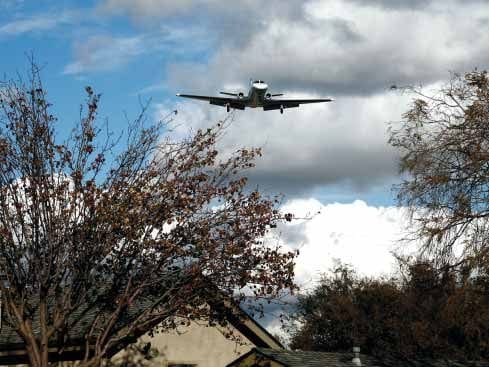
File photo LOOKING TO LAND: A jet flies over a local neighborhood off Bundy Drive in January. City Hall officials fired back at the FAA this week, calling the federal agency's challenge of a local law banning large, fast jets from Santa Monica Airport a ‘legal assault’ on public safety. FAA looking at its options
CITY HALL The FAA’s challenge of a local law banning faster, larger jet aircraft from using the Santa Monica Airport is a “legal assault” on public safety, and any decision on the merits of the ban should be made by a judge instead of federal administrators, City Hall said this week in a 40-page legal brief defending its actions.
The brief, which was filed Monday with the Federal Aviation Administration along with hundreds of pages of exhibits, was in direct response to the federal government’s decision to reinstitute an administrative complaint against City Hall that was brought in 2002 to block attempts to enhance safety at the airport. The FAA issued the order to show cause on March 26, a day after the City Council approved the jet ban.
In the brief, attorneys for City Hall once again laid out their concerns with the lack of safety measures at the airport, citing the close proximity of homes to both ends of the runway and the dramatic increase in the number of faster planes using the airport in the last few years.
Some homes are located within 300 feet of the ends of the runway, and the number of Category C and D aircraft using the airport has increased by nearly 30 percent. Combine that with the fact that the airport has no runway protection zones or safety areas to protect against a possible runway overrun and there are the makings of a disaster in which many lives could be lost, city officials said.
The brief also states that under an agreement reached between the FAA and City Hall in 1984, Santa Monica is only responsible for accommodating slower Category A and B aircraft, and as a partner in that contract, the FAA is “disqualified from adjudicating the validity of the ordinance because the FAA Airports Administrator Kirk Shaffer has already prejudged the matter, stating in a letter to the city that the ordinance is ‘flatly illegal.’”
“There is no ground to proceed forward,” said Deputy City Attorney Marti Tachiki, who helped prepare the brief. “They should allow us to go to a court and have a judge decide.”
In addition, the FAA, City officials contend, is violating the Tenth Amendment prohibition against the federal government commandeering local resources and is placing the aviation industry’s interests above public safety.
Ian Gregor, a spokesman for the FAA, said the agency is reviewing City Hall’s response “to determine the appropriate next steps for us to take.”
The FAA contends its offer to instal a series of concrete buffers at the west end of the runway will greatly improve runway safety. The buffers, called an Emergency Material Arresting System, are precautionary safety measures protecting against aircraft from overshooting the runway and into homes — the concrete blocks are designed to handle planes traveling at up to 70 knots.
The 70-knot EMAS would be designed to stop roughly 97 percent of operations at the airport and 90 percent of C and D classified jets. The enhanced safety measure would consume more runway than the 40-knot EMAS, which the FAA previously proposed and city officials turned down as being insufficient.
Along with the enhanced EMAS bed, the FAA also offered to reduce noise and pollution by changing the alignment of aircraft on Runway 21 where the majority of operations take place, adjusting the line of planes so that emissions go down the taxiway instead of toward homes. The FAA is also offering to add information about the noise abatement procedures and lack of runway safety areas through electronic notifications sent to pilots who file their flight plans into or out of Santa Monica.
The FAA has also suggested City Hall look into purchasing homes at the west end of the runway to create protection zones, something elected officials are opposed to given the lack of housing in Santa Monica and the impact the plan would have on homeowners.
City officials have rejected all proposals, criticizing them as not going far enough, and instead enacted a ban on the fastest jets from the airport.
FAA officials have repeatedly said that they will not approve any runway safety enhancements that would severely impact pilots and their passengers. Santa Monica Airport is considered a reliever airport for LAX and plays an important role in the regional aviation network, federal officials and representatives from the aviation industry said.
A long legal battle between City Hall and the FAA is expected.
The next step in the process is for FAA directors to make a determination on the merits of the ban and make a preliminary administrative decision. If City Hall is not satisfied, it can appeal to the associate administrator of airports. An appeal of that decision can be made to the Ninth Circuit Court of Appeals, Tachiki said.
“We would like to get someone impartial to look at the issue,” Tachiki said. “Obviously, even if we go through the [administrative process] the place we would end up is in court. It’s fair for both parties to have a judge make the decision.”
City Hall has been negotiating with the FAA over runway safety enhancements since 2002 when the FAA blocked the council’s attempt to approve the Airport Conformance Program, which was comprised of various safety measures.
Originally published in the Santa Monica Daily Press print edition on April 9, 2008. Read the original PDF.