

Coalition’s intentions come under fire following report
CITY HALL — Officials said a report ranking Santa Monica among the country’s “meanest” cities for criminalizing the homeless missed the mark, failing to recognize efforts underway here to help the down and out.
That National Coalition for the Homeless — a nonprofit group whose mission is to end homelessness — issued a January report which ranks Santa Monica as the No. 9 “mean” U.S. city for the down and out to live, due to its anti-homeless laws.
National news agencies like MSNBC have written about the NCH report, upsetting some local officials who contend the information in it is skewed and question the methodology of its findings.
“It’s crazy,” Mayor Bob Holbrook said. “There’s so much misinformation about what Santa Monica’s doing in regards to homelessness that I can only question the intention of those who wrote the report.
“If it were true, then why do so many homeless people move to Santa Monica?”
Michael Stoops, executive director for the NCH, admitted there might have been some factual errors in the report.
However, the NCH — which he said is the nation’s oldest homeless advocacy group — stands by its rankings.
“We’re glad that cities don’t want to be considered mean to the homeless,” Stoops said. “At the same time, we’re trying to put a magnifying glass to anti-homeless laws, which these cities have.
“Santa Monica may have great people and programs to address homelessness, but (none of the cities polled) can house all of their homeless.
“We’re trying to attract attention to a civil rights issue.”
Stoops said the rankings are based on information gathered from 212 cities’ anti-homeless laws. The NCH contacted the city attorney’s office of each municipality, weighing all the anti-homeless laws on their respective books in comparison to others.
Stoops said he has been working on homeless issues for more than 30 years and that he spends considerable time living among the homeless population. Years ago, he said he slept in Palisades Park and on Santa Monica beach, where he was removed at the request of police.
“The police were professional and service oriented, but we still had to go,” Stoops said. “I was all right, but there was a woman, and I’m not sure what happened to her or where she went.
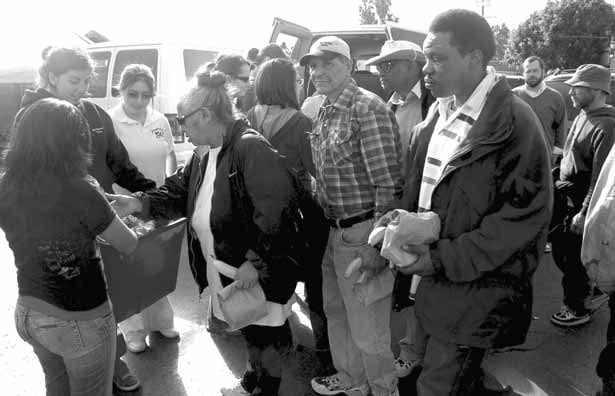
“Because she had no place to go.” According to the NCH report, a proposal soon to be floated by Mayor Holbrook would require that social service groups which provide meals to homeless people in parks would be fined for clean-up costs.
“Food providers may be required to pick up the yearly estimated tab of $40,000 that Santa Monica spends annually providing park rangers and a cleaning service after meals,” the NCH report said.
Mayor Holbrook has in fact asked City Hall to research how much clean up for the feedings costs City Hall. However, he has not pushed for any further discussion of new laws that would require service groups to pick up the tab for the cleaning up City Hall does after the feedings, said Mona Miyasato, acting human services manager.
The NCH report also takes a swipe at Santa Monica’s newest elected official, Councilman Bobby Shriver, who it describes as one the ringleaders for the city’s anti-homeless laws.
It states, “with the election of (Shriver) to the City Council, homeless people in Santa Monica are facing what may be the single biggest push in the nation to pass a massive wave of new anti-homeless laws.
“The new collection of proposed city laws would make it illegal for any homeless person to set down a backpack for more than 10 minutes on any sidewalk, lie, or sit, on any sidewalk in the city, shave, bathe, wash clothing items in any public restrooms, and sleep anywhere in a vehicle.
“The laws would also sweep homeless individuals from all freeway sides and ramps.”
Miyasato said the information regarding Santa Monica’s homeless laws was not entirely accurate.
“The city does prohibit lying or sitting on sidewalks on the Third Street Promenade, but that’s because it’s an area with a high volume of foot traffic,” Miyasato said. “It’s intended for safety. That law is not in effect in any other part of Santa Monica.
“I believe the report says its a citywide law.”
Miyasato said that Santa Monica does prohibit people from leaving personal belongings unattended. However, she said that items must be left unattended for more than an hour before a person is cited, not 10 minutes, as indicated in the report.
Miyasato also said there are rules in place at public restrooms which do prohibit bathing. However, City Hall’s public showers, located at the Santa Monica Pier, do permit bathing starting at 5 a.m.
Homeless residents are prohibited from camping in parks, on the beaches, bluffs and other public open spaces. However, sleeping inside cars is permissible in areas of the city.
Shriver, dismayed by some of the suggestions in the NCH report, recently appeared on local television in an effort to set the record straight.
Shriver noted that while the NCH focuses on what it believes to be anti-homeless laws, it fails to indicate what sorts of social services cities such as Santa Monica also provide to help the down and out. He believes such information is central to the issue and that neglecting to include it is inappropriate for cities which are attempting to combat the problem.
“I have to wonder about the method of analysis,” Shriver said. “The report focuses on the laws, but it doesn’t even address our budget. Requiring social service providers to have to pay for the clean up after feedings may be seen as anti-homeless, or not.
“But the report fails to mention what the city is spending on social services to address the homelessness.”
Stoops conceded that Santa Monica uses its own funds to address homelessness, unlike most municipalities, but that issue wasn’t within the purview of the NCH report.
Miyasato said City Hall spends more than $1.4 million a year on its grant program to social service providers.
When “unseen” costs are figured in — such as the cost for City Hall to clean up after feedings, that actual budget may be hundreds of thousands of dollars higher.
Some residents believe that may already be too much, if it’s not effective.
Bill Bauer, a local resident who also contributes a Monday column for the Santa Monica Daily Press, often questions how City Hall tackles problems, including homelessness.
Bauer said he believes people who need help getting back on their feet should be able to receive it, as long as getting back on their feet is what they’re trying to do.
However, Bauer feels there are homeless people who come to Santa Monica because of its reputation for being homeless friendly. He suggests social service providers which provide a one time fix of food, coffee and rest may be exacerbating Santa Monica’s long-term homeless problem.
“I don’t believe in enabling, because there are people out there looking to take advantage of the system,” Bauer said. “People who are down and out and need help should get it, but there needs to be a process in place to see to it they’re getting an intervention... job training, working, something that is seeing to it they’re heading toward being productive members of society, if they’re going to use its services.”
Bauer, who has not yet had an opportunity to read the NCH report, said it’s been his experience that some groups hoping to solicit a public reaction often publicize literature which puts cities actually trying to solve a problem in an unfavorable light.
He also said he often questions the methods of such groups’ approach.
Originally published in the Santa Monica Daily Press print edition on January 18, 2006. Read the original PDF.