

Drills help coordinate local agency efforts
MID-CITY — Weapons of mass destruction were discovered here on Friday.
That was the fictitious scenario around which local police and fire agencies from the Los Angeles area conducted their disaster response drill Friday morning, showcasing a new state-of-the-art hazardous material truck the Santa Monica Fire Department received about two weeks ago.
The emergency preparedness drill was meant to bring together and coordinate the efforts of the local agencies — Santa Monica Police and Fire departments; Los Angeles County Sheriff’s Department; Culver City Police and Fire departments; Beverly Hills Police and Fire departments; and the Federal Bureau of Investigation — that would have to respond to such a terrorist attack in Santa Monica.
The Santa Monica Red Cross donated canteen services, providing drinks and food to the drill participants. The Red Cross also conducted its own exercise, gauging how it might react in an emergency situation of such magnitude.
In the federally funded drill scenario, Santa Monica emergency officials received a call of a victim suffering from a seizure at an office building — in this case, the vacant former Paper Mate facility on 26th Street and Olympic Boulevard. En route to the site of the emergency, officials received multiple calls of victims suffering from seizures at the same building, prompting suspicions of a hazardous situation.
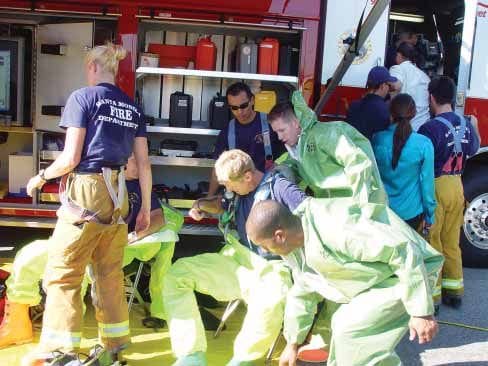
Wearing gas masks, the firefighters pulled out all the victims, evacuating the building. The hazmat team, fully protected with oxygen masks, investigated the scene and discovered the presence of sarin gas — a deadly toxin that was used in the Tokyo subway attacks in 1995. It turned out a group of individuals, conducting business under a Middle Eastern-sounding name, were secretively creating a substance that could be considered a weapon of mass destruction.
The hazmat team then located a suspicious individual — played by SMPD Officer Michael Chun — roaming the building and immediately alerted the police department. The Santa Monica Police S.W.A.T. Team, in protective gear with air purifying respirators, arrived on scene. After being briefed on the situation, the description of the suspect, and his whereabouts, the S.W.A.T. team entered the building armed with weapons, which were not loaded in the simulation.
The suspect was arrested on the second floor about a half hour later.
In the scenario, two people died and 10 to 12 victims were transported to the hospital for treatment.
The entire drill took about three hours from start to finish.
“Being a controlled environment, it was quicker than it would’ve been in a (real situation),” said Capt. Scott Ziegert of SMFD.
In light of Hurricane Katrina and 9/11, where miscommunication among police and fire officials proved costly, drills are deemed necessary to ensure that local agencies can coordinate their efforts in the event of a terrorist attack, said SMFD firefighter Milo Garcia.
The idea for the drill came after the Santa Monica Fire Department purchased a $500,000 hazmat truck through federal post-9/11 grant money.
The emergency preparedness drill utilized both the Santa Monica hazmat vehicle, which services the entire Westside, and one belonging to Los Angeles.
Santa Monica’s hazardous materials response truck is fully equipped with its own chemical lab, satellite Internet, radio communication, liquid crystal display monitors and surveillance cameras. It also provides storage for hazmat protective suits.
“This thing is phenomenal,” said Paddy Cates, an SMFD engineer, of the hazmat truck.
The city went all out in conducting the drill, closing down a stretch of 26th Street; suiting all participants in the protective gear that would be used in an actual emergency; setting up a decontamination shower tent; and actually forcing all participants who entered the former Paper Mate facility to hose down, even though there were no actual toxins present.
To an unknown passerby, 26th Street almost looked like the scene of a real attack.
“We consider it a success,”Ziegert said.“It allowed the agencies to interact and see the workings of the other agencies.”
Originally published in the Santa Monica Daily Press print edition on November 18, 2006. Read the original PDF.