

The Ink Well was a place for black beachgoers to escape
OCEAN PARK Before progressive Santa Monica, there was a considerably less racially tolerant beachside city.
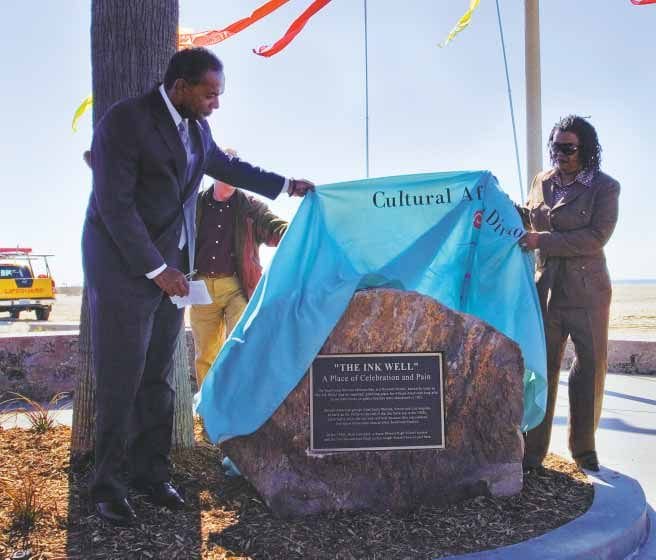
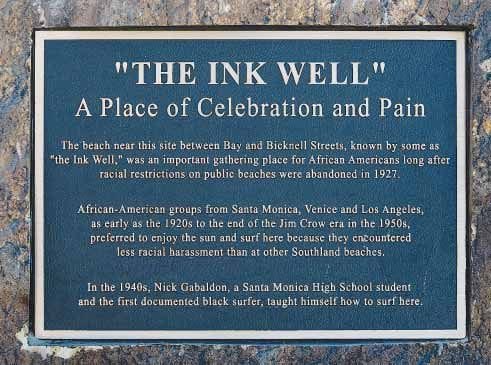
A piece of the city’s little-known past was remembered and literally set in stone on Thursday when city officials unveiled a monument dedicated to honoring the history of the Ink Well — a slice of sand off Bay Street that was unofficially designated as a gathering spot for black beachgoers.
“The Ink Well: A place of celebration and pain,” the monument, located off the bike path, reads.
“Many African Americans have found sanctuary on this portion of the beach we sit on today,” City Manager Lamont Ewell said during the unveiling.
The unveiling of the plaque was the culmination of a more than two-year effort to recognize an often forgotten chapter of Santa Monica heritage, an effort initially brought forth by Rhonda Harper, the chief executive officer of Inkwell Surf, to the City Council to commemorate the historical significance of the site, said Jessica With the help of the Santa Monica Conservancy and the Southern California Black Surfing Association, staff with Cultural Affairs Division at City Hall spent the past few years extensively researching the history of Ink Well, how it came to be and the historical figures associated with the site, including Nicolas Gabaldon, a Santa Monica High School graduate who was known as the first documented black surfer.
“It’s good to acknowledge history, good and bad,” Mayor Herb Katz said after MC’ing the morning ceremony. “We can stand up and say that we can honor (Ink Well) for what it was, remembering it so that we don’t forget it.”
The first African Americans moved to Santa Monica in the turn of the 20th Century, settling a few blocks east of the beach near what was at the time the Phillips Chapel CME Church, the first black church established in Santa Monica more than 100 years ago, according to Alison Jefferson, who helped research Ink Well’s past for City Hall.
“Like African Americans who moved to the northeastern part of the United States, they also were escaping the worst of Jim Crow segregation,” Jefferson said during the ceremony.
It was around the 1920s that a small portion of the beach just off Bay Street became known as the “Ink Well,” a place where black beachgoers could socialize without experiencing the level of racism seen in some of the other Southern California beaches.
But there were encounters of bigotry, most notably a white beachside property owner who subdivided several of his lots and adopted a “Caucasian clause,” barring black residents from owning or leasing property, Jefferson said. Several other property owners, including real estate developer R.C. Gillis and C.L. Bundy, followed his lead.
Even after the practices of restricting black residents from owning beachside property was legally challenged and eventually eradicated and racial restrictions at all California beaches were removed, the Ink Well remained a comfortable gathering spot for black swimmers.
“Although some may not recognize it, these stories of the Ink Well and Nick Gabaldon are part of American history,” Jefferson said. “All of us, no matter how recently arrived, share in these stories.”
The dedication ceremony, which was held during Black History Month, also paid tribute to Gabaldon, his role in the African American history of Santa Monica and how through surfing, he was able to stand up to bigotry.
Gabaldon died in a surfing-related accident at the age of 24 in 1951, crashing into the Malibu Pier, according to Los Angeles filmmaker Erich Hicks, who is producing a documentary about black surfers.
Hicks grew up surfing in Santa Monica, taking the bus from his childhood home in Los Angeles to a bus stop on Pico Boulevard near Woodlawn Cemetery where Gabaldon is buried.
“I would walk by his grave site and I never knew it,” he said.
At the end of the ceremony, Kevin Ogletree, a Los Angeles resident who wore a wetsuit, called on the people in attendance to join him in a memorial surf in honor of Gabaldon.
“Nick and other people who were discriminated against, overcame boundaries to make this a better place for future generations to come,” Ogletree said.

Originally published in the Santa Monica Daily Press print edition on February 8, 2008. Read the original PDF.