

It may be one way to reduce number of transients in city
There’s a good chance that the homeless won’t get a free lunch in Santa Monica much longer.
Feedings in public spaces for the homeless could be eliminated if the Santa Monica City Council acts on a recommendation made by the Bayside District Corp. Board on Thursday.
The board will ask the council to consider crafting an ordinance that would limit the number of people who can be fed in a public place by a group, as well limiting the number of feedings. The city issues permits for events in public spaces, which applies to church groups who feed the homeless.
The Bayside District Corp., which manages the downtown area and works with the city, has been dealing with complaints by business owners for the past several months, if not years, that the transients are ruining the charm and economy of Santa Monica. Residents said the high number of homeless people was their No. 1 concern in the city, a recent survey said. Dozens of vagrants sleep in doorways in front of businesses on the Third Street Promenade, as well as urinate and defecate in public. Transients spend their days panhandling — sometimes aggressively — which scares many tourists and residents away from the outdoor shopping mall.
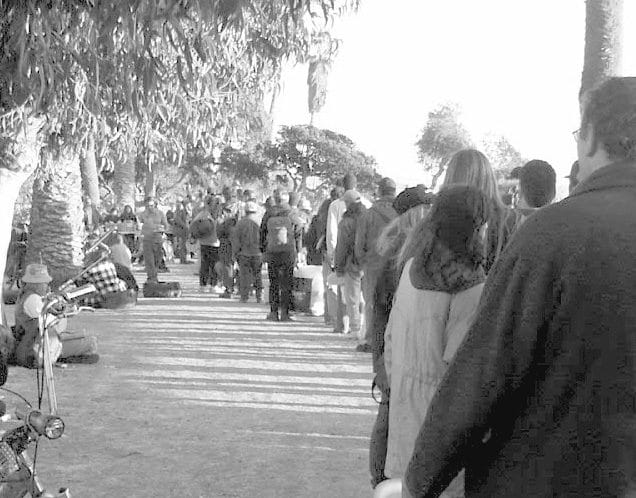
Officials believe the root of Santa Monica’s vagrant problem stems from outside church groups that host public feedings in Palisades Park and on the front lawn of City Hall, which draws hundreds of hungry homeless people to the downtown area.
The Bayside board formed a public safety subcommittee a few months ago that began looking at ways to deal with the problems plaguing the Promenade. Committee members, Bayside board members, city representatives and residents hashed out their solutions on Thursday.
As officials continue to grapple with why Santa Monica has earned the reputation as a haven for the homeless, they look to other cities to figure out why they don’t have the same problem.
Beverly Hills, for example, only allows permitted events in public places that have no more than 10 people at a time.
Joel Schwartz, the city’s homeless service director, said there are about 21 scheduled feedings each week hosted by church groups outside of Santa Monica, and there are more than that that are unscheduled.
Santa Monica Police Chief James T. Butts, Jr. said while the feedings are noble and operated by compassionate people, they cause public safety and health issues. “(21 weekly feedings) is outrageous and I think we need to set that much lower and enforce it and that will get rid of (our) reputation,” Butts said. “I don’t know if (public feedings) are the best land use policy.”
Santa Monica City Attorney Marsha Moutrie warned the group that by enacting an ordinance that limits the number of people that can attend a permitted event in a public place also limits picnics and city-sponsored events.
But, she said, there may be a way to write a law that exempts picnics and major events from the ordinance, and focuses just on public feedings.
Parks and public spaces are places for everyone to enjoy, but they shouldn’t be dominated by one group, Moutrie said.
“Special interest groups are monopolizing the parks,” she said.
The Bayside board also voted to recommend to the city council that the aggressive panhandling law be more heavily enforced, particularly on the Third Street Promenade.
And because the state trespassing law only requires that people not stay in one place if they have been asked to leave, the homeless can move from one doorway to another along city streets. That makes it difficult for police to keep people from sleeping in doorways, which are considered private property.
The city may look at creating a new ordinance that would specifically address “vestibules” so no camping or trespassing can occur ever. In the meantime, Butts said he is committed to at least protecting the spirit of the trespassing law.
“We will provide an exceptionally high number of uniform police officers at night and keep a log of those people who have been asked to leave,” within roughly a three-block radius, he said.
When the city successfully addressed the number of homeless 10 years ago, public feedings were reduced by limiting park use and an effort by the police to curb drug dealing led to 1,200 people arrested in three months, Butts said.
But for many reasons, Santa Monica’s homeless population has grown again.
“We agree something needs to be done,” Moutrie said. “I think when the city adopted its policy in 1994 it was determined that the city does not support people in the street, but to get them housed.
“I think this is a good time to remind people that that is the city’s policy... we should not allow this to continue and if we can stop it and get people off the streets then we ought to.”
There are a host of non-profit organizations designed to help the homeless get their lives turned around — by providing shelter, programs and permanent housing — for those who are willing to accept the help. The city also has many similar programs.
But as City Manager Susan McCarthy pointed out, the policy doesn’t mean much if all the forces that have the power to effect it don’t align and address the problem together.
“It’s time to step back and think about our actions and how they relate to our policies,” she said.
Originally published in the Santa Monica Daily Press print edition on July 12, 2002. Read the original PDF.