

SMC student body contains close to 3,000 international students
SMC — Ami Ogura’s first impression of Santa Monica can be described as typical for someone from one of the busiest and dampest cities in the world.
“There are no clouds in the sky,” said the 22-year-old Ogura, who hails from Tokyo.
The beaches, cool breezy climate and, yes, clear blue skies, are just some of the qualities unique to Santa Monica that drew Ogura all the way from Japan this year to study dance at Santa Monica College.
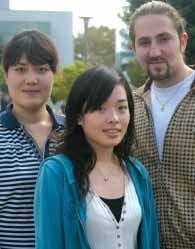
Ogura is one of 2,800 students from more than 100 countries who are attending SMC this year, following their dreams of studying at a American school.
“We have one of the largest international student populations of any community college in the nation,” said Darryl-Keith Ogata, director of international programs at SMC. “We’re probably ranked second or third (in terms of international population in the nation).”
Santa Monica College serves as a hotbed for international students for many reasons, including its location, transfer rate to four-year universities and affordability, Ogata said. But matriculating on the Westside doesn’t come cheap. International and non-California residents pay approximately $5,692 a year, while in-state students pay less than $700 for tuition.
“It’s only fair for international students and out-of-state students to pay higher tuition because local taxpayers are supporting the community college,” Ogata said. “It’s still a pretty good deal compared to private universities and other state universities.”
UCLA international and non-California residents dish out approximately $26,000 a year for tuition, as opposed to California residents, who pay a little over $7,000.
Niki Chen, 20, from Taiwan, was a foreign exchange student at a New Mexico high school when she decided to attend SMC after hearing about its vaunted transfer rate for international students to four-year universities. Chen is in her second year at Santa Monica College and probably has another year left before she can transfer.
The psychology student has not decided on a university, but is considering schools in Canada and Australia.
About half of the international student population come either for the career certificate program or to receive their associate degree, said Ogata. The other half transfer to a four-year school.
Afram Chukro, 21, made the decision to study at an American institution after an international agency came to his Swedish school to talk about overseas colleges.
He came to Santa Monica last February, following three months of an English-language class in Santa Barbara.
“I didn’t know anything about Santa Monica College,” Chukro said. “I was supposed to be here for only a year, but now I’m thinking of transferring to California State University, Northridge to study international business.”
Chukro estimates he has another year left before he can transfer.
Japanese students comprise the largest population in the international education program at SMC. Students from South Korea, Sweden, Hong Kong and Indonesia are also well represented,rounding out the top-five list.
The large Asian population on campus came as a surprise to Ogura, who expected to see primarily Americans walking about.
“I’ve learned a lot here about different cultures,” she said. “I’m broadening my mind and having a good time.”
Chukro’s image of American colleges was limited to what he had seen in movies in Sweden. He too had pictured a school filled with American students.
“It’s very diverse,” Chukro said. “I never thought there would be a lot of international students.”
The large international population at SMC allows foreign students to mingle with their peers from different countries.
Chen communicates with American students not only to hone her English, but to work on her social development.
“We’re shy and don’t express ourselves well,” Chen said of the Taiwanese.
AN UPHILL BATTLE International students face an uphill battle in the rigorous admissions process to SMC. American students can attend if they have graduated from high school, are 18 years of age or older, or are 16 years of age or older if they passed their California High School proficiency exam.
The application process for international students includes proof of English proficiency, an essay, official transcripts from a secondary school, a financial statement proving they can afford at least one year’s tuition and a $50 non-refundable fee.
After the student is accepted, the visa process begins. “[The F1 student visa] can be difficult, depending on the country,” Ogata said. “Japan, Korea and Sweden are fairly easy.”
One of the most common reasons why a student could be denied an F1 Visa is if the United States consulate officer feels there is a high probability the student will not want to return back to their country. He said this is more common with students from India, China and countries in Eastern Europe.
Students have the option to stay in the country up to one year after they finish their studies. A work visa is required after a year.
Janelle Hironimus, spokesman for the State Department, said a visa can be approved in a matter of days.
Security screening has become more vigorous since 9-11, Hironimus said. An applicant is evaluated on a case-by-case basis, regardless of their country of origin.
“We have more information to work with,” Hironimus said. “We have a name check system that gives information from a variety of sources.”
Ogata said the college has seen a decline in the number of students from the Middle East since Sept. 11, 2001, but the population is slowly starting to replenish.
Every international student at SMC has their own vision of life after school.
Chukro said he would like to stay in the United States for a few more years to establish a business before he goes global.
Ogura would like to stay in America to pursue her dream as a professional dancer. She said Japan’s performing arts scene is not as popular as it is in the United States.
Chen sees herself as a children’s psychologist in America.
“There are more opportunities in America,” Chen said. “The system here is more well-developed.”
Originally published in the Santa Monica Daily Press print edition on October 17, 2006. Read the original PDF.