

Eerie chaos reigned over city on July 16, 2003
“For a long time, I didn’t want to come to the market at all, and this kind of helped me get over it,” said Kariem McKnight, who works at Step Up on Second, a transitional housing program for the mentally ill that’s located on Second Street.
Step Up employees and clients had arrived shortly before 2 p.m., when the market was beginning to shut down. Step Up employees and clients regularly visit the market to buy and collect produce for their Fresh Start Cafe.
Leroy Lattier, a client at Step Up, was killed in the crash. Another client, Herb King, broke his hip when Weller ran into him with his 1992 Buick LeSabre.
“I have to put the baby to bed and stop being morbid about it,” McKnight said as tears welled up in her eyes. As a result of the enormous medical and emergency response to the accident, McKnight is now pursuing a career as a physician’s assistant.
There were many witnesses, including McKnight, who felt helpless but responded anyway.
“People on cue did what they what they had to,” she said.
Another spontaneous helper was her co-worker, Steven Elam, a case manager at Step Up. He rushed to the aid of King, who was pinned under a table at the corner of Arizona Avenue and the Third Street Promenade.
“There was a lot of common folk who helped that day,” he said. “I’ll never forget.”
And neither will Weller, a retired wholesale grocer who has lived in seclusion in his home north of Montana Avenue since the accident. He apparently lost control of his car after he rear-ended a Mercedes Benz at the intersection of Fourth Street and Arizona Avenue. Police say he hit the accelerator instead of the brake.
“I feel so bad for that man, he’s been through enough,” McKnight said.
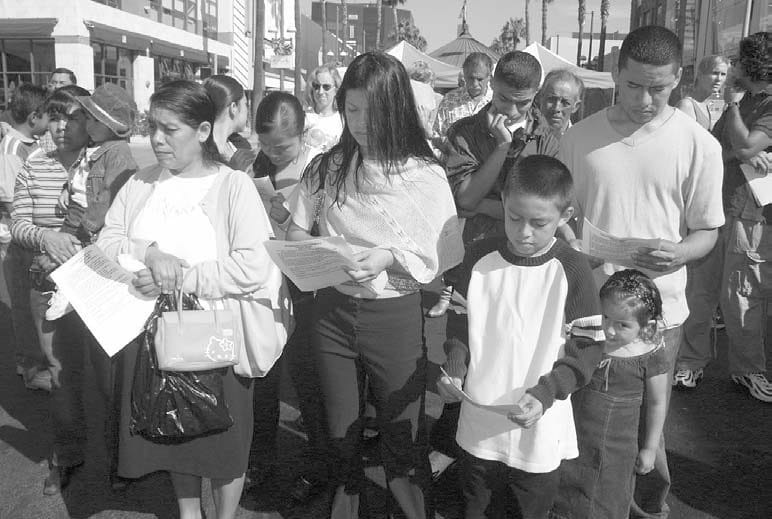
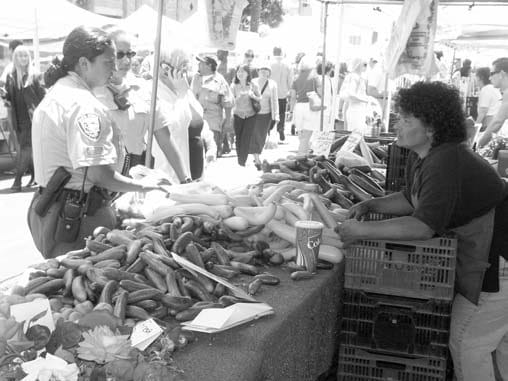
It was business as usual at the market Wednesday, as shoppers packed Arizona Avenue under a baking midday sun. Signs commemorating the victims lay at the intersection of Arizona Avenue and the Promenade, where a few shoppers stopped to study the handwritten messages left for the victims and write their own. Most continued along the road, sampling fruits and vegetables from the stands and navigating through the heavy foot traffic.
Laura Avery, who manages the city’s farmers’ markets, said it seemed busier than most Wednesdays. And beyond the ceremony, not much was said about the tragedy.
“We’re glad to be moving ahead,” she said. “The first anniversary is hard but we all made it and we are still here.”
The events of a year ago remained on venders’ minds.
“I’m still sketchy at the farmers’ market when I hear cars accelerating,” said Howard Gregory, 36. Gregory runs the olive stand at the market’s east end, where Weller entered. “I didn’t even look up until he was through the barricade. I remember hearing the noise and thinking that somebody needed to slow down. Then I look up and he’s going through the market making soup.
“I went to bed hearing ‘thump, thump’ and waking up hearing it,” he said. “It’s worn off now. I was really messed up psychologically those first few days. I felt really guilty that I (had seen) people dying, people up in the air, but I hadn’t been hurt.”
Fred Kosmo, a 68-year-old farmer from the San Luis Obispo area, helped lift Weller’s car off of a body when it finally came to a stop on the west end of Arizona Avenue. On Wednesday, he publicly thanked all of the emergency personnel, police and vendors who helped clear the carnage from the street.
“They were very good, they got here quick,” Kosmo said, adding he went home that night and had “two hellacious marti-nis” to take the edge off what he experienced that afternoon.
In a matter of seconds on July 16, 2003, downtown Santa Monica was transformed into a dark, eerie and unrecognizable place.
Chaos reigned along Arizona Avenue as by-standers rushed to help the wounded, sirens blared the arrival of emergency personnel and hordes of news helicopters began a buzzing vigil in the skies above that would last until after nightfall.
Then, as the dead were covered and the depth of the tragedy started to sink in, the skies suddenly opened and a rare summer downpour added another layer of sorrow that seemed to magnify the pall of the afternoon.
All along Arizona, from Fourth Street where Weller first entered the bi-weekly farmer’s market to west of Second Street where his battered car finally came to rest, was littered with debris. A mangled baby stroller lay near the car, while behind it stood a wide trough of destruction that included smashed fruit, crushed bouquets of flowers, bloody gloves and towels, splintered wooden tables and green and white tents blasted askew.
A Red Cross helicopter swooped between buildings ferrying the most critically ill to area hospitals. Witnesses and onlookers near the makeshift triage area at Fourth and Arizona seemed to be moving in slow-motion while a hurricane of action swirled around them.
Members of the city’s clergy were on scene too, blessing the wounded and administering last rites to the dead.
And in the days following, an outpouring of community support and unity filled the street.
Hundreds of donors lined up to give blood for the injured at a Red Cross Bloodmobile and mourners laid flowers and candles at a makeshift monument at the corner of the Promenade and Arizona Avenue.
Three days following the tragedy, an interfaith group of more than a dozen religious leaders led a procession from St. Augustine’s By-the-Sea Church, on Fourth Street, to the intersection of Arizona Avenue and the Third Street Promenade. There, they consecrated the site with blessings and prayers.
A year later, some of the same clergy leaders returned for a reconsecration. During the ceremony on Wednesday, they said these words: “... There are not two people who are struggling over this piece of land, this street, this market.
Instead there are two conflicting emotions.
One is the emotion of memorial and mourning.
Remembering what happened here one year ago, we feel, somehow, that this place can never again be given over to the normal day-to-day.
How can we smile and laugh in this place — a place where many can still hear the echoes of pain, suffering and even death?
How can we go about living in a place where other lives were cut short? Do we insult those who died and were injured here when we come here and do not remember?
The other emotion that struggles to own this land is our very human passion for life, for the future.
We know that this future is filled with fragility, fraught with danger, failure and disappointment.
But the future is also filled with possibilities for creativity, kindness, caring, insight, strength and love.
We do not come here and not remember.
We do not come here and forget. We come here to live, To taste the flavors of the marvelous produce, To see the colors, To smell the fragrance, To enjoy the company of friends old and new.”
Originally published in the Santa Monica Daily Press print edition on July 15, 2004. Read the original PDF.