

Earth meets the arts
By KRISTIN MAYER Special to the Daily Press
Lita Albuquerque stepped off the C-17 Globemaster military transport plane and into blinding whiteness.Welcome to Antarctica.
“She was just ecstatic,”said Sophie Pegrum,a documentary filmmaker who accompanied the Santa Monica earth artist on her Antarctica art installation in December. “She was beaming with a smile across her face.”
Albuquerque inhaled a breath of frozen and unpolluted air under a clear blue sky. Her eyes gazed hundreds of miles into the distance across a brilliant expanse of snow that reflected the unblocked sun.
“Where we were was completely magical,” Albuquerque said.“It’s a very profound experience to be in that purity of landscape, in the middle of sea ice surrounded by mountain ranges.”
Albuquerque, a local artist whose Tunisian childhood inspired her to create art linking the earth and sky, flew to Antarctica for a month with a team of scientists and artists to install her “Stellar Axis” project.
The team arranged fiberglass spheres into a pattern that reflected the arrangement of stars in the winter solstice sky. The royal blue orbs ranged in size from 10 inches to four feet,their relative diameter corresponding to the brightness of the star they represented.
Two weeks and endless hours of documentary video and photos later,they tore it down;whatever enters Antarctica must leave.
The Stellar Axis project came about when Albuquerque pictured the earth surrounded with stars when, all of a sudden, all the lights get sucked into the North Pole.
She took this image and decided to reflect the pattern of the 99 brightest stars in the sky above on the ice below. Mountains surrounded the 400-foot-wide patch of smooth ice to create a majestic scene.
“It was unbelievable,especially there,because the ice was kind of bluish,” Albuquerque said. “We couldn’t believe we were the only ones who were seeing it.It was what happened with the contrast of the blue and white and the 3-D.It was a lot of dynamism. We didn’t want to leave.”
Albuquerque’s team worked in freezing conditions ranging from 20 to negative 20 degrees Fahrenheit. They stayed at a base in a military town called McMurdo, where 1,000 scientists, researchers, support staff and a few artists live during the southern hemisphere’s summer months.
“Lita was profoundly affected by actually being in the Antarctic,” Pegrum said. “It was something we had anticipated, but we find it hard to express that experience even now. It was profoundly moving and it changed all of us.”
SCIENCE MEETS ART Albuquerque frequently collaborates with astronomers and scientists to give her art a fundamental and accurate architecture underneath, Pegrum said.
“What really impresses me about Lita is that she’s an artist but she’s really concerned about the scientific validity of her work,” said Dr. Simon Balm, an astronomy professor at Santa Monica College.
Balm accompanied the team to Antarctica as a scientific advisor to calculate the exact map coordinates for the spheres.
“It was absolutely amazing to see those abstract numbers turn into a thing of beauty, an artistic thing,”Balm said.“I don’t think I’d seen science in that light before. She made science accessible.”
The National Science Foundation funded the trip to Antarctica.
Albuquerque is heading to the Arctic Circle at the opposite end of the earth in July to assess locations and conditions for a second installation.
The idea is to install star patterns on both poles then imagine a shaft of light streaming through the earth’s axis.
As the planet moves, stars appear to spiral clockwise on the South Pole and counterclockwise on the North Pole. With this spinning, the shaft of light would take the form of a double helix — the shape of a DNA strand — which Albuquerque explained as yet another connection between humans and their universe.
Pegrum called Albuquerque inspirational to the extreme, but Albuquerque doesn’t always acknowledge how compelling her artwork is to others.
“She’s doesn’t limit herself in any way,” Pegrum said. “She doesn’t really think big or small.She simply has a vision and then attempts to pursue it.”
Pegrum said the minimalist nature of Albuquerque’s work makes it speak different messages to different people.
“It compels the viewers to place themselves on the planet in terms of the earth and sky and where we exist in that continuum,”Albuquerque said.
Examples of this fascination with the intersection between art and science cover the walls and tables of Albuquerque’s studio in Santa Monica. “The Glorious Constellations” and “Lost Star of Myth and Time”lay in a stack of books next to Styrofoam models of the spheres and a large wooden protractor.
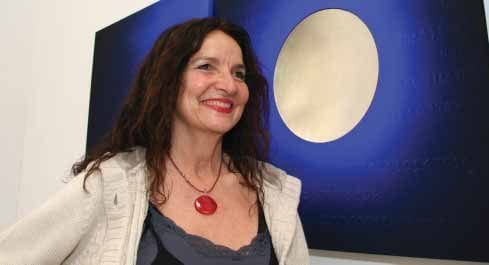
Albuquerque paused in front of “Auric Field”, a painting with a gold circle surrounded by the numbers of the Fibonacci Sequence in relief on a royal blue background.
“This piece is almost like taking a chunk out of the universe,” she said. Fibonacci Sequence states that after two starting values, each number is the sum of the two preceding numbers.
The sequence, which exists in growth patterns in everything from the human cell to intergalactic space, fascinates Albuquerque.
“I’m really interested in forces that are hidden and mathematics and the Pythagorean way of looking at the world,” Albuquerque said.
She pictures the world from the cosmos down to see how everything is part of a larger field.
“We start thinking not just of our lives here but much bigger,” Albuquerque said.
BECOMING AN ARTIST Born in Santa Monica, Albuquerque moved to her mother’s native Tunisia in North Africa when she was only five months old. Her artistic inspiration reaches back to her childhood in Carthage, where a huge emphasis is placed on the connection between the land and the body.
“In Tunisia, you get a real feel of the land and your relationship to the land,” Albuquerque said, explaining that the ancient Mediterranean culture focused on the earth-sky relationship.“There’s a poetry from the land itself that everybody feels there.”
Albuquerque moved back to the states as an 11-year-old. From age 19 to 23 she wrestled with her dual loves for visual and performing art.
Once while she was rehearsing a performance on stage, Albuquºerque realized that her heart was in creating art and not in performing other artists’ creations.
“I realized I was saying other people’s words,and I walked out and never came back,”she said.
Albuquerque worked in studios in Marina Del Rey, downtown Los Angeles and Venice before settling down for her current 12-year stay in her Santa Monica studio in the 18th Street Arts Complex.
Other than the second polar excursion, Albuquerque’s plans include writing a book,creating a documentary from the footage shot in Antarctica,giving lectures and displaying her work in various exhibits.
An installation of about a dozen of the spheres is also on display at a solo exhibition at the Peter Blake Gallery. The exhibit runs through March 29 at 326 N. Pacific Coast Hwy in Laguna Beach.
Originally published in the Santa Monica Daily Press print edition on March 5, 2007. Read the original PDF.