

County health dept. may monitor school bathrooms
The bathrooms at Samohi are leaving some students feeling queasy and mighty uncomfortable.
Stall locks are broken, graffiti mars the mirrors and ceilings, stink bomb attacks are common and feces and urine adorn the walls and floors, students said.
Some students complain that the bathrooms are so bad they end up steering clear of them all day, opting to wait until they get home to relieve themselves.
“No one here likes to use the bathrooms because they’re so dirty,” said sophomore Bryan Marquina. “There’s defecation all over the floor and on the toilet seats.
“It sucks because sometimes you really have to go.”
Administrators, concerned parents and students agree the messiness is not acceptable. But despite their best efforts to remedy the situation, a handful of students appear to be bent on bathroom destruction.
“It’s too much,” said Phillipe Cueva, one of 11 Samohi custodians responsible for cleaning the school’s 17 student bathrooms. “Every single day it’s like this. Every single day.”
A recent survey of Samohi’s restrooms by the Daily Press found the problems were not exaggerated.
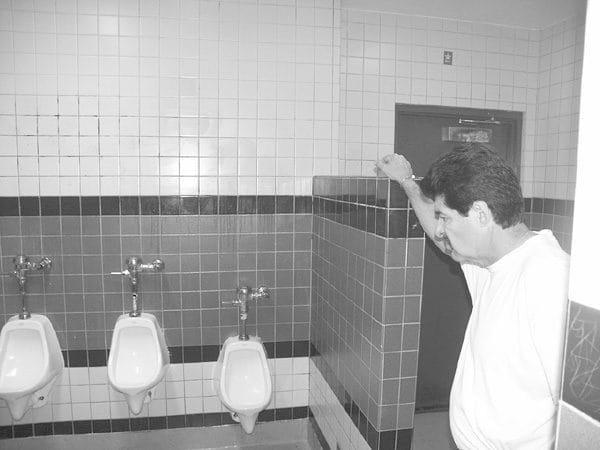
By 3:08 p.m. Thursday, when the final school bell rang, all five boys’ bathrooms visited were locked. One was recovering from a stink bomb explosion. Custodians, who asked not to be named, told horror stories of shoes and shirts wedged into toilets, bathroom supplies being scattered about and the improper disposal of human waste.
“Those kids don’t give a damn,” said one clean-up worker. “We lock (the bathrooms) as soon as the bell rings because that’s when the damage is done.”
Like many of his classmates, a ninth grader who identified himself only as Tyler reacted with frustration to a locked door and blamed fellow students for “messing up” the bathrooms.
A visit the following day revealed a slightly better situation. Though most of the boys’ bathrooms were locked by the end of school, three were open. Of the three, two were in decent shape, suffering only from graffiti scrawl and scattered toilet seat covers and toilet paper.
The other bathroom, however, was a veritable cesspool. The puddle of urine on the floor was so large it threatened to spill out of the bathroom and claim the adjacent hallway, while the stink was overwhelming.
Custodians, students, parents and administrators say the girls’ restrooms are generally cleaner, but not always.
Cueva said he is grateful that at least the bathroom fires — a persistent problem at Samohi last semester — have subsided. Administrators said they expelled the student they believe was responsible for the arson.
Troubled parents, who keep tabs on the dirty situation through an electronic mailing list, said the filthiness is a health risk. Kids forced to “hold it” all day are doing irreparable damage to their bodies and the distraction effects their studies, according to the postings.
“Kids should not have to suffer just to have a body function,” one parent said.
One parent’s posting last week called the bathroom problem “pervasive” and said her son, now in college, had experienced the same thing while studying at Samohi years ago. Another parent, who met with administrators on Friday, asked that signs be put in bathrooms spelling out prohibited bathroom behavior.
But Vice Principal Greg Runyon said negative signs aren’t the answer because it’s not realistic to expect kids responsible for the vandalism to respond.
“If you say ‘No gunfire,’” he said, “the place will be riddled with bullets.”
Runyon said positive signs that remind students the bathrooms are for all students could be a part of an overall solution.
A recent investigation by Channel 2 into more than 50 California schools showed the problems with bathroom cleanliness are not peculiar to Samohi. As a result of the expose, Michael D. Antonovich of the Los Angeles County Board of Supervisors spearheaded a campaign that would make enforcing the cleanliness of school bathrooms a task for the County Health Department.
Currently, health officials can respond to complaints and shut down filthy bathrooms, but they have no jurisdiction to monitor them regularly. A state bill sponsored by Senator Marsha Escuttia could change all that.
“The school cleanliness issue was not confined to one school, it was spread around the county,” said Tony Bell, a spokesman for Antonovich. “We have standards for restaurants. We have standards for animal control facilities. We have standards for jails.
“But right now we have no standards for bathrooms.”
Some Samohi teachers attribute the bathroom problem to part of larger loss of community at the school.
“There’s no respect for the sense of place,” said English teacher Berkeley Blatz, who has taught at Samohi for 30 years. “I was here in 1960, and I just remember a different climate.”
An article published recently in The Samohi, the school’s newspaper, placed the blame for the appalling bathroom conditions mainly on the students and encouraged them to clean up their act.
In February 2002, parents banded together to create Samohi’s “Bathroom Task Force.” The parents examined the conditions of the school’s sickly rest-rooms and set goals for recovery, while conducting regular checks to make sure the school was doing its part to remedy the situation.
“When all this stuff kind of hit the fan,” said Inese Verzemnieks, the group’s leader and the Parent Teacher Student Association’s vice president of health and safety. “I wanted to first get my facts and then go to administration.”
Following the first round of inspections, the task force found the school guilty of short-stocking the bathrooms. Soap receptacles were empty and toilet paper and seat covers were missing, Verzemnieks said.
“If we don’t provide kids the bare minimum we will not get the respect returned,” she said. “We cannot ask kids to clean up their act until we give them the supplies they need.”
Verzemnieks said her Tuesday morning spot check showed the school appeared to be keeping supplies well stocked.
“It was in great shape,” Verzemnieks said. “There were only two or three stalls that had run out of toilet paper in the whole school. I was shocked.”
While bathrooms look a little better in the morning, Verzemnieks said there is still room for improvement — mostly by students.
“In the end we realize we can’t control everything,” she said. “It’s like herding cats.”
Runyon conducted his own bathroom inspection one morning last week and said he was actually “shocked” at how good they looked.
“I’m on a high note,” he said. “We’ve made tremendous progress in the past two weeks. There’s always room for growth on both sides but a lot of this rests on the young adults.”
While parents and administrators may applaud the improvements in Samohi’s bathrooms, those stuck holding the mop don’t see it quite the same way.
“I don’t know what’s wrong with these kids,” said Cueva, who has worked at Samohi for three years. “They just want to make problems.”
Originally published in the Santa Monica Daily Press print edition on March 24, 2003. Read the original PDF.