

Criminal proceedings against Lamle delayed
A judge now will decide whether or not a local game inventor’s constitutional rights have been violated by the city.
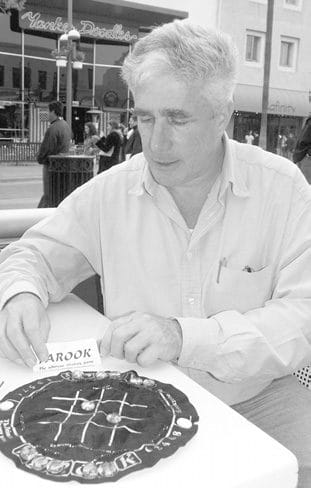
Stewart Lamle argued in front of a city hearing officer on Thursday that he should be granted a business license to play and sell his “Farook” game on the Third Street Promenade.
City officials denied Lamle a business license last year, citing that he couldn’t sell his game without either a performance permit or a city-rented cart.
Lamle appealed the city’s denial and hearing examiner Ed Edelman has 30 days to make a decision.
Paul Mills, Lamle’s attorney, argued the city is violating his client’s first amendment right of free speech by not allowing him to play and sell his game in the public right of way along the Promenade.
“Speech doesn’t have to be people talking,” Mills said. “It can be people walking down the street, whether or not they’re carrying signs. It can be people sitting down, whether or not they’re wearing T-shirts with words printed on them.”
Mills argued Lamle’s game is an exchange of ideas and literature — pointing out that Farook attracts game players who engage in lively debate on a spectrum of political and philosophical issues.
“It’s only ideas,” he said of the game. “It’s symbolic debate.”
Deputy City Attorney Linda Moxon, who requested that a reporter be kept out of the hearing, didn’t argue the first amendment issue. She said it had already been ruled on in Lamle’s performance permit hearing last year, when another administrative judge found in favor of the city.
“This is not the proper forum,” she said. “The business license issuance is not a first amendment case.”
Lamle was denied a performance permit last year because the city considers his game a personal service and not a performance. Under city laws, Lamle has to apply for a license as a vendor.
Moxon argued that Santa Monica couldn’t issue a business license to Lamle because only a limited number of certain types of vendors — including carts, sidewalk cafes and farmer’s market retailers — are allowed to sell their items on the Promenade, she said.
“This was not an arbitrary denial of a business license,” Moxon said. “If he chose to come in and apply for a license where this could occur, there would be no issue.”
Mills pointed to an “open-air vendor” exception in the municipal code that allows Lamle to operate anywhere on the Promenade.
But Moxon said the city attorney’s office said the City Council hasn’t designated where the open-air vending sites are allowed.
Mills said the sites don’t need to be designated because the exception speaks for itself.
Mills raised several issues questioning the city’s handling of Lamle. He said Lamle’s application for a business license was only processed on his third visit to City Hall, and only then because he was flanked by two witnesses and an attorney.
After it was filed, Lamle’s application was immediately denied without reason and Lamle’s request for an appeal was consistently ignored. That was until Mills formally challenged the legality of the city’s actions, he told the court.
Based on the city’s alleged mistreatment of Lamle’s appeal, Mills argued last year’s ruling against his client should be overturned.
“He had the right to the respect and the dignity of due process,” said Mills, who added that Lamle was led on a “wild goose chase” in his quest for a business license. “Instead, he was told nothing.”
Mills alleged Lamle’s treatment by City Hall was unique because business applications are usually easy to acquire.
“Abusiness license is a very basic thing,” he said. “It’s like a library card. They want to know who you are and what you’re doing out there. It’s just a registration.”
Lamle, who has been issued 41 misdemeanor citations and incarcerated twice, faces 11 criminal charges. Those include doing business without a license, performing at a table higher than what’s legally allowed and located outside of designated performance zones. Each count carries a maximum of six months in jail and a $1,00 fine.
The criminal proceedings are likely to be delayed until Edelman rules on whether Lamle is entitled to a business license, Mills said.
Lamle describes Farook as one of only three high-level strategy games ever invented. The other two are the 3,000-year-old game Go! and the 1,500-year-old game of Chess. Mills said Farook is like “tic-tac-toe to the tenth power.”
Playing and selling the game was a lucrative occupation for Lamle, who charged $1 to play the game and $15 for a take-home version of Farook.
The local inventor called the city’s treatment of him ridiculous, and vowed to take his case to the state and federal level until he is permitted to play his game on the Promenade.
“The city just adoesn’t like games,” he said. “You have these people out here playing music and charging for their CDs, and you have other performers out here. But for some reason, I’m not allowed. It’s discrimination.”
Originally published in the Santa Monica Daily Press print edition on March 14, 2003. Read the original PDF.