

Resmer said he was returning from breakfast at Rae’s diner a few blocks away when he noticed two police cars in the road and then the man on the roof.
“He had his hands over his head and was dressed in black,” Resmer said. “He was totally agitated.”
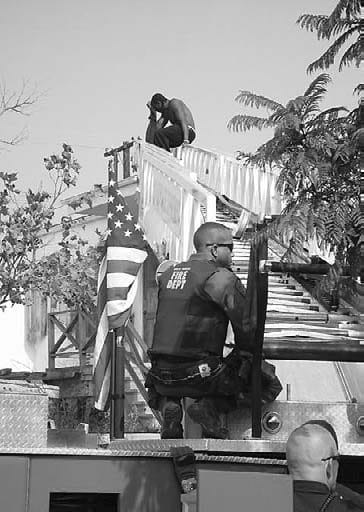
Within a couple of hours, the area was teaming with dozens of police and fire personnel. A ladder truck was placed near the building so the man could climb down, which he eventually did, but not before crawling halfway down and taking a seat.
At about noon, the man took off his sweatshirt and started to show signs of fatigue.
That’s when witnesses began to wonder how long he would remain on the roof.
“I thought, ‘geez, how long are they going to do this?’” Resmer said, adding that officers initially had weapons pointed at the suspect, that is until negotiators showed up. “I really felt it was time to do something else.”
By 9 a.m., the SWAT team had shown up. An hour later, the SMPD’s crisis negotiation team took over the situation and tried to reason with the suspect, Resmer said.
“Our first duty is to make sure that he is not a danger to the public and to himself, and also to bring the incident to a peaceful resolution,” Fabrega said. “If need be, we would have waited him out.
“Time is always on our side,” he added. “Sooner or later, they’ll get tired and they want to go to sleep.”
Police determined that the man’s state of mind was not normal, based on what he was saying and his verbal outbursts. When officers approach a suspect, they operate as if he is armed, which is why weapons were initially drawn, police said.
“In the beginning, there were a few moments when no one knew which way it was going to go,” Resmer said. “I can’t really fault the police, but maybe the guns needed to be put down.”
Still, Resmer, who said he watched nearly all of the events unfold from his office, said the incident was well executed by the SMPD.
“Hats off to the police for waiting it out,” he said, adding between 30 and 35 officers and firefighters were at the scene.
“But some of us were getting impatient because there was a huge amount of resources here.”
The Los Angeles Police Department arrived on the scene, but despite the suspect’s requests for LAPD to come, he wouldn’t talk to officers, Resmer said.
Resmer said an officer told him that a private security officer from Bel Air Patrol saw the man driving on the wrong side of Interstate 10 and flashed his lights to warn him. The suspect reportedly exited at Centinela Avenue, got out of his car and fled on foot.
Fabrega said it’s unclear how the man ended up on the roof or why he stayed up there for as long as he did. He added that the SMPD appreciated the patience of those disrupted by the incident.
“We appreciate their cooperation due to the street closures,” Fabrega said.
EMOTIONS RUN HIGH There are only a handful of Santa Monica police officers trained in crisis negotiation, which is a highly specialized area of law enforcement used in situations that go beyond what routine patrol officers may be able to handle.
Negotiators are specially trained to utilize verbal skills to save lives. SMPD realizes that in most domestic crisis incidents, emotions run high. The emotion-based solution the individual chooses to resolve his or her problem can be changed given the right verbal or tactical strategy, police said.
Crisis negotiators are brought in when distraught or despondent individuals barricade themselves, exhibit threatening behavior to themselves or the public, or take hostages.
When they respond to a call, negotiators are immediately faced with the heavy burden that if they are not successful, the consequences could be fatal. Not only is there a high level of stress involved, but it’s emotionally draining for both sides.
That’s why it takes a certain type of individual to deal with such intense circumstances. Negotiators must have an enormous amount of patience and empathy, and have the ability to engage distraught individuals into a conversation, police said.
When negotiators first approach the individual or situation, they try to strike up a conversation with him or her and build a rapport.
Negotiators must build trust with the individual so he or she feels like someone does care about them, which can take hours. The goal is to let the person vent long enough about his problems and then reason with him.
Crisis negotiators work closely with SMPD’s SWAT team when needed, like in Thursday’s incident.
Originally published in the Santa Monica Daily Press print edition on October 21, 2005. Read the original PDF.