

City Hall’s bank balance hovers around $1.6M
CITY HALL — With less than a month before they have to present a proposed budget for the upcoming year, city officials are scrambling to cut $2 million from 10 departments.
For city financiers, the end of the fiscal year is much like tax time for accountants — the final push must be made before the deadline draws near. Making final tweaks to the massive budget will require plenty of overtime and weekends spent at work for many in City Hall, who must prepare thousands of pages for the City Council by the end of next month.
Department heads first submitted their proposed budgets in late February to City Manager Susan McCarthy, who gave them a target figure to obtain based on the City Council’s direction. Since then, she has reviewed those proposed cuts and has sent some department heads back to tweak where necessary. As those proposals come back within the next two weeks, McCarthy will review the numbers and prepare a proposed budget for the council to examine on May 25. A public hearing on the proposed budget is scheduled for June 15, which also is when the City Council will formally adopt the budget.
The City Council held a public hearing in February during the mid-term review of the budget, which was laid out by City Finance Director Steve Stark. Council members gave a general list of their priorities — with most saying vital services like police and fire had to remain at current levels — and sent staffers to work on how to close the gap.
This year, City Hall faces a $4 million deficit. Officials plan to shave $2 million in operating costs and take $2 million out of the capital improvement projects budget. Nineteen positions within City Hall have been identified for possible elimination if more cuts need to be made, according to City Hall spokeswoman Judy Rambeau.
This will be the third consecutive year of budget deficits within City Hall — totaling $28 million. In 2002, City Hall faced an $8 million shortfall, and was able to cut $2.2 million in operating costs and $6.6 million in capital improvement projects. In 2003, City Hall plugged a $16 million shortfall by cutting expenses and increasing revenues. Thirty-one positions were eliminated as part of the cuts.
There’s been a hiring freeze citywide since 2002, as well as a hold on all cost of living increases for office supplies and expenses in every department.
The public will get a chance to pour over the city’s $353 million budget during three study sessions, scheduled for May 25-27. The proposed budget is expected to be available on the city’s Web site (santa-monica.org) by May 18. The study sessions are designed to give citizens a chance to better understand the budget process and learn in more detail where the money comes from and where it goes.
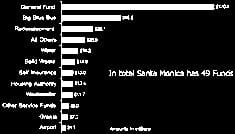
Of the $353 million, the City Council is able to control spending for about 44 percent of it, or $174 million.
“The one we spend the most time on is the general fund because it’s the dollars with the fewest strings attached,” Stark said.
The remaining $179 million is earmarked in 48 other accounts that have stipulations on how the money is spent. That’s because the money comes from the federal and state governments, as well as grants, that dictate where the money should go. Those funds include the Big Blue Bus, the airport, the Redevelopment Agency, as well as the water, the solid waste and the housing departments, to name a few. (See chart above for further information).
“It’s the source of those funds that put restrictions on that money,” Stark said.
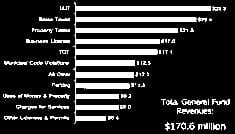
General fund revenue comes from a host of sources, with the largest being utility user taxes, which generate $28.3 million. Sales taxes are the second largest generator — $25.4 million — and property taxes bring in $21.5 million. (See above chart).
Most of that money is spent on salaries for city workers — it accounts for 68 percent of City Hall’s expenditures.
“When you cut budgets, you can’t cut far before you cut into personnel,” Stark said.
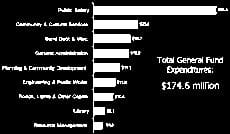
The second-largest expenditure is for public safety, at $65 million, while community and cultural services cost City Hall $23 million. (See chart above).
Property tax income is distributed for a variety of uses — 14 cents of every dollar goes back to City Hall’s general fund, while 17 cents of every dollar goes to the local school district. The rest of it goes to the state for an education reimbursement program and Los Angeles County for services, Stark said.
As of Monday, City Hall had $1.6 million in the bank, which doesn’t include its investments.
Originally published in the Santa Monica Daily Press print edition on April 28, 2004. Read the original PDF.