

Rendering courtesy of city of Santa Monica The site plan for the Marion Davies Estate project depicts what renovators envision by the 2008 completion date. Residents turn out to weigh in on Davies
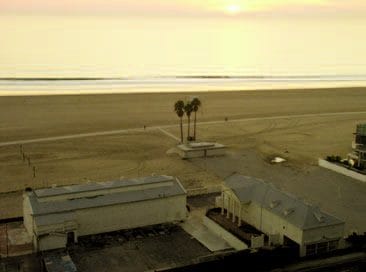
415 PCH — A $24 million project is underway to restore a historic estate on the beach built in the 1920s by newspaper giant William Randolph Hearst.
Project leaders last weekend met with community members to discuss the emerging design schemes for the five-acre Marion Davies Estate, located at 415 Pacific Coast Highway. Approximately 110 residents attended two workshops held Oct. 1-2 to comment on the site plans proposed by Pankow Special Projects, Ltd., the Pasadena-based design firm contracted by City Hall in July to manage the project from conception to completion.
The renovation is scheduled to be finished by December 2008.
The Davies Estate is expected to offer the public a beachside location to host banquets, barmitzvahs, weddings and other events, as well as provide recreational activities for visitors to include a children’s playground, pool, volleyball courts, and possibly paddle tennis, said Libby Carlson, who works in City Hall’s community and cultural services department and is overseeing the project.
The major source of funding to refurbish the property is a $21 million grant issued to City Hall in December by the Annenberg Foundation. City Hall agreed to kick in an additional $3 million to complete the project.
Neil Carrey, vice chair of City Hall’s Recreation & Parks commission, attended the workshops and said many citizen concerns focussed on operating issues.
“They wanted to know about maintenance, security, hours of operation, neighborhood impacts such as lighting and parking and traffic,” Carrey said. “In general, people were positive about the design.”
Carlson said many workshop participants wanted to be sure the site would have year-round use and offer a sustainable program.
Carrey agreed, saying activity would be the key to ensuring the facility is successful and doesn’t become neglected or overrun with transients.
“One thing that’s important to keep in mind is that the more you use something the less issues you have with it, because the homeless population doesn’t want to be around a place with a lot of activity,” Carrey said. “Once we had the skatepark in place at Memorial Park, for example, there was lots of activity there and the homeless activity dropped off.”
Carlson said parking lots at the site will remain in place, which will provide enough parking to appease state officials.
The project, once complete, is expected to accommodate 200 people.
Noise generated by motor traffic on the PCH also was an issue, Carlson said. To counteract the noise, City Hall may hire an acoustics expert to look for ways to sound-proof the facility.
The noise problem, however, may go both ways, said Fred Deni, owner of Back on the Beach, the restaurant located next to the property.
Deni said he has extended a tent on the property to host events, often involving alcohol and music. To do so, he has adopted strict guidelines, such as ensuring no music starts until 7 p.m. and is over by 11 p.m., he said.
“One of my first red flags is when I get a call from someone who wants to throw a party and he says, ‘Can we drink until two in the morning?’” Deni said.
Deni said City Hall will likely regulate use to minimize noise or other complaints associated with the estate’s operations.
Carrey said it will be imperative for City Hall to regulate such activity.
“People won’t necessarily be able to just walk up from the beach,” Carrey said. “The property is owned by the city, so the city will be required to set up rules to determine how the site is used.”
The estate was built for Davies, Hearst’s mistress. The lavish compound once had dozens of rooms with expensive, detailed furnishings. In 1959, City Hall took control of the property and leased it to the private Sand and Sea Club, an arrangement which lasted from 1960 to 1990. Then the site was open for public events, such as barbecues and weddings, until it was severely damaged in the 1994 Northridge Earthquake and had to be closed down.
The estate, once the splendor of the rich and famous, has since been neglected and prone to trespassing and vandalism, some say.
Pankow Special Projects, Ltd. has completed a number of projects of “greater magnitude and complexity” than the Davies estate, according to a city staff report. The firm’s resume includes historic projects, making it “keenly familiar with the issues associated with preservation and restoration.”
Frederick Fisher and Partners, the team’s design architect, is an internationally-recognized architecture firm based in West Los Angeles. The award-winning firm specializes in art-related design, historic building rehabilitation and residential work. Its projects include the restoration of the A. Quincy Jones Studio, and the adaptive reuse of the Santa Monica Bay Telephone Company Building for the headquarters for the Broad Art Foundation, among others.
As of July 25, an “e-workshop” has been available at 415pch.smgov.net. The e-workshop will provide historical information on the site, background information on the revitalization project and an opportunity for community members to provide input on their vision for the site. Comments received will be forwarded to the design team.
Barbara Stinchfield, director of community and cultural services, said the e-worskhop is a relatively new concept for city projects. It’s being used, in part, to help expedite the timetable to finish the project in 2008, as requested by the Annenberg foundation.
“It’s good there is money for this project and it’s moving forward quickly,” Carrey said. “City Hall isn’t known for always being on time.”
Originally published in the Santa Monica Daily Press print edition on October 8, 2005. Read the original PDF.