

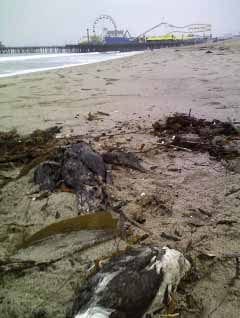
SM BEACH The lifeless bodies of seabirds that have been washing ashore over the past several weeks have public health officials scrambling to find the cause of the mysterious deaths.
Many experts are blaming domoic acid, a toxin found in certain algae blooms that has killed hundreds of birds and other assorted marine life up and down the coast. In the wake of the poisonings, state health officials have warned against eating certain types of seafood — including shellfish and sardines — caught by recreational fishermen off most of the Southern California coast.
Autopsies have been performed on the seabirds found just south of the Santa Monica Pier on Monday morning. Nothing out of the ordinary was found inside the birds’ bodies, said Dr. Karen Ehnert, senior veterinarian with the Los Angeles County Department of Public Health.
“There has been an ongoing outbreak of domoic acid poisoning all along the coast, with several marine mammals being stranded or dead, as well as sick birds,” Ehnert said. “We are assuming the clusters of birds that are coming off the Santa Monica Beach are associated with that.”
Mike Vaughan, a Santa Monica resident who surfs regularly when the water is clean enough, was jogging on the beach Monday morning when he first spotted rows of black seabirds lying dead in the sand.
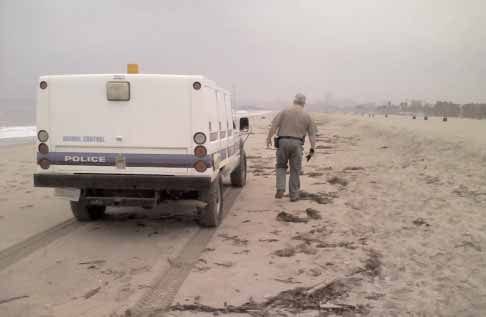
Animal Control officers were on the scene picking up the bodies.
“I saw more today,” Vaughan said Tuesday.“When we surf, sometimes we’ll see maybe a dead duck in the water or a seagull, but this was jacked up. I’ve never seen this many seabirds dead at one time.
“The water is really filthy right now and I’ve noticed that the red tide hung around a lot longer last year. That’s a sign of how dirty the water is.”
“Red tide”is the name given to large algae blooms that can alter the appearance of the ocean’s color, making it a dark, blood red. The blooms can cause many marine and coastal species of fish, birds, marine mammals and other organisms to become infected by a potent neurotoxin.
It is unclear what causes red tides, but the frequency and severity of algae blooms in many parts of the world have been linked to increased nutrient loading from humans. The growth of marine phytoplankton is generally limited by the availability of nitrates and phosphates, which can be abundant in agricultural run-off.
Coastal water pollution produced by humans and systematic increase in sea water temperature have also been implicated as contributing factors in red tides.
Frequently, shellfish collected in areas affected by algae blooms can be potentially dangerous for human consumption, leading to closures of shellfish beds for harvesting. Initial signs of shellfish poisoning from red tide toxins such as domoic acid is tingling in the lips followed by a reduction of motor abilities and difficulty breathing. It can be fatal if consumed in sufficient amounts.
Ehnert said tests on the birds should be completed in the next three or four weeks.
Meanwhile,the county continues to test for the Avian Flu and West Nile virus. So far, officials have not found any signs that the deadly strain of Avian Flu has surfaced locally.
The general public is being warned against consuming the organs of commercially sold lobster and crabs, as well as those caught by recreational anglers. The seafood warning also pertains to bivalve (two-shelled) shellfish such as oysters, clams and scallops, as well as anchovies taken off the cost of Los Angeles, Orange, San Luis Obispo and Santa Barbara and Ventura counties.
The warning does not apply to commercially caught bivalve shellfish, such as clams and oysters, which are sold by certified harvesters and dealers subject to frequent and mandatory testing, regulators said.
Officials advise those who eat crabs and lobsters to consume only the white meat, removing and discarding the dark-colored organs, or viscera, before cooking.
Originally published in the Santa Monica Daily Press print edition on May 2, 2007. Read the original PDF.