

Controversial meeting called to push 21-story high-rises for 10-acre site downtown
DOWNTOWN — A private meeting has been called with public officials to discuss the largest and most controversial project facing Santa Monica in decades.
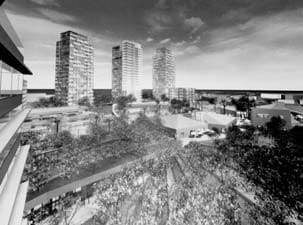
Developers hope to replace the 24-year-old Santa Monica Place mall downtown with a 10-acre project that features five high-rise towers, three standing 21 stories high. The plans will be unveiled at a public meeting on Thursday.
However, developers also have asked elected officials to attend an invitation-only reception and project presentation to be held at the mall Monday evening. If the officials attend, the private meeting will violate a state law mandating City Hall’s business be conducted in the public sphere, City Attorney Marsha Moutrie said.
Macerich Co., which owns the mall, has been working on its controversial plans for several years. In recent months, it has privately floated those plans to select groups and contributed thousands of dollars to various political allies.
Because City Hall owns a portion of the land in question, and because Macerich’s proposal doesn’t conform with the rules governing new construction in Santa Monica, the developers have paid City Hall $15,000 to consider what’s called a “development agreement,” where the project is allowed to skirt city code. Developers typically offer something of value to City Hall when operating under a development agreement.
Macerich has proposed building three 21-story towers housing a total of 300 condominiums, and two seven-to eight-story towers, one with 150 apartments and the other offering rental office space. The project contains another 600,000 square feet of space for restaurants and retail outlets, nearly six acres of park space and three to four levels of underground parking, according to the plans.
City Hall has a stated goal to build more housing downtown and acquire more open space citywide. Part of that would be accomplished through Macerich’s proposal to extend the Third Street Promenade from Broadway to Colorado Avenue. That would then connect to a planned multi-million dollar Civic Center, which would tie together the Promenade, Main Street and the Santa Monica Pier.
The plans will be unveiled at a Thursday meeting of the Bayside District Corp., the nonprofit organization that manages downtown in conjunction with City Hall. Randy Brant, vice president of development for Macerich, also sent out invitations to a number of public officials, asking them to review the plans privately next week.
“Knowing of your interest and involvement in the city affairs, and considering the scope and significance of our proposal to the future of the Civic Center, I am hoping you will join me for an invitation-only reception and project presentation on Monday, 22 November,” reads the invitation, which was extended to members of the Planning Commission, the City Council and the Pier Restoration Corp., a board that oversees the Santa Monica Pier.
Brant declined to discuss the plans on Tuesday. He did, however, respond to allegations that Macerich has avoided public scrutiny.
“That is not our intention at all,” he said. “We welcome public input. We look forward to public input. We’re going to offer the public ample time for public input.”
However, the private meeting scheduled for Monday night may be a violation of the Brown Act, a state law that dictates how local officials conduct city business. Under the Brown Act, it’s illegal for public officials to discuss issues concerning the public in private. It’s also illegal for them to lobby one another individually or meet serially, where different council members discuss the same topic in separate meetings, Moutrie said.
A developer holding a private reception for elected leaders would be a clear violation of the law, according to Moutrie.
“There’s no exception to the open meeting law that would cover that,” she said.
Moutrie does not prosecute Brown Act violations because it would be a conflict of interest for her to pursue the same officials she reports to. Instead, she reminds local leaders of apparent violations and can refer cases to the Los Angeles District Attorney’s Office, which is the only agency in the state that actively pursues Brown Act violations, Moutrie said.
The plans are considered especially controversial because of the scale of the proposed development. Only one other building in downtown Santa Monica — the high-rise tower at 100 Wilshire Blvd. — stands 21 stories high.
“We haven’t seen a proposal like this in a very long time,” said Andy Agle, assistant director of City Hall’s planning department. City officials expect the development agreement to be discussed by the City Council on Dec. 14.
Despite the opportunity it provides to add open space, the proposal is sure to face stiff opposition and it’s unclear whether Macerich officials are prepared to scale back their plans if the community calls for it. Though he hasn’t reviewed the plans, Planning Commissioner Darrell Clarke said the scale of the project will be an important consideration.
“I will tell you very strongly that compatibility with the city is very important to me and I think we’ve seen, in the City Council election that just ended, very strong interest and concern by Santa Monica residents about intensity of development,” he said. “Any new project on that site will have to pay attention to those things.”
The ambitious plans to redevelop Santa Monica Place were prepared by Jerde Partnership, a prominent architecture firm also credited with major malls, hotels, casinos and urban centers throughout California and around the world. Before the plans can be acted upon, they will have to be approved by the City Council and the Coastal Commission, which governs all development near the coast of California. It’s unclear if the controversial plans could be forced to a vote, leaving local residents with the ultimate decision.
No matter what happens, most officials agree something needs to be done with Santa Monica Place, built in 1980 when indoor malls were popular. Mall officials stopped signing new contracts with tenants months ago in an effort to empty out the property.
“Santa Monica Place definitely needs reinvestment of some sort,” said Rob York, a consultant who tracks development downtown. “This is probably the most dramatic approach one could take. It will have tremendous impacts on downtown in a variety of ways... Santa Monica Place, in whatever form it takes, is an anchor for downtown. It’s obviously not operating at its peak under the current situation, but it’s an important aspect of downtown.
“It’s in a critical location. It needs to work.”
Originally published in the Santa Monica Daily Press print edition on November 17, 2004. Read the original PDF.