

By TAYLOR VAN ARSDALE Special to the Daily Press
You may recognize filmmaker David Ayer’s name as the screenwriter of “Training Day” starring Denzel Washington or as the director of “Harsh Times” starring Christian Bale. Today, his spectacularly shot, riveting urban-thriller, “Street Kings” starring Keanu Reeves opens. These films share a commonality; all three belong to a genre that Ayer maintains, from growing up in South L.A., he understands. When you see the finished product, you’ll know this to be true. No one does cop films like Ayer.
With his goatee, slightly shaggy brown hair, and thoughtful demeanor, Ayer does-n’t appear to be a risk-taker, but back in 2005 (in an interview with Reelblack TV) he borrowed money against his house to finance “Harsh Times.” It was a gamble, and one that paid off. Reeves saw the film, but more importantly saw what Ayer did with Bale’s role and wanted a little bit of that same “madness” in “Street Kings.” Approached by producers Erwin Stoff and his team with a “good detective yarn” written by famed novelist, James Ellroy (and Jamie Moss), Ayer was up for the task. Says Ayer, “It was hard-wired with the elements of corruption; and the Ellroyian devise of the subordinate learning from his boss is the source of it.”
Originally intended as a period piece set in post Rodney King L.A., “Street Kings” was more a comment on racial politics, but Ayer says, “I felt like that had been done to death.” Screenwriter Kurt Wimmer retooled the piece for modern-day L.A, and gave it a much more contemporary feel.
To obtain the film’s rich, saturated look, Ayer worked with production designer Alec Hammond, putting together color boards, sample pictures and stills. He shot on Kodak stock # 5218, push-rated the film, and used “Zeiss Master Primes,” a fast lens that provides incredible clarity. “It doesn’t have the look of a bleach bypass or reversal process which can desaturate the film,” says Ayer, who completed the process with a “digital intermediate,” allowing for finer control of individual colors.
“We were really conscious of wall colors and wardrobe. In “Harsh Times,” I went naturalistic and in “Street Kings” I played with a heightened aesthetic.” He worries though in building in the aesthetic he may have tipped his hand to the manipulation. “I don’t know if I pulled it off,” he says. But he did. Ayer successfully redefines the washed out palettes and textured grittiness we’ve come to associate with cop dramas imbuing new life to the genre.
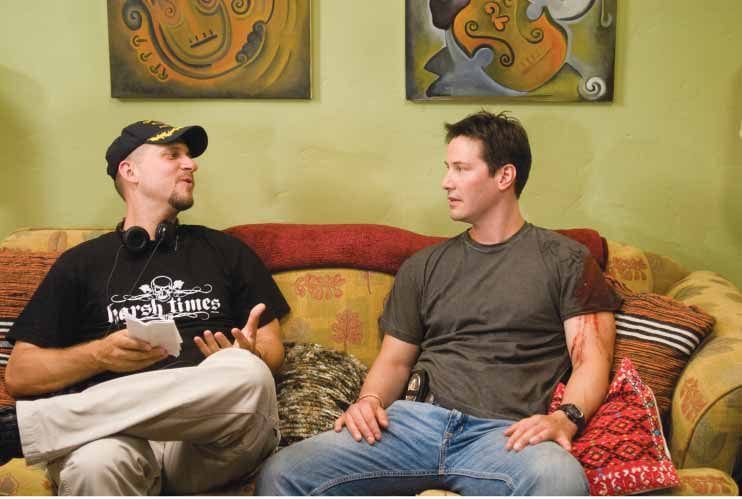
Having a background for the material, allowed Ayer to focus on performance. In some cases, Ayer used “psychiatric tricks” to get his actors to react. When pressed for information, he jokingly states, “You don’t talk about Fight Club.” Then relents, “A lot of it was preparation. I got them martial arts training, sparring the way street guys fight.” Of Reeves, Ayer says, “One of the hardest things for him to do was to hit people. He’s a gentle soul and for him to embrace violence as such was the toughest part of the journey. I had to sort of poison his worldview.” Ayer laughs good-naturedly when he admits, “On set, I would sometimes make him mad on purpose.”
If Ayer was at ease badgering his star other cast members were more reticent. Jay Mohr, recounts how Forest Whitaker, unsure as to whether to shove Keanu in a particular scene, pulls him aside and asks, “Dude, in your opinion, do you think I should, really push Keanu?” Mohr jokes, “You just won an Oscar, you’re asking the club comic how you should act? I don’t know. I’m at the Brea Improv. Let me face 300 people and get back to you on that.” “It’s tough,” says Ayer, “Because I really grew to like him … then during the shoot, he was starting to get mad at me.” There is an interesting psychology that occurs between actor and director, and Ayer believes, “It may have been a conscious choice for Keanu to use me as a foil.” But Ayer wouldn’t settle, “I know he’s an incredibly gifted actor, capable of great things and I wouldn’t let him stop short of greatness.” The badgering pays off, as Ayer elicits one of Reeves’ finest performances yet. In his character, Detective Tom Ludlow, he conveys the tragic complexity of a police officer tormented by professional and personal demons.
Giving scope and scale to the project are aerial shots, which Ayer credits to Searchlight, saying, “This is one of those rare instances where the filmmakers got more resources midstream.” Impressed after seeing the dailies, executives asked, “Do you need anything else?” Ayers opted for a helicopter. “You pull out to the macro and back into the micro and realize that Ludlow is just one small guy in a very big city.”
Ayer grew up in this big city, in what he calls “shady areas” with a “troubled childhood.” A high school dropout, he seized the chance for a better life enlisting in the Navy. One gets the sense that Ayer is slightly remorseful about his lack of formal education, but he shouldn’t be. Some people spend four years in college to become filmmakers and never learn how to tell a story. Ayer is endowed with this gift inherently.
Ayer got his big break working as an electrician at writer/director John Wesley Strick’s house. Strick put Ayer’s work in the hands of producers who realized Ayer could write organic dialogue, stage a scene and give characters unique voices. “There was something I connected with when I wrote,” says Ayer whose tenacity paid off. Ironically Ayer says, “I got sick of being rejected so I wrote something I knew they’d reject, and never make and that was “Training Day”... which they made.” Sometimes it’s hard to understand Hollywood.
When Ayer looks at “Street Kings” he doesn’t see the beautifully crafted piece that translates to screen, with its camera shots from inner-city ridges and rises, composing glimpses into a Los Angeles not often seen. He sees the omissions, “I see where we got rushed because the sun was coming up, where we had three cameras going instead of two and the angle is a little wrong.” Ayer doesn’t claim to be a great director, though he clearly has an innate instinct for the craft. He modestly says, “I’m learning, growing.”
Now Ayer is looking for projects that he says will “make me obsessive.” He’s ready to get away from the police motif and do a western or coming-of-age movie. As for “Street Kings,” you couldn’t wish for a better “cops, robbers and corruption” flick than this.
Originally published in the Santa Monica Daily Press print edition on April 11, 2008. Read the original PDF.