

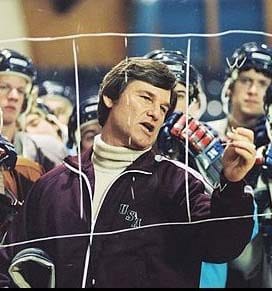
It is, perhaps, the most famous line in sports broadcasting history: “Do you believe in miracles?” The goosebumps still come, nearly a quarter century after Al Michaels posed the question to millions of viewers in the waning seconds of the U.S. hockey team’s incredible upset of the Soviets at the 1980 Olympic Games in Lake Placid. In “Miracle,” Kurt Russell stars as Herb Brooks, the legendary coach who took a ragtag group of college kids and transformed them into national heroes. Russell sat down recently with a group of reporters to discuss the film.
Question: Herb Brooks told his players at the outset of training for the Olympics, “I’ll be your coach, but I won’t be your friend.” Did you employ a similar technique in dealing with the young cast of “Miracle,” many of whom were hockey players with no acting experience?
Kurt Russell: I maintained a good distance throughout from the rest of the cast. I got to thinking that a lot of these guys have never acted before, and if I got close to them and we had fun, they were liable to have a difficult time separating that relationship they have with me from the relationship the players had with Herb.
Q: It must have been a lonely shoot for you.
KR: It was. They’d ask me to go skating with them, and I found myself making excuses not to. And finally I realized, I didn’t want to be out there on the ice with them. I knew the best thing to do was to just stay away from them. It wasn’t going to be that much fun, that’s for sure, but I knew it would be bad if they started having a difficult time relating to me (as Herb).
Q: So, in essence, you stayed in character when the cameras weren’t rolling?
KR: There’s an old saying which is really true, that you can’t act a king, you have to be treated as a king. Well, these guys were going to have to treat me like Herb. I couldn’t act Herb – I was just going to be Herb, and they were going to treat me like him. For the film to work, I had to have that respect.
Q: Besides isolating yourself from the players, what sort of things did you do on set to establish the hierarchy?
KR: Early on, we did some improv to get things rolling and kind of see where things were going. On some of the improvs, they started to feel their oats, and it would go south and I felt I was losing control of the scene. So it was good to do those improvs, because when it started to go south, I’d slam it shut. I’d get personal and scary, and they didn’t know whether it was real, and they were getting fired off the movie. What it did was establish who was who in the room, and made it real simple for them to stay focused.
Q: Many of the guys in the film weren’t even born when the Miracle On Ice occurred. How did you help familiarize them with the spirit of the times?
KR: As an actor, you take on the habits of the times you’re living in. One of the habits of our time now is that we can communicate with anyone anytime we want, so we carry that demeanor with us. It’s a different demeanor than someone who wants to get in touch with somebody, but there’s no way to do that. The more you’re aware of that, and the more you can infuse the movie with (the attitude of the times), the more fun the audience is going to have. So I tried to let them know what the world was like before cell phones and the Internet.
Q: What do you enjoy most about this film?
KR: What’s fun about watching the movie is that, for people my age or anywhere near it, we really do tend to forget how different things were back then. It was a really different atmosphere. This movie has a good feel for the way it really was. Gavin (O’Connor, the director) did a terrific job of getting the young players to feel comfortable with that. It’s really something to see.
Originally published in the Santa Monica Daily Press print edition on February 6, 2004. Read the original PDF.