

Board members want biggest bang for their buck Old Pasadena provides model
DOWNTOWN — More eyes and ears are needed in the city’s busiest shopping district, and officials are considering hiring some.
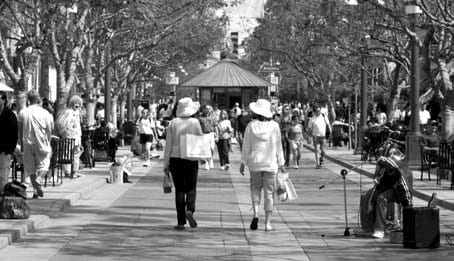
Board members of the Bayside District Corp., which manages downtown Santa Monica in conjunction with City Hall, are considering an ambassador program that would involve hiring individuals to serve not only as watchdogs for illegal activity, but also as concierges to guide visitors through the district and help manage the bustling area.
Though it’s been discussed casually for two years, officials have begun talking more seriously about a program. But how to pay for it — at an estimated cost of $500,000 annually — remains an issue.
“We’ve been talking about it for a long time, and I personally think there is a strong level of support for it,” said Kathleen Rawson, executive director of the Bayside District Corp. “It’s not paid for, and it’s not flushed out. It’s a big cost, and we don’t know how many people it would take or how much time.”
The concept is that an outside AMBASSADORS, from page 1 LIGHTING, from page 1 firm could be hired that employs people to serve as “ambassadors” to the Bayside District. Those individuals wouldn’t serve in any authoritative capacity, except to help police in reporting unlawful activity that officers don’t always witness firsthand. Rawson is quick to point out that the ambassadors would not serve as a security force, but instead as more eyes and ears for police.
The ambassadors also could help monitor noise levels produced by street performers, work with Bayside staff in management issues such as maintenance and cleanliness, and serve as liaisons between Bayside officials and merchants. They also could direct visitors who are looking for restaurants or stores.
“We do that now, but we are talking about a more significant presence. It’s a customer service issue, it’s a visibility issue,” Rawson said. “We want to add this level of visibility and level of management that we’ve never had.”
LOOKING ‘BLOCK BY BLOCK’ The program in Santa Monica could be modeled after Old Pasadena’s business district, which instituted a “clean and safe” program in 2001. The Old Pasadena Management District hired a Kentucky-based firm called “Block by Block,” which provides trained staff to walk the 21-block district. In Pasadena, the program focuses on enhanced security, provides support and referral services for area transients, and helps guide shoppers through the area.
The staff is cross-trained with local police and is equipped with radios to report illegal activity directly to officers, who then respond to the calls.
“We didn’t want a bunch of rent-a-cops running around,” said Maggie Campbell, president and CEO of the Old Pasadena Management District. “We wanted to keep that arms’ length role. For six to eight months we talked about what we needed. We needed enhanced security, not more police, so we made a philosophical commitment that we weren’t acting as police.”
She added that Block by Block didn’t necessarily need to provide people trained in the security industry. Instead, Pasadena officials wanted a staff hired for personality with the idea that they could be trained for the specific job.
“We want them to be friendly,” Campbell said. “These people are the face of our company.”
The goal in Pasadena is to deter illegal activity and serve as the district’s eyes and ears. Like Santa Monica, Pasadena has a steady homeless population, many of whom engage in anti-social behavior that upsets area retailers and shoppers.
“We won’t tolerate that kind of behavior,” Campbell said.
Old Pasadena, like Bayside, has in some respects been a victim of its success, and both districts have had their share of growing pains.
“There was this growing understanding of ‘how do we manage our success?’” Campbell said. “We thought if we could keep it clean and safe, the investment into the district would continue.”
A DOWNTOWN BREAKDOWN While Rawson said crime is relatively low in downtown Santa Monica, she agrees with merchants and Bayside board members that there are issues that need to be addressed. Merchants for many years have complained that transients urinating and defecating in the area creates a dirty environment, which turns off visitors.
“There are advantages of an identifiable presence on the Promenade,” said Bayside Board member Patricia Hoffman, adding that she wants a clear definition of what the program would entail and specifics on how it would be funded. “I’m interested in the program with no security component.”
The program would most likely be funded through assessments paid for by property owners and merchants downtown. But a review of where that money goes is necessary before any ambassador program is put in place.
“That has been a frustrating point for many of the merchants because they are paying these assessments and they can’t tell where it’s being spent,” Hoffman said. “They sure would like to know where their money is going.”
Bayside’s annual budget is about $900,000, and $608,000 of that comes from City Hall. Revenue collected from assessments goes directly into City Hall’s general fund, a portion of which is then blocks, on Second and Fourth streets between Colorado Avenue and Wilshire Boulevard.
“I deal with a lot of tourists, and they say Second and Fourth streets are dark and very unfriendly,” said Barbara Bryan, a Bayside board member. “I say we get rid of the ficus trees and add some safe, well-lit crosswalks. I’d rather we use the budget to make sure what’s done on this project is done right.”
Participants at the meeting reviewed a 1997 downtown urban design plan that calls for every ficus tree to be replaced with London plane trees within the improvement area. In addition, the plan calls for adding low, flowering shrubs to the tree wells, as well as historic-looking lamps.
Some aspects of the plan didn’t appeal to Bayside’s board members. While some looked forward to replacing the ficus trees, some did not — and few felt it was the top priority.
John Warfel, a Bayside vice chair, said the top priority was using the grant money to improve the lighting on Second and Fourth streets.
“We want to draw the pedestrian in,” Warfel said, referring to the effect appropriate lighting on Fourth and Second streets should have.
Other board members said placing dispersed to Bayside. City Hall collects $2.3 million from four different fees assessed to property owners and tenants downtown: ■ Businesses between Second and Fourth streets collectively pay $791,000 a year, which pays for ongoing costs to maintain the Third Street Promenade. ■ The central business district — which is businesses between Ocean Avenue and Seventh Street, from Wilshire Boulevard to the 10 Freeway — pays $200,000 annually for Bayside’s promotional fees. ■ Property owners who don’t provide on-site parking are collectively assessed $500,000 annually, which pays for facility operations, maintenance and improvements. ■ Property owners also pay an assessment that goes toward the debt service on bonds issued to make the original improvements to the Promenade. This year, assessments account for $794,000, which is a reduced assessment because property owners benefited from a 2002 bond refinancing. Next year, that assessment will be about $1.1 million.
“Bayside is an economic generator for the city,” said Miriam Mack, City Hall’s economic development manager. “All business generates money for the general fund.”
Rawson said an ambassador program would most likely come from new assessments.
“None of this will come from current funding,” she said, adding she doesn’t anticipate increased funding from City Hall. “We haven’t had a budget increase in four or five years.”
In Pasadena, the business district’s $1.2 million budget is spent 14 percent on administration, 23 percent on marketing, 29 percent on maintenance, and 34 percent on the safety and guide program.
The challenge for Bayside is that although it continues to produce increased sale tax revenue for City Hall, the budget for its maintenance costs remains the same.
“We are trying to protect the long-term vitality of the business district, but we are doing it with one hand tied behind our back,” Rawson said, adding that as more people visit downtown Santa Monica, the more wear and tear it gets. “We are looking awfully tired.”
Originally published in the Santa Monica Daily Press print edition on May 2, 2005. Read the original PDF.