

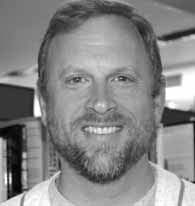
THIRD STREET PROMENADE — After 18 years of performing his critically acclaimed one-man show for audiences across the country, former UCLA pitcher, Santa Monica High School baseball coach and playwright Eddie Frierson is returning to the place where it all started: the Santa Monica Playhouse, which played host to some of his first performances.
“It’s so great to be finally coming back,” Frierson, 43, said during an interview last week at a bookstore on the Promenade. “I have a lot of fond memories of the Playhouse and of that time in my life when I was fresh out of college, coaching at Samohi. Those were some of the best moments in my life. It’s going to be so much fun.”
Frierson, who coached several championship teams at Samohi before hitting the road with his show, “Matty,” will perform his act as a special engagement at the Playhouse on Friday, April 21, and the following weekend, April 28 and 29. “Matty” tells the story of Christy Mathewson, a Hall of Fame pitcher for the New York Giants who went on to become a novelist, playwright and advisor to president William Howard Taft, not to mention the inventor of the screwball. He still holds the record for most wins in the National League with 373. For the show, Frierson dresses up in a replica 1920s baseball uniform, complete with a real glove from the era, and plays the role of Mathewson. He reminisces about some of Mathewson’s greatest moments, both on and off the field, and answers questions from the audience.
“It’s the greatest thing in the world when people who were dragged to the show come up to me afterwards and tell me they feel inspired or that they just had a fun time,” says Frierson, who lives with his family in Valencia. “I know there’s skeptics out there who think, ‘Oh great, a one-man show about baseball. Who’s Christy Mathewson, and better yet, who’s Eddie Frierson?’ But once you see the show, I think you’ll be pleasantly surprised.”
To Frierson, Mathewson represents more than just a former athlete who made a splash in the big leagues. He’s a hero, a true scholar who cared about youth and strived to make the world a better place, and Frierson feels that it is important to introduce a new generation to “this incredible man.”
While Frierson can be seen in sitcoms and his voice heard on several movies — including Disney’s “The Wild,” which premiered in theaters this past weekend — nothing seems to fill him with as much joy as playing Mathewson, his American idol.
Frierson sat down last week with the Daily Press to discuss his life as a ballplayer, coach and actor, as well as where those roles have intersected.
How did you hear about Christy Mathewson?
“It was a fluke. My dad would rummage through used book stores, and one day he came across this old, beat-up Boy Scout version of ‘Pitching in a Pinch’ by Mathewson. He gave it to me to read, and I just threw it on my shelf, where it sat for about two years collecting dust until one day I was running to catch the Big Blue Bus to LAX for a flight and I rushed back into the house to grab something to read. I just happened to pick up this book, and once I began reading it, I couldn’t stop. I was laughing out loud at these incredible stories about old ball players. The stories just seemed to jump off the page … After that, I thought he would make a great subject for a play, and from there I went on this incredible road trip to his home town of Factoryville, Pa., and began asking as many questions as I could … The more I learned, the more I was fascinated by this man, who contributed so much more than just a great screwball.”
How did you get the job at Samohi? “I started coaching in 1983. I was 23, fresh out of UCLA and (a buddy of mine) from Nashville was out here visiting. It was a Sunday, and I said, ‘You know, I really want to throw.’ I had nobody to throw with ever here, and it had been about a year since I was at UCLA pitching, so we went up to Samohi to just throw off the mound, and all these kids started showing up, among them Charlie Sheen, who I didn’t know at the time, and a couple of dads to play a scrimmage for fun. They didn’t have enough people, so we joined in. I pitched. I started asking one of the dads if he knew anyone at Samohi because I wanted to help out since I lived so close, just living on the beach being an actor dude. I was able to support myself because the rent was nothing. When I moved in, the rent was $170 a month right down on the beach at the Sandy Bay house … So I got a call a couple of months later that Don Sealy, who was the coach at Samohi, had died unexpectedly … So they called me up, and I jumped at the chance.”
When did you notice you had an interest in acting as well as baseball?
“I always wanted to do it. When I was in the third grade, I had an incredible teacher. We had dramatics every Friday, and I had a great time making the other kids in the class laugh. I loved baseball too, and I always thought that one day I would become a famous sports announcer. I had this little transistor radio, and I would listen to the Atlanta Braves every night. That just got me hooked … A big influence, though, was when I was 6 years old in Nashville, they had just started busing. I had a very influential teacher who took all the sixth grade classes, and both classes did a show. It culminated with my class doing a rendition of ‘West Side Story,’ but instead of it being Puerto Ricans, it was the blacks against the whites. It was a stuffed auditorium. All the teachers and parents were there, along with TV crews and everything. I didn’t realize it at the time, but we were kind of making a statement to Nashville and the rest of the South. We were kids, we didn’t understand the significance of it, but I’ll always look back on that time as being some of the best moments in my life.”
What’s harder: to throw a no-hitter or to write a play?
“Throwing a no-hitter, especially when there’s two outs in the bottom of the seventh and they pinch hit with a girl that had an article written about her in the local paper that morning. My buddies out in the outfield were yelling, “Don’t get knocked out by a girl. She’s a girl.” I was like, ‘Oh great.’ But she ended up not being so good, and I struck her out. It was my only no-hitter, and my family wasn’t even there. My sister had a big tennis tournament. She ended up coming out here and played as the starting point guard for the UCLA women’s championship basketball team.”
It seems like you come from a long lineage of athletes.
“Well, I’m from a basketball family. I guess that’s why I played baseball. My uncle was a gold medalist, Bob Davies. He’s in the Hall of Fame. He’s known for inventing the behind-the-back pass … Nobody went pro from my immediate family. My brother-in-law was drafted by the Dallas Cowboys. My other brother-inlaw could have gone pro, but he became a brilliant doctor instead. He played in the Rose Bowl in ’76 for UCLA.”
How come you never went pro? “It was kind of an easy decision. I was-n’t getting a lot of playing time to begin with (at UCLA) … Basically, you had to be on the field from noon to 7 p.m., and then from 7:30 to 11 I’d be rehearsing for shows or whatever. I wasn’t able to take the required courses in drama to get my degree because they were all at night, so it became a decision of whether or not I wanted to stay with the team or pursue the acting career. So I talked with my coach, one of the greatest guys ever, weighed my options and decided to go with theater. It just made sense … I’ve got to say the highlight of my career, if you can even call it that, was last year being asked to be the master of ceremonies for Coach Gary Adams’ retirement party. I was like, ‘Me? You’re kidding me.’ Not being the best player to come out of there, I was surprised, but I never felt for one second I wasn’t a big part of the success we had there. We were all part of a big family.”
What was your best pitch? “I had a really good breaking pitch and really hard dropping curve ball. I had a lot of movement on the ball and change ups. My fast ball was in that 83, 84 (miles per hour) range, and they had started using me as a short reliever, but that wasn’t my game. I liked to use a lot of strategy on the mound, mix it up from one inning to the next. So for me, being a reliever just didn’t work. I started getting hit hard. I don’t know, it might have been that I wasn’t mentally prepared. No excuses. I just didn’t perform well in that role. So I made the decision to move on. I made a joke at Adams’ retirement that I’m probably the only guy who has thrown more innings in the alumni game than I ever did on the field.”
Would you ever recommend sports as a career for your kids?
“Absolutely, but it’s really hard because all of that competitive stuff. It really depends on who your mentors are, who your coaches are. You can have one bad experience, and it’s all gone. You just have to make sure that your kids, and to a certain extent yourself, are into it for the right reasons. It’s really about building character, teaching life lessons, than it is about making it to the big leagues or whatever.”
What do you think about the pressure that many parents are placing on their children to be star athletes, get that scholarship and one day make millions?
“For lack of a better word, it’s just weird. The fact that you hire (public relations) people to market you to college coaches to get you recruited is just weird. If you’re good, they’ll find you. If they’re not finding you, hopefully you have a coach with enough brains that he can get in the door with people. And that’s easy to do if you’re respected at all or you come off with that air. Confidence is everything. I had a kid who wanted to go to Penn, and there was no way in his mind that he was going to get in. Well, we did it. We had a set of twins when I was coaching at Samohi who came to practice one day and their heads were drooping real low. Turns out they had wanted to get into UCLA and were denied. I looked at them like, ‘Why didn’t you tell me you wanted to go to UCLA?’ I got on the phone, called Coach Adams, and he came to the very next play-off game. He said he’d get them in and put the stamp on it. They ended up playing at UCLA for four years.”
What about the baseball steroid controversy. Do you think records set while using steroids should be thrown out?
“My problem is with the owners, who now control the game. When they got rid of the former commissioner, who was very impartial and very passionate about the game, it all went downhill. He would-n’t do all the stupid stuff the owners wanted so they could make more money. Bud Selig? You can’t call him a commissioner. He’s the owner of the Milwaukee Brewers, plain and simple … The rampant steroid abuse, everyone knew it was happening. Look at Mark McGwire. When he was at USC, he was this scrawny little thing, but could still kill the ball. He didn’t need all that crud … You can’t go back and erase things, you can’t go back and put an asterisk. It does just make you a little disappointed and skeptical of the game.”
What do you think about the Los Angeles Angels and Anaheim?
“That is just goofy … I guess it’s OK since they were once the Los Angeles Angels. But they’re not in LA, now in LA County, so come on. Once again, it’s not about baseball. It’s all about selling more hats, more shirts, things that say something different every year as opposed to just playing the game. Baseball’s cool. I wish they would just hire Bob Costas, Jimmy Carter, anybody who isn’t in their back pocket.”
Do you have a special place in your heart for Santa Monica?
“Oh yeah. I can remember when this was known as the Third Street Mall and it shut down, literally, at 6 o’clock. But at 6 the whole town was dead. They had built the Santa Monica Place Mall, but at that time nobody came to Santa Monica at all. I remember the old Criterion Theater, this big barn theater that had double features that would change every week, only for 49 cents. It was subsidized by the city. I saw so many movies. It was the best place. You would slip in puke and everything else because it only cost 49 cents to get a good nap in there. It was already becoming the home of the homeless.
“Another thing that was great was being able to wake up to the sounds of the ocean every day, seeing the sunset every night. I took advantage of it, though. I remember when I got engaged and knew I was going to have to leave to the (San Fernando) Valley to buy a house, I spent the last six months looking at the sunset every night. It was something special, 15 years of living on the beach.”
Originally published in the Santa Monica Daily Press print edition on April 17, 2006. Read the original PDF.