

Ocean Park’s past gives look into the present
By JODI SUMMERS
People were freaked by the recent Supreme Court ruling on Kelo vs. city of New London, which allows government agencies to exercise eminent domain and take private property for economic development. Well, allow us to introduce you to our very own eminent domain branch of government — The Santa Monica Redevelopment Agency.
The Santa Monica Redevelopment Agency was established in 1957. Its staffers state they work “in partnership with the community,” striving “to improve a neighborhood’s physical, economic and social environment through redevelopment activities.”
Their first quest was the Ocean Park Redevelopment Project in April 1958 — a plan to redevelop 33 acres in the southwest corner of the city. The Ocean Park Redevelopment Project encompassed the northern 25 acres. It was approved by the City Council on June 30, 1960. The results were two 250-unit, 17-story apartment buildings, completed in 1967, and the 340-unit Sea Colony condominium project. They threw in Ocean View Park to please the community.
The second Ocean Park Redevelopment Project, completed in 1983, encompassed the southern eight acres. It now features two senior citizen residential apartment complexes. The 100-unit Nelson Villas was completed in 1977. Barnard Park Villas is 61 units and opened in 1983. A utility now houses the art collection of the Eli Broad Family Art Foundation.
Ted Gleason has lived in Ocean Park since he was born in 1948. He grew up at 116 Ocean Park Blvd. He has vivid memories of how the Santa Monica Redevelopment Agency used its version of eminent domain to clear his neighborhood.
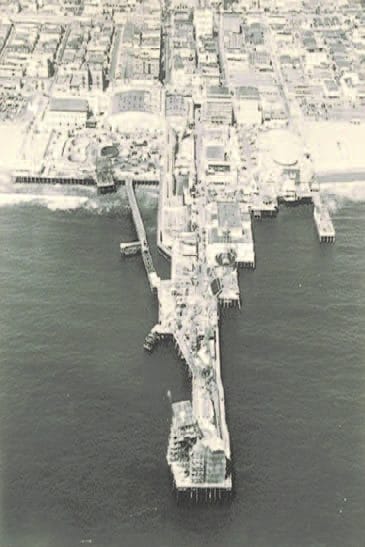
“The old Ocean Park Pier was not unlike Coney Island,” Gleason said. “There was a theater, wrestling arenas, skating rinks, barrooms, dance halls, eating places and hotels. People were “The change first started in 1958 and went in phases,” he added. “Their vision was for Santa Monica to be wall-to-wall skyscrapers, just like Miami Beach. They went into a back room somewhere and strategized. They had already done this in Long Beach, so they had a blueprint.
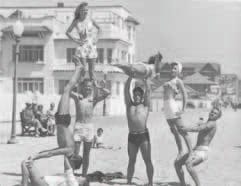
“To begin with, they used eminent domain and took all the property up to the mean high tide line. They said the state owned that property. They took things off the beach — the swings and the rings and the bars and the balance beams. Then the city bought up the hotels and buildings along the beach — brownstones like the Cadillac Hotel on Venice Beach. Everything south of Hill Street along the Boardwalk (Barnard Way) to Marine got destroyed.
“The next step was to pick apart the infrastructure. The way they took over the commercial zone was like a Roman field maneuver. They took the bank, they took the apothecary, they took the gas station, they took the Safeway; they took everything except for the library on the corner of Ocean Park.
“Somewhere along the line they declared it a slum, an eyesore, a blighted community. All the different buzz-words and terms were used. They went after some little mom-and-pop stores that were on the ends of the streets. After that they came up into the neighborhoods.
“For a long time we were playing kick-the-can down streets growing more and more empty. All of sudden there’s a house missing and another house missing, then there are nine vacant lots on your block … Oh, now there’s 10.
“They would decide behind closed doors what they were going to go after. Sometimes they used eminent domain, other times they would send the fire department and the building department and condemn it.
“When they were trying to take our house, they’d send out inspectors to find something wrong. My father was a carpenter, so every time they’d find something wrong, he’d fix. It was always chicken sh*t stuff, like the kind of wire that you use to put the stucco on wasn’t the kind that the city approved of at this point in the game.
“There were a lot of crummy little shacks down there, but we didn’t feel our house was a shack. It was all handmade. My mother had seven brothers who were stone masons and had built the big grotto over at the Catholic cemetery in Fox Hills. They dug the stone out of Latigo canyon and trucked it down here. The walls of our house were 4 feet thick. We had beautiful French doors that opened right into the sand. Around the corner, 20 feet away, was the beach.
“By the time they actually took the house at 116 Ocean Park Blvd., it was around 1963. They gave us $20,000, which at the time was fair market value. Then we paid the Epsteins $17,500 for our house on Wadsworth. There was about a year where we had both houses. They gave us enough time to remodel it because it was in pretty poor shape.
“They really tore the heart out of the community. Picking it apart the way the buzzards pick a carcass apart. Then, they left it laying in decline. Blighted wasn’t even the word. They left the Ocean Park Pier with nothing but an old chain link fence around it. Every kind of freak and punk and dog-town hobo were there. The punks down there used to go light bums on fire for fun. Finally it burned down.
“I can remember my mom yelling at a City Council meeting 45 years ago, ‘What do you think you’re going to do with the traffic you generate?’ They did no plan-ning whatever for traffic impact … Just like they’re doing now. They’re throwing these places up on Main Street by Pico. They have a hole going half way to China. And traffic on Main Street is already at a standstill by 3 p.m. in the afternoon.
“Don’t even ask how and how they got the land for the 10 freeway.” (Jodi Summers is director of the investment division at Boardwalk Realty Santa Monica. Contact her at, or call 310-309-4219.)
Originally published in the Santa Monica Daily Press print edition on August 10, 2005. Read the original PDF.