

Treat it before you flush it, they say
SM BEACH — Dysentery, pink eye, rashes, hepatitis, and ear, nose and throat infections — the biological reactions to polluted ocean water can be severe.
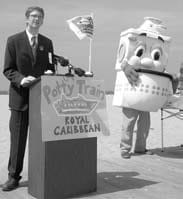
Citing those effects, a group of activists met on the beach Wednesday to demand that cruise liners do more to clean their waste before dumping it overboard. The large ships aren’t required to follow the Clean Water Act and regularly discharge only mildly treated sewage.
At least by Santa Monica Bay standards.
The Hyperion Treatment Plant near LAX filters sewage to a “secondary” level and pumps it seven miles out to sea. Cruise liners, on the other hand, can dump their sewage within four miles of the shore after it undergoes a lesser, “primary” cleaning.
“It’s time to end the wake of shame and protect the health of all Californians,” said Moira Chapin, organizer for Environment California. Chapin was joined at the podium by Craig Shuman, scientist for Heal the Bay, Mollie Culligan from the Malibu Chapter of the Surfrider Foundation and Jesse Littlewood, organizer for Oceana, the group that staged the event.
“It’s time to end the wake of shame and protect the health of all Californians.” — — MOIRA CHAPIN Organizer for Environment California
Cruise ships carry up to 5,000 people. On average, each ship dumps 195,000 gallons of “gray” water, 13,000 gallons of treated sewage and 2,200 gallons of oily “bilge” water each day, according to the International Council of Cruise Lines, the trade association for the industry.
Michael Crye, president of the trade association, said the United States Coast Guard regularly checks all vessels and holds the cruise liners to self-imposed regulations that require they dump all treated sewage in international waters at least four miles from shore. Crye said a team of scientists is currently working on recommendations to the industry, adding several liners are testing advanced systems.
At the Wednesday protest on Santa Monica Beach, organizers pointed their criticisms at Royal Caribbean, the second-largest cruise liner in the world with 28 ships. Only three of its vessels, however, are outfitted with advanced wastewater treatment systems. Activists think the company should take the lead and outfit all of their ships. Company officials said that takes time.
How much it costs to install the systems in unclear. Littlewood maintained they cost about $2 million a piece.
Michael Sheehan, a spokesman for the cruise liner, said they actually cost millions more, because different models have to be tested and installed — a process already underway.
“The whole industry announced in December our plans to move to advanced wastewater purification systems,” Sheehan said Wednesday. “It’s not the sort of thing that you can just go out and buy at K-Mart, put it in and say, ‘Hey, this does the job.’”
“It’s not the sort of thing that you can just go out and buy at K-Mart, put it in and say, ‘Hey, this does the job.’” — — MICHAEL SHEEHAN Spokesman, Royal Caribbean
Sheehan went on to say that Royal Caribbean doesn’t discharge sewage unless until it is at least 12 miles offshore and traveling at six knots an hour or faster. Dropping the sewage at that speed has been shown in studies to have a negligible effect on the environment, he added.
“This company — and the cruise industry as a whole — has an extremely strong self-interest in preserving the world’s oceans,” said Sheehan, who accused Oceana of waging a misleading campaign. “We derive our livelihoods from them. If we don’t protect them, we most assuredly will lose our jobs, our way of life and our very quality of life. We are not about to take that chance.”
Sheehan added that Royal Caribbean is at the forefront of the environmental movement among cruise liners and questioned why it’s been targeted. Littlewood countered the cruise liner should set an example for others, and pointed out that they tout themselves as environmentally friendly.
“They’ve refused to retrofit the rest of their line,” he said. “They have the opportunity to really set the bar, to really set the standard for environmental accountability.”
Originally published in the Santa Monica Daily Press print edition on April 8, 2004. Read the original PDF.