

Line set to reach Westside
CITY HALL Light rail is seemingly just around the corner. The only question now is: Which corner?
While construction has already begun on the first phase of the Exposition Light Rail line — an 8.6-mile stretch from downtown Los Angeles to Culver City — where it goes from there is anybody’s guess. The only certainty is that county transportation officials appear committed to extending the line to Santa Monica.
“We are very enthusiastic and as anxious as anybody to finish (Culver City) and move right into Phase 2, and get it out here to Santa Monica as soon as we can,” said Rick Thorp, chief executive officer of the Expo Construction Authority. “But we are also committed to doing it right.”
To do it right, planners at the MTA need to hear from as many people as possible on a wide range of issues, Thorp said, the most important being which route or routes the Expo line should take to Santa Monica and how many stops there will be along the way.
Earlier this week, the MTA held the first of several community meetings to determine the future of Expo, with Santa Monica’s gathering scheduled for Tuesday at the Civic Auditorium. The session marks the first time residents, business owners and other community stakeholders will have to meet with planners from MTA to debate details of the project.
The City Council had a brief opportunity to speak with Thorp during a study session earlier this week, highlighting some of the decisions that will have to be made in guiding the MTA board.
“There is, with good reason, a lively debate in Santa Monica on where the stations should be and how many there should be,” said Councilman Kevin McKeown. “We have seen the impacts of (Interstate 10) and there were some we anticipated and some we had not. I hope we do a better job this time. Placing stations in the right locations will be very important.”
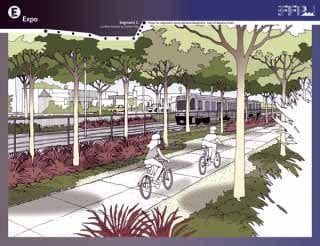
There will be a total of 10 stations along the Culver City phase of the Expo line, each within a mile or so of one another, Thorp said. Drawings of the stations show lush vegetation that is well manicured, with bike paths running alongside.
Stations can help enliven an area and help local businesses, however, they also increase travel time.
That was a concern of Councilman Bob Holbrook, who questioned whether or not an estimated travel time of 45 to 55 minutes from Santa Monica to downtown LA would be a turn-off for riders.
“I can get in my car and drive to downtown in 30 minutes if I leave at 10 o’clock,” Holbrook said.“It might take a little longer if I leave earlier than that. I’m just thinking about whether or not people would want to ride if they could get somewhere faster on their own.”
Thorp said he was not sure how long it would take to travel downtown on the train since the number of stations and the route has yet to be determined, however, he assured Holbrook that people will ride because of traffic on the 10 freeway.
Councilmember Pam O’Connor, chair of the MTA board, said people will ride because of the rising price of gas and their frustrations with traffic congestion.
The first phase of the project is expected to be completed by 2010, and there is hope that the second phase can begin immediately thereafter. Cost for the second phase is estimated at $805 million, however, that is subject to change based on rising construction costs and the route that is ultimately decided.
Two routes under consideration include laying track along Venice and Sepulveda boulevards to connect with the old Pacific Electric right-of-way along Exposition Boulevard, or sticking to the right-of-way entirely, which would send the line through the northern Palms and Cheviot Hills area, where there are many single family homes.
Neighborhood groups there believe the line would serve more people by traveling along Venice and Sepulveda boulevards, but there is concern about how traffic would be affected on those major thoroughfares during construction.
Once the line hits Santa Monica, it would most likely travel from Bergamot Station along Olympic Boulevard over to Colorado Avenue and end at the old Sears’ property, recently purchased by City Hall.
Councilman Ken Genser expressed some concern about traffic congestion near future stations, comparing them to freeway on-ramps, where cars are backed-up for miles waiting to get on.
“Entrances to freeways wreak havoc on city streets,” Genser said. “Those driving east at 6 o’clock find it extremely congested until you get past the San Diego Freeway, then it opens up again... Stations will be points of extreme congestion. We need to explore ways to disperse those points of concentration and make it easier to access the system.”
Genser suggested splitting the rail line, with one section going east and another going west.
Councilman Bobby Shriver pointed out that the council does not have the power to force MTA to build the light rail line where residents want it.
However, with O’Connor sitting on the MTA board, Santa Monica can have a lot of influence in the process, according to Thorp.
Originally published in the Santa Monica Daily Press print edition on March 2, 2007. Read the original PDF.