

Debate continues regarding downtown parking
DOWNTOWN With the lack of parking being one of the most common gripes shared by residents and visitors alike, it seemed strange for many to learn that the Planning Commission was going to consider a proposal that would allow developers to build less spots in exchange for lower rents.
Naturally, commissioners received plenty of feedback, mostly from residents living outside of downtown who were concerned that the concept would mean more congestion as drivers continue circling blocks for a parking space.
But it wasn’t the intent of Commissioner Terry O’Day, who placed the issue on the commission’s agenda last week, to put people in a panic. He said he merely wanted to encourage debate and get people to take another, comprehensive look at parking in the downtown area to see if it could be better utilized so that the $40,000 spent on each parking space built in Santa Monica today could be spent elsewhere, such as public transit.
“This is not a proposal to take parking away from anybody,” O’Day said Monday. “Essentially, we have to acknowledge that we as a community are paying for that parking infrastructure in one way or another. We have to think of ways to mange it more efficiently first, and then decide if that is where we want to be spending all of our resources on, considering that parking has a lot of costs that come along with it.
“When it’s cheap and easy, people drive their cars and that ads to more traffic,” added O’Day, who as executive director of Environment Now is seeking ways to create environmental programs that protect and restore the state’s environment.
Debundling allows housing developers to build fewer parking spaces than required by current zoning codes in exchange for lowering the rent of residents who chose not to have a parking space. The concept also includes allowing businesses like restaurants and retailers to operate with fewer parking spaces than required for customers and employees; all of which is supposed to encourage pedestrian activity or the use of mass transit or alternative transportation, such as bicycling.
O’Day and fellow Commissioner Gwynne Pugh are just some of those who believe that parking in downtown is not being used to its fullest potential and would like to see the availability and distribution of parking studied as city planners continue with the update to the Land Use and Circulation Element, which will drive development in the city for the next 20 years or more.
O’Day said the decision to place debundling on the commission’s agenda came from an earlier discussion about parking at the soon-to-be-expanded Big Blue Bus facility in downtown, where the majority of parking would not be used at night.
Commissioners were interested to see how that parking could be opened to the public in the evenings.
Pugh said he knows for a fact that parking spaces in downtown are not being used to their fullest potential. As an architect, his firm, Pugh + Scarpa, is currently working on a housing project for mental health provider Step Up on Second. Because many of the people who will be living there cannot afford a car or would be unable to obtain a drivers license because of their physical condition, Pugh asked the city to allow them to build less spaces. But because of the zoning code, his firm would have to go through what he described as a lengthy appeals process to obtain a variance. They decided to build the parking required under law.
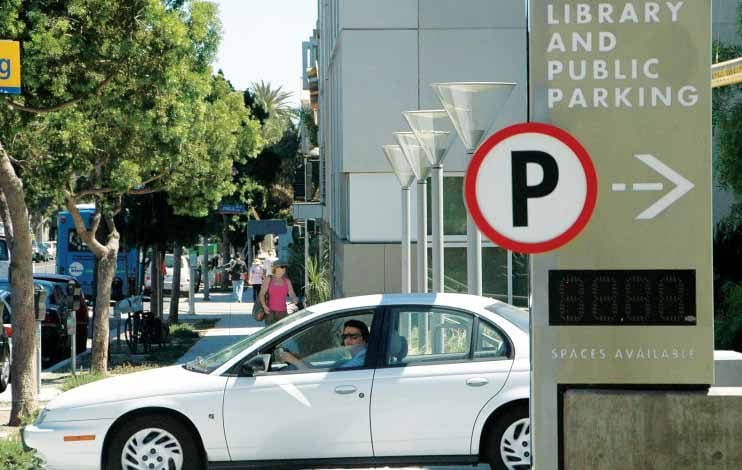
“Obviously, we have to be realistic about the requirements for parking, however there is an amazing amount of parking, some of which is being underutilized and so we are ending up spending an enormous amount of money on parking which isn’t necessarily to our advantage,” said Pugh, who said the Main Library’s underground structure is a good example of underutilized parking.
“We want to encourage people to use other means of transportation to come into downtown, but it has to be reality based,” Pugh said, explaining why he and other commissioners asked for city staff to examine how parking is used in downtown. “We need more information.”
Members of the public, along with other commissioners, said encouraging public transit is good, but to do so without taking into consideration residents and visitors who live outside of the downtown area would be a mistake. People who live in downtown may not have a need for a car if they work in the area, but for those residents who live on the eastside of town or in other neighborhoods such as Wishire-Montana or Sunset Park would need places to park when running errands on the Third Street Promenade or elsewhere in downtown.
In letters to the commission, residents expressed their opposition to debundling out of fear that it would mean more time spent looking for a place to park.
“We all know that our downtown is traffic-clogged days, nights and weekends, with steadily increasing intersection gridlock and little street parking,” wrote Diana Gordon, spokesperson for the Santa Monica Coalition for a Livable City, a group comprised of residents concerned about over development and traffic. “So this proposal would add more automobiles and also pit the parking needs of downtown residents and their guests against the parking needs of other residents, visitors, businesses and community workers.
“It will also cause nearby neighborhoods to become parking meccas for these rental units lacking sufficient parking, exacerbating scarce parking in those neighborhoods.”
Residents also pointed out that there is no guarantee that building mass transit near housing will encourage people to give up their cars, meaning that residents who chose a cheaper apartment because it does not have a parking space may still have a car that they need to park somewhere.
“I’m very cautious here,” said Commissioner Julie Lopez Dad. “I share the residents concerns … about needing more information, but also looking at in terms of us not having massive amounts of residential housing along the transit lines. We have some and we want to build in that way, but we are not there yet and we don’t have the transit yet to eliminate parking. It doesn’t seem feasible at this point or even in the next five or 10 years period.”
Amanda Schachter, a senior planner with City Hall, said the City Council has already eased parking requirements for some restaurants and other businesses in the downtown area to encourage people to get out of their cars and walk. While that may be suitable for downtown, Schachter said it would most likely not work in residential areas, something which O’Day does not advocate. The focus, he said, is on downtown and on changing the mindset of people to drive less and take public transit more.
“If we don’t start doing the things now that are in line with this vision (of protecting the environment and improving quality of life) than it will never come about,” O’Day said as he acknowledged the difficulty of trying to move people to become less car-dependent. “Or when it does, it will be the result of a very significant crisis.”
Originally published in the Santa Monica Daily Press print edition on September 11, 2007. Read the original PDF.