

11 Less injuries in rugby, despite lack of pads
PENMAR PARK, VENICE — Determination, endurance and, most importantly, the ability to mask that look of fear.
To 13-year-old Nkechi K. Ampah, of Los Angeles, they’re the keys for a successful rugby player, necessary to help her thrive in one of the most physically and mentally brutal contact sports in the world.
“Let your inhibitions go. You can’t be scared in the game,” said Ampah, a freshman at View Park Preparatory High School.
A rugby player of four years, she has begun practicing with the Santa Monica Rugby Club, where she hopes to build on her skills as a competitive player in order to some day land on a collegiate women’s team.
Since its inception in 1972, the Santa Monica Rugby Club, composed of men’s, women’s and youth teams, has gained national recognition as one of the country’s best, with the men’s team notching an undefeated record in its first year and winning back-to-back national titles in 2005 and 2006.
Today, the club has more than 150 players.
Rugby is a relatively uncommon sport in the United States, where football, basketball, hockey and baseball dominate ESPN and Fox Sports television coverage. Ampah took an interest in rugby because there was no powderpuff football at her school, but there was a men’s rugby team.
Ampah and her friend were able to convince the school to start a women’s rugby team, and the sport has since taken over their lives.
“I’m into contact sports, so rugby fit right in,” Ampah said proudly during a SMRC practice on Tuesday night.“I’m a very physical person.”
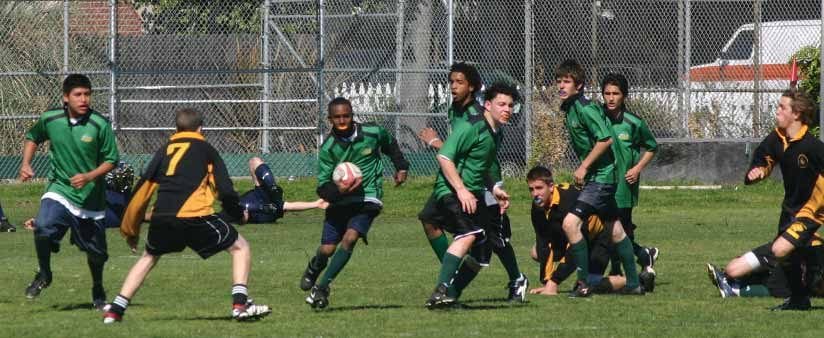
A relative of American football and soccer, rugby is a game where two teams of 15 players each, or sometimes less depending on the region, attempt to score as many points as possible by passing, carrying or kicking a ball through their opponent’s goal line.
Many believe the sport originated in 1823, when William Webb Ellis, a student at the Rugby School in England, ran with a ball in his arms, breaking the rules of soccer.
Though similar in appearance to football and soccer, the unique rules dictating rugby make it a sport in its own right. For example, in rugby, a player is allowed to use their hands to run with the ball, something that is outlawed in soccer where the ball can only come in contact with the foot, leg or head. In rugby, the forward pass is illegal, unlike in football, where the practice is commonly used by quarterbacks.
The game is played on a 100 meter-long field called a “pitch,” with a football-shaped leather ball. The game depends on tackling and scrums — a huddle, or web-like formation, made up of members from both teams. The scrum is used after infractions, such as when the ball is improperly passed forward. A ball is rolled in the center of the scrum, allowing both teams to try and gain possession.
Rugby stands out from other sports, SMRC players con-tend, because of its focus on team play.
“You have to rely on the rest of your teammates,” said 16-year-old Daniel Stinson, a junior at Amino Venice Charter High School.
The team concept is more apparent in the game of rugby where players that possess different skills have to depend on each other to play a successful game, said Dominic Riebli, head coach of SMRC.
SMRC players say they also enjoy rugby because the amount of athleticism required. The sport demands from its players endurance, stamina and ambidexterity, Riebli said. The game also requires a lot of courage, since unlike in football, players wear very little protective padding.
“Most parents are scared off by the lack of protective equipment of the game of rugby,” Riebli said. “Studies show that the possibility of major injury is less because there is no blocking.”
“Rugby tends to be more bruises and cuts, whereas in football, the possibility of an injury, like a torn ACL, is much higher.”
Stinson, a SMRC member, has not suffered an injury from the sport in the two years he’s played. He said he’s not afraid of getting hurt either.
In a sport that is more popular in England, New Zealand and Australia, Stinson hopes to be one of the first famous black rugby players in the United States.
Stinson originally wanted to play high school football, but Amino Venice doesn’t have a high school football team, only a rugby team.
Since he never played organized football, Stinson needed to undergo a lot of conditioning in order to keep up with other rugby players who had years of experience. Though he can’t say whether rugby is better than football, Stinson knows rugby is certainly exciting enough to continue.
It’s also exciting enough to try and convert some of his football friends to rugby.
“I just let them know it’s tight and they should play,” Stinson said.
Riebli believes rugby is about 10 to 20 years behind where soccer currently is in terms of popularity. The sport will eventually catch on more at the collegiate level since rugby is considerably less expensive than football, where protective gear and helmets can rack up a high price tag.
The Santa Monica Rugby Club has recruited players from all over Southern California.
The upcoming season will show Nadav Djiji, a freshman at Calabasas High School, whether rugby in the United States can hold a candle to rugby in his native New Zealand, where he played for four years.
“I’ve been told it’s not as hard here because most kids haven’t played for very long,” said Djiji, who moved to the United States two months ago.
P.J. Canterbury started playing rugby during his sophomore year at St. Francis High School in La Cañada, 30 minutes northeast of Santa Monica. Now a student at Santa Monica College, Canterbury, who has ambitions of playing the sport professionally, joined the team at SMRC because of its national prestige.
The former football offensive lineman was looking to play a sport in the football off-season. After playing some rugby, where the season starts in January, Canterbury was hooked.
“Everyone gets the ball and it’s more social,” Canterbury said. “It’s also more physical.”
Originally published in the Santa Monica Daily Press print edition on November 16, 2006. Read the original PDF.