

Line to city in jeopardy after FTA yanks $156 million grant
The reality of a light rail train coming to Santa Monica suffered a blow recently when local officials learned federal money for the project is being taken away.
Metropolitan Transportation Authority officials recently were told that the Federal Transit Administration has pulled $156 million earmarked for a rail line that would link Los Angeles to Santa Monica.
MTA officials say they have been planning the Expo Line for the past three years under the assumption that the Federal Transit Administration would give $156 million for the first leg, which would run past the University of Southern California and stop near Culver City.
But now the FTA has taken the money, 40 percent of the Expo Line’s budget, and put it toward other mass transit construction projects around the state.
Darrell Clarke, head of the MTA and a Santa Monica planning commissioner, said the federal government’s move surprised him and the MTA board, especially since the FTA put the Expo Line on its priority list for mass transit projects.
FTA officials told Clarke’s group that the money was released because planning for the project won’t be completed by the end of next year, when it was supposed to begin construction.
“Expo is far enough along that they have accepted it,” Clarke said. “Now we’ve got to compete again.”
Officials will have to push hard to get the project funded under the next transit bill, which is going to require some heavy lobbying to Santa Monica’s elected representatives in Washington D.C.
Congress will consider another nationwide re-authorization of transit construction in 2003, which local officials hope the Expo Line will be included in. The entire project is expected to cost $700 million.
The Expo Line will be competing against a long list of other transit projects from across the country, making it even more important for local officials to continue their lobbying, Clarke said.
“You’ve got to fight step by step and it isn’t easy,” he said.
The city employs a full-time lobbyist in Washington D.C., who will continue to push for the Expo Line, said Santa Monica Mayor Mike Feinstein.
He added that he anticipates continued support from state representatives such as Rep. Henry Waxman (D-West Hollywood) because the need for a light rail in the traffic-ridden Los Angeles area is great.
“This project needs to be built,” Feinstein said. “It’s not that we have to convince people we need this.”
“This project needs to be built. It’s not that we have to convince people we need this.” — —MIKE FEINSTEIN Santa Monica Mayor
Clarke said he’s frustrated because the federal government gives California only 88 cents of every $1 of gasoline tax it contributes, while every other state receives dollar-for-dollar what puts in. Gasoline tax funds transit projects.
“We are not getting our fair share,” he said. “We really need Waxman and other Congressmen in the LA area to bring that money home.”
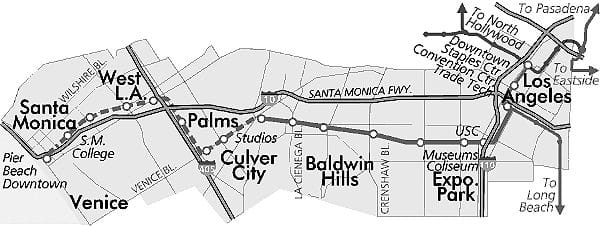
The 9.6-mile line will begin at the existing Metro Rail Station at the 7th Street station in downtown L.A., to Robertson Street in Culver City, traveling parallel to the Santa Monica Freeway.
The second leg, which is expected to cost $344 million, would enter Santa Monica with the freeway and stop at Olympic and 20th Street, Olympic and 14th, and Olympic and Seventh Street. The rail would then turn south to the area around Olympic and Fourth Street, where the city is currently debating the Civic Center Redevelopment Plan.
The Expo Line is key to the planning of the civic center redevelopment plan and a host of other projects within the city, Feinstein said. The light rail train also will effect how Santa Monica College will address its growth in the future. Officials also think the train will help alleviate the growing traffic congestion on the east side of town, where many large companies such as MGM are installing their headquarters, Feinstein said.
“Several local planning issues are in part being held hostage to get this (money),” he said. “There are a lot of urban design issues in the city that need to be addressed.”
Because of the long budgeting process and uncertainty of the federal funding, construction most likely will be delayed. The first leg to Culver City was scheduled to begin in 2004 and take four years to complete. The second leg to Santa Monica is supposed to begin once the first leg is completed.
Originally published in the Santa Monica Daily Press print edition on May 10, 2002. Read the original PDF.