

By JOHN F. MULLER Special to the Daily Press
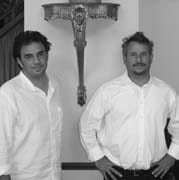
Surfing always came first for Raphael Lunetta and Josiah Citrin.
Starting in elementary school, the two of them would hit the Santa Monica beaches early each morning and go out again after the final school bell. Only when the young friends’ appetites forced them out of the water would they turn to their other passion: Food.
Then, Lunetta and Citrin would go eat — Thai, Japanese, Indian food. They didn’t exactly stick to the typical restaurant choices of hungry fifth and sixth graders.
Both passions have stuck. After brief stints in professional surfing, Lunetta and Citrin have transformed the Santa Monica dining landscape and established themselves as two of the Los Angeles area’s premier chefs. Now 37 and 36, Lunetta and Citrin were both named to Food and Wine Magazine’s “Top Ten New Chefs” list and to Restaurant Hospitality Magazine’s list of “Rising Stars” in 1997. Although Citrin said he has had little time for surfing as of late, Lunetta has gained the title of “the surfing chef” for his repeated visits to Southern California beaches.
It’s been a giddy adventure for a pair of young boys who met at Santa Monica’s now-defunct Washington Elementary School. Both Lunetta and Citrin graduated from Santa Monica High School before trying professional surfing for a short time.
Lunetta and Citrin have taken an unconventional road to success. They bypassed traditional cooking schools and chose to learn in French kitchens and LA restaurants. Citrin’s path included experiences with Wolfgang Puck.
The childhood friends jointly opened the highly successful JiRaffe off the promenade in 1996. The restaurant features the contemporary American and French cuisine that characterizes most of Lunetta and Citrin’s work. Both chefs have one parent who was born in France, and each chef spent time in France studying the cuisine. Citrin’s father and Lunetta’s mother are actually from the same small town there.
Citrin left JiRaffe to start Melisse in 1999. The new restaurant was an instant success, earning Mobile’s four-star rating after 18 months of operation and retaining that designation every year since. Melisse was voted “Best New Restaurant” in 2000 by Food and Wine Magazine, and has won a number of other awards.
To a casual observer, it looks like the two are at the top of their game. JiRaffe and Melisse are going strong and continue to pack in customers nightly and receive high ratings and awards.
The pair has had its share of difficulties, however. Citrin opened a Café Melisse in Valencia last year, for example, betting that valley residents would reject sit-down chains like Chile’s and Red Lobster for fine dining and fresh ingredients. The expansion has since closed.
Now the two chefs are embarking on a risky new venture, trying to extend their vision of fresh tastes and good nutrition to the other two meals of the day. The pair got back together in April to start Lemon Moon, a new cafeteria-style eatery that boasts hand-crafted cuisine and the fresh-est farmers’ market ingredients for customers on the go. Lunetta and Citrin plan to spread the “healthy fast food” place across Southern California.
The new restaurant serves breakfast and lunch and features homemade doughnuts and scones as well as soups, salads and rotisserie sandwiches. The popular three-salad combo includes options such as roasted beet salad with tangerines, hazelnuts and sherry vinegar; skirt steak salad with Thai basil, grilled scallions and shitake mushrooms; and rock shrimp ceviche with avocado, jicama, mangos and lime juice.
Here, the Daily Press sat down with the two chefs to ask about their experiences in the restaurant business and their plans for the future.
How did Santa Monica surfers turn into restaurant entrepreneurs?
Josiah Citrin: Everybody needs something to do.
Raphael Lunetta: Josiah’s father is French, and my mom is French. Jo really wanted to be a chef; his mom was a caterer, and they had a lot of good food in the family. Having a French parent, he was able to go over there and work legally. Same thing for me. But yeah, just dreams. We joked around in younger days. We used to just have a lot of good food when we were younger. We enjoy food. So, I guess something that you enjoy eating is probably something you’ll get into. We used to get pretty solid appetites from spending a lot of time on the beach or in the water, you know, and then as opposed to just going to eat some junk food we wanted to eat something a little bit better.
Why did you guys choose the restaurant business?
RL: People are gnarly. I think it’s in our nature that we really want to please people. We chose to be in this business because we enjoy eating food and we enjoy going out and being taken care of. We’re critical when we don’t get taken care of, like when the service or something is bad and people aren’t paying attention, because we attempt so hard to [make people happy].
JC: We enjoy making nice experiences for people. (RL: Exactly.) Even when we were younger and we had girls over and whenever people came over to the house or we did stuff with the parents, before we were even into this, we’d try to make it all really nice, set it up really nice, do everything nice. Even if it was just food from takeout.
Why did you choose to open restaurants in this market after you studied in France?
JC: We’re from here. Our families were here. So, it’s home.
RL: Born and raised here... We like surfing, we like the beach, we like the area, and it’s a good market. We’ve got our families here, we’ve got a lot of local support because we grew up here, we’re by the beach, we both have kids. One day, if we make it big we may choose to go somewhere else, but what do you have, 13 million people in LA?
What can be frustrating about the restaurant business?
RL: There’s a lot of personal fulfillment that comes out of pleasing. Why am I in this f---ing business? Sometimes you try so hard to please people, but people don’t understand that you are trying to please them. That’s when I question why the hell am I in this goddamn business. And that’s how I feel sometimes. But that’s not how I always feel. With this new challenge that we have over there [at Lemon Moon], it’s great. And it’s great [at JiRaffe] and it’s great at Melisse. But it’s difficult sometimes when you really are out there trying to please someone and they don’t understand that we didn’t choose to do this because we thought we would make a million dollars. The perception is that you are making a million dollars and that you’re doing it for the money. Yeah, now we want to make some money, and we’ve always wanted to make money, but in the beginning we chose to do it for a very different reason. It wasn’t to go out there and make a million bucks.
JC: The overall perception is that we make tons of money because people don’t understand how much it costs to actually run a restaurant. The profits are like 3 or 4 percent and you actually go, “Wow, I’m going to lose money, like 10 percent.” So, the overall perception is everybody’s making so much money, they don’t pay anybody, they don’t have to pay waiters.
What’s the most challenging part of being an entrepreneur in the restaurant industry?
JC: Keeping up with the trends and keeping stuff always new, always happening.
RL: I’m not going to say anything about the city of Santa Monica, but there are a number of things. Your costs. I mean, costs have gone just crazy. I don’t know how fish is for you right now, [Josiah], but fish gets all over the place. You have to deal with Mother Nature. Or like gas. People think gas just affects what goes on [behind the wheel]. But think about the price of fuel for boats going out.
Think about what that does to the price of fish... Workmen’s comp [cost] has doubled, dairy is through the roof, everything, parking. It’s crazy.
JC: It’s tough to really find a balance of how things work.
RL: And as a customer, like Josiah and myself or anybody else, when you go out to dinner, you don’t want a soft piece of fish, you want something good, especially when you’re going out and paying 28 bucks or 30 bucks for a steak, it better be good. But the challenge is, it’s not always good, and we’re trying to fight as hard as we can to get something good, and it may not even come the way that it should. And really, you don’t have that much say because everybody’s strapped. That’s the way that I’m feeling right now. I’m feeling that everybody is strapped in the restaurant business. The vendors and the purveyors are strapped. Their margins are cut so short. Everybody’s trying to find a way to have a profit in a tough situation. It’s a tough time to be in the restaurant business unless you’re Cheesecake Factory or P.F. Chang’s, you know, a real big chain restaurant where you buy things by such giant quantities and you’re getting such ridiculous [rates], that you’re doing well. It’s hard.
Have you run into difficulties doing business with the City of Santa Monica specifically?
RL: Everybody says the city of Santa Monica’s so tough. I don’t know if they’re that much tougher than anybody else. But hey, it’s tough. I’m not going to say anything against the City of Santa Monica because what good is that going to do me?
JC: It’s very expensive to do business here in Santa Monica, and there are a lot of regulations that inhibit you from actually doing business also. But they want the business here. It’s a Catch-22. They want the business, on their terms.
RL: Talk about longevity in the City of Santa Monica and how many restaurants stay in business over five years. Not that many. But they want them to come, and people still come.
JC: It’s a Catch-22 because Santa Monica wants to have it, but on their terms only. Their terms don’t always work for good business.
With JiRaffe so successful, why did Josiah decide to leave JiRaffe and start Melisse on his own after the two of you worked together for so long?
RL: It was a small kitchen back there. JC: It was a small kitchen, yes, but also it was just time, you know? Time to do something different, just an evolution of things…. Best friends forever, yeah, but we were at different stages, spending every single day together. We just needed something different, to keep changing. But, as always, history repeats itself, so we’re doing something together again.
Why did Josiah decide to start a Cafe Melisse in Valencia? What happened?
JC: Because I was crazy. I thought that it might be a good idea, a good new opportunity. It sounded like a good opportunity. They enticed me, actually, the people out there in the area.
RL: There was nothing like that up there, so you either make a bunch, or you get nothing.
JC: They enticed me. They were ready to give a lot. They wanted a restaurant up there, Newhall Land did. Now it’s closed down. You cut the finger before you lose the arm. When we went out there, we signed a lease four days before 9/11. There was nothing. It was all a dark end. There was no Black Angus, no Olive Garden. They weren’t there yet. There was nothing. No one ever told me “Hey, there’s going to be three of these open over here and this,” so I thought, “Hey, it’s good.” A couple things went wrong. They used to have a movie theater here, a movie theater here, and we were right here [in between them]. So people used to walk back and forth. But then they got rid of this movie theater [on one side]. So the traffic stopped. It was a mistake.
How do you expect to compete with the type of chains that you encountered in Valencia like Chile’s and Red Lobster? What’s your business vision for the future?
RL: Compete? I don’t think ‘compete’ is really the right term. Whether people are educated and whether they have the desire to go do something more, that’s one thing. What the local trends are has a lot of influence. I mean right now, everything is protein. In ‘n’ Out Burger sells burgers with [lettuce instead of] buns now. We’ve had to work with the trends.
JC: It’s different. We’re not doing this to compete. We’d like to share. People that go eat at McDonald’s aren’t going to come eat [at our restaurants]. People that eat at Houston’s might come here and we go there.
RL: Somebody’s going to want to cater to the masses. It’s a business. I mean, not all of them, but at least get a piece of all of them.
JC: Yeah. I don’t have that at Melisse, but you could do it. Lemon Moon caters to anybody, any time.
Why did you decide to get back together and start Lemon Moon?
RL: I think we got lonely (laughs). But you know what, it was a good idea. We both thought it was a way we could make some money.
JC: If we make a good concept that everyone can enjoy, that masses can enjoy. We try to give people good experiences. For JiRaffe and Melisse it is that upper echelon of people that can have it. We wanted to create something that everyone could really get to enjoy what we want to give and our vision.
RL: It’s a concept that we can duplicate many times over, and after spending so much time you think that you gain some knowledge after doing this for so long.
How does Lemon Moon differ from other restaurants that you can duplicate?
RL: Well, just the concept. It’s basically healthy fast food. Where people can get in and out. Jo states it pretty well, however you explain it.
JC: It’s approachable, it’s easy, it’s fast, it’s successful, you can get in and out, you don’t need a reservation, it’s healthy. You can go every day and have total different sandwich or this or that.
Have you had any problems with Lemon Moon?
RL: No real problems, just areas to build on…. Getting people in during the off hours. You have to understand that people have been trained for how many years to order fast food in what type of establishments? Do you think they’re comfortable or familiar with ordering fast food with these kind of ingredients? So it takes time.
JC: It’s also not as cheap as McDonald’s, unfortunately.
Do you have any future plans for expansion?
JC: I’m not trying to expand Melisse. No way.
RL: Our hope is to open more Lemon Moons all through Southern California, first off.
Has expansion and the opening of Lemon Moon been tough?
RL: No, but…. You need to understand the restaurant business a little bit. Any time you do anything new, especially at the beginning of a restaurant, it’s just hard. No matter how many times you’ve done it or whatever, opening a new restaurant is hard. So, yeah, it’s very difficult. But it’s difficult right now because it’s the beginning. So, I want to stress that it’s hard in the beginning. But yeah, it’s stressful…. Damn right, it’s a brand new restaurant, it’s a brand new concept, it’s never been done. So is it hard, is it stressful? Yes. Will three and four be stressful? Probably not as much. It’s just new.
JC: Would it be fun if it wasn’t hard? Wouldn’t be any fun if it wasn’t hard, now would it?
RL: Actually, I wouldn’t mind if it wasn’t hard. I’d take it.
Did American anti-French sentiments surrounding the war in Iraq have any effect on business?
JC: It had an impact on Melisse. RL: Yeah, it had an impact. I hear things. People don’t want to order French water, French wine. There’s a lot of arrogance and a lot of naive people out there, you know. Not that the French aren’t arrogant, don’t get me wrong. But let me tell you something. You think the Americans aren’t naive?
What do you think led to your successes, especially at Melisse and JiRaffe?
RL: A lot of hard work, time and commitment.
JC: And giving a good product, having a good name. In the end it’s delivering a good experience for when you leave. People are happy, right?
RL: Probably some luck. JC: Nah, luck. We weren’t lucky. It was all hard work (chuckles). The luck part didn’t come yet.
RL: I know. I’m waiting for that to happen, actually.
Lemon Moon is open Monday to Friday for breakfast from 8 to 10:15 a.m. and lunch from 10:30 a.m. 3:30 p.m. It is located at 12200 W. Olympic Blvd. on the ground level of the Westside Media Center with street and one-hour validated lot parking available on Olympic Boulevard.
Originally published in the Santa Monica Daily Press print edition on June 28, 2004. Read the original PDF.