

Long-term effects feared for sea lion population
Environmentalists fear long-term damage may have been done to area’s sea lion population Fewer sea animals are washing up on the shores of Santa Monica and other beachside cities in the past two weeks.
A poisonous algae that has caused a large number of animals to be dazed and confused since spring seems to be subsiding.
“Things are tapering off,” said Joe Cordaro, wildlife biologist for the National Marine Fisheries Service and coordi-nator of the Marine Mammal Stranding Network. “I think it’s following the general pattern that the first two months are the most intense, and then we see a tapering off.”
Marine biologists and environmentalists say they have witnessed the same trend locally.
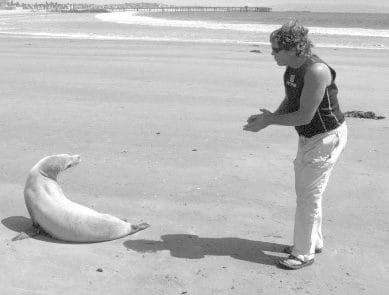
“It has just been a major drop-off,” said Peter Wallerstein, head of the Whale Rescue Team, a Santa Monica-based non-profit that patrols the beaches of Los Angeles County attending to sick sea animals.
“The bloom dies out and then the fish are able to safely flush the toxins through their bodies so when mammals eat them they no longer are affected by the poison,” he said.
Usually the algae, which is known as bridal plankton, blooms during a two-month period each summer. However, for some unknown reason it has bloomed early this year, catching many animals — especially sea lions, dolphins and pelicans — off guard.
At least 70 dolphins died and 250 sea lions became ill after they ate anchovies, other small fish and shellfish that fed on the plankton, according to the National Marine Fisheries Service and the Marine Mammal Stranding Network.
The toxin affects the animals’ nervous systems and can cause disorientation, violent seizures, comas and death.
The substance doesn’t appear to affect people because they do not swim far enough to come into contact with it. But scientists warned that humans can become ill after eating fish poisoned by the algae.
Compounding the problem, female sea lions usually give birth in April and May. In their weakened state, many pregnant sea lions are giving birth prematurely.
“Sea Lions will nurse for a year, but many of those mothers died before finishing weaning their young,” Wallerstein said.
If those pups are too weak to fight off predators and hunt for food, an entire generation of sea lions could be lost.
“We’re very, very concerned with the numbers we’ve seen on our beaches alone,” Wallerstein said. “This should be a major red flag to what we can expect on the effects it will have on the entire West Coast’s environment.”
“This should be a major red flag to what we can expect on the effects it will have on the entire West Coast’s enviroment.” — —PETER WALLERSTEIN The Whale Rescue Team
Wallerstein believes that in urban areas like Santa Monica the bulk of the Sea Lions could be saved but in more secluded areas, like the Channel Islands, many died on the beaches.
He also believes many more sea lions had seizures in the water while they were swimming and likely drowned before reaching the shore.
“The numbers the federal government are giving out is much lower than the actual numbers,” Wallerstein said.
Biologists also fear demoic acid may have caused lesions on the animals’brains, which could have a long-term effect on how the animal population recovers.
“They could still have future seizures,” he said. “It could be continued with the ones that supposedly recovered, and if this happens again at the same time next year the entire population of the sea lions could be devastated.” (The Associated Press contributed to this story.)
Originally published in the Santa Monica Daily Press print edition on June 12, 2002. Read the original PDF.