

By PAM WIGHT Special to the Daily Press
DOWNTOWN — We see them every year around the holidays — the red-vested Salvation Army volunteers, ringing bells as they stand outside grocery stores in the cold.
But there is more to the Salvation Army than just the “kettle people.”
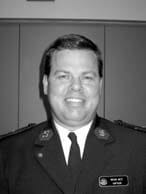
Captain Brian West is a Salvation Army pastor who ministers to a parish of 130 people every Sunday at the Fourth Street Santa Monica Corps of the Salvation Army.
Raised mostly as a southern Baptist, West spent the first years of his life in the hills of West Virginia before the family migrated to Rock Springs, Wyo., in search of work.
West’s parents, however, were not loyalists to the Baptist church, and they dabbled in other denominations throughout different periods of his childhood. Eventually they stopped attending church altogether.
The ingenuous 40-year-old revealed a touch of country boyishness when recalling the first time his mother saw him preach.
“When my mom first saw me as a pastor, I had been in the Army for years,” he said. “She never understood what it was all about. But then she saw this whole congregation, and I’m the pastor. She was amazed. She said, ‘I can’t believe you’re a pastor.’”
But West wasn’t always so clear on what to do with his life.
The son of an electrician and a housewife, he began working at age 14. When he was 18 years old, West’s family moved back to West Virginia where he spent several more years in a series of low-wage jobs.
“The economy was so bad in West Virginia that if you weren’t a coal miner there weren’t a lot of jobs,” West said. “So I worked in diesel mechanics, fast food and, ironically, I worked in a brewery.”
He became involved with the Salvation Army after meeting his wife, Iva, at a skating rink. She asked him if he wanted to go to church with her at the Salvation Army.
“I said, ‘Isn’t that a thrift store?’” West said, laughing. “See, Iva was born into the Salvation Army. That’s all she knew. But what I saw was a church that was motivated by love and expressions of love. I just love the Army. Even though I wasn’t a Salvationist or a soldier at the time, I was fully accepted for just who I was.”
It was while attending a Salvation Army men’s camp that West began to feel he was not living a life that he considered to be meaningful.
“At that moment I really realized that I was living a life of a hypocrite, saying I was a Christian but not identifying with what a Christian was all about in my mind,” he said. “It’s about surrendering every day to the will of the Lord. When I did come to that place of surrendering everything, there was this calling on me that said I could do nothing less than to serve and love other people. I never had found any other vehicle except the Salvation Army that really does that.”
In 1986 West earned the rank of “soldier” and soon he was teaching Sunday school, helping with the summer camp programs and running a domestic-violence program in Charlestown.
Both West and his wife became commissioned officers — captains — in the Salvation Army in 1996.
The couple now lives in Santa Monica with their three children.
West spoke with the Daily Press recently in his Fourth Street Santa Monica office.
As a captain, what are your responsibilities?
“Well, I oversee 28 hired staff and besides that, I have a lot of leadership roles. It’s a regular church. I watch over people, giving them spiritual guidance and also being their pastor, loving them, encouraging them, visiting them … all of those kinds of things. The Salvation Army is kind of unique in some ways. We go visiting nursing homes because we believe in visiting shut-ins. So at Christmas time you’ll see us out and about visiting convalescent homes. We visit each and every resident and hand them a gift and a package. Also at Easter we do this. That’s because we try to build relationships and reaching people and letting them know there’s someone thinking of them.
“I get calls sometimes to do funerals and memorial services for people who don’t have anyone to do it. Or sometimes people will call me up and say, ‘My brother’s in the hospital, can you check on him?’ And I’ll say, ‘Sure.’ Or I’ll get calls from people traveling across the country who tell me they have no where to stay, and we help find them a place.
“And of course, as I came up the ranks of the Salvation Army, I looked back and said, ‘I can’t even believe I’m here today, that I’m behind this desk.’ I didn’t think it was something I could do. It was only because of the open doors that I walked through of opportunity. I didn’t think that I could run this or do that, but yet the Lord puts me in this place. And I rejoice that I have this opportunity everyday.”
When and why did you come to Santa Monica?
“We came to Santa Monica in July of 2001 because I was appointed here. That means I got a phone call saying I had been assigned to Santa Monica. We had been living in Oceanside for a while. But they needed someone here. You see, I don’t get a choice in where I go. They just order me to go wherever they need me.”
How do you like Santa Monica? “I love Santa Monica. Oceanside was more of a country-style setting. But we’ve taken to Santa Monica, and we really enjoy the feel of the city, and people seem to know each other. Especially when you get involved in a service group. I think Santa Monica keeps that hometown feeling alive, which is wonderful. There are really wonderful people in the community who rally around the Salvation Army and identify with what we do because we’ve done it for so long. The city has accepted us, and we’ve accepted the city and enjoyed our stay here.
“I’ve also been coaching little league here. My son is on the local team.”
What kind of training was required to be a pastor and a captain?
“Most of it was practical experience. I was an assistant pastor for a while, and I ran some Christian programs for the Salvation Army like the summer camps and the domestic-violence program, stuff like that. Then I went to the Salvation Army Crestmont College in Rancho Palos Verdes, where I earned an associate degree in ministry. Both my wife and I are ordained pastors. We oversee this whole operation and the Samoshel Shelter, which provides emergency shelter for 110 homeless people.”
Is the shelter the primary service the Salvation Army provides?
“No, our history speaks to our service to the community. We’ve run lots of different programs. Wherever there’s a need. That’s what the Army is about — meeting the suffering needs of humanity. We’ve made roots here, and we’re not going anywhere. Ever since we’ve started, we’ve been the church first, having services, Bible studies, character-building programs, scouting — something like the Brownies for girls called ‘girl guards’ and ‘sunbeams.’ We’ve done that for many years.”
How did the Salvation Army start? “Our founder, William Booth, was a Methodist minister in England in 1865. He wanted to minister to the down and out. So people began to follow him, but they weren’t accepted in the churches because their smell or the way some of them behaved. So he began renting out dance halls or local saloons and having revivals in them. Now the Salvation Army has its own places of worship.”
What did the Salvation Army give to you that was missing from the Baptist church?
“It was totally different. I don’t think that when we saw people down and out that the Baptists went and rolled up their sleeves and went and did the kind of stuff that the Army did, like with the down-and-out people. I think they only helped the people of like-mindedness maybe. The Salvation Army was different because they believe that if someone needs help, you rush to their help.”
Was there a mentor or an individual who inspired you?
“I just go back to the idea that when I saw a corps officer spend the time to visit and pray with me, to ask how I was and what I was about, that kind of gave me the idea that I wanted to become something like that. Then when I saw the mission of the Army and I saw this role model of becoming better than yourself, and on top of that you have a great place to serve. But without the devotion to the Lord first, all of this probably wouldn’t last very long. I think I’d get tired and I’d kind of roll up and quit it. But if you’re really connected to who you are in the Lord you can do nothing less than this.”
Do you have any success stories of people you’ve helped?
“There’s so many. I’ll talk about one here locally. A gentleman who’s attending our church here in Santa Monica … he came from the courts, his last try at redemption in society. He came as part of a court order to the ARC — Adult Rehabilitation Center on 11th Street. It’s the thrift-store part of the Army. This, where I am, is the corps — corps meaning church.
“The ARC, they take articles that are donated, take the money and get people off addictions. Drug, alcohol, cocaine — any addiction whatsoever, they liberate them from that. After some time here at the corps, this gentleman accepted the Lord. Now he’s been six or seven years clean and sober. Now he’s presently a Sunday school teacher, and he has his own business. He never thought he’d be a business owner. He’s a contractor. He passed all the contractor laws. If it wasn’t for the Salvation Army, he believes without a doubt there’s no way he would have been redeemed.
“He had multiple addictions. That’s usually the case — one addiction leads to another and so on. It’s a great success story. He’s actively engaged in the community, too. He puts on his uniform and does community walks. He just participated in a walk against hunger. He’s active in leadership and taking more responsibility. We take people who feel that they would be discarded and make them feel appreciated so they can see how life can be really changed.”
How exactly does the Salvation Army help people switch their perspectives?
“I really think it’s deep within them, and when the heart is changed from just taking to giving, it changes everything. It transforms the individual to think outside himself. It transforms the community, and it transforms the individual. It’s a devotion you live. I don’t think you can teach it, I think it has to be experienced, and that’s something the Salvation Army really understands.
“When William Booth said he had a vision, he said he was pulling people out of this miry clay. He turned back and saw that some were unappreciative, but some were turning back around to pull up more people out of the clay. We don’t judge anyone. Our mission is just to try to save as many people as we can.”
Originally published in the Santa Monica Daily Press print edition on November 22, 2004. Read the original PDF.