

the surface after season’s ‘first flush’
By KATHLEEN BISHOP Special to the Daily Press
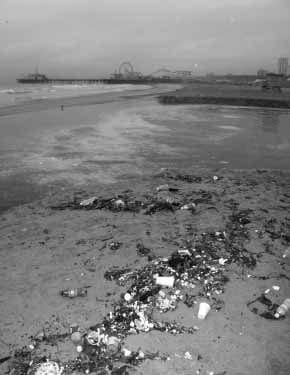
THE BEACH — An overcast sky, free-flowing storm drains and warnings not to swim in the ocean can only mean one thing — the impact of the season’s first rainstorm has hit local beaches.
Friday night’s rain inducted the city and surrounding areas into the region’s official rainy season. As the showers continued into the week, dirt and trash that settled on city surfaces over the summer spilled onto the beach.
“We call it the ‘first flush phenomenon,’” said Craig Perkins, director of Santa Monica’s environmental and public works management department. “That sounds kind of bad, but that’s really what it is.
“The first couple of storms clean out the streets and the alleys and the parking lots that have accumulated residue for the past nine months,” he added. “That’s a lot of extra contamination going into the ocean.”
Perkins said the last time Santa Monica had measurable rainfall was in April — about 181 days ago. Cleaning up debris along the shore might take longer than a week, said Ruben Harow, a crew leader in Santa Monica’s beach maintenance department. A storm later in the season without the drain build-up takes three or four days, he said.
When a storm is predicted, the city’s primary goal is to prevent flooding, so extra staff is on call in case of drain blockage and the screens of curb catch basins are cleaned out, Perkins said.
Even with those precautions and Perkins’ assurance that the city has been doing much better at controlling pollutants that enter drains, he said people should not be swimming near a flowing storm drain within three days of rainfall.
Mark Gold, president of Heal the Bay, a non-profit organization that works to improve conditions in the Santa Monica Bay and Southern California coastal regions, thinks people should be more cautious this time around.
“Because this was the first flush, this would be an extremely polluted slug of storm water that went into the bay,” he said. “We’d normally say don’t swim within three days of a storm, but since we got about a half inch or so and it hadn’t rained for so long, four or five days would make more sense.”
Gold said people should avoid the water all together, not just the areas where stormwater flows into the ocean.
“Generally, when we have a storm like that, most beaches get Cs, Ds or Fs,” he said, referring to Heal the Bay’s weekly reports on the health of the beaches. He said studies have shown the most common outcomes of swimming in a contaminated beach are stomach flu, upper respiratory infections and skin rash.
The system that carries rainwater to the ocean begins with the 2,500 curb catch basins throughout the city. All water and run-off flows through the drains to five discharge points on the beach. Perkins said the Pico-Kenter point — just south of the Santa Monica Pier — is the largest. Half of its run-off comes from other Los Angeles County areas, including Brentwood and the Santa Monica Mountains. Pico-Kenter pumps about 300,000 to 500,000 gallons of water into the city’s Santa Monica Urban Runoff Recycling Facility (SMURRF) every day during the dry season, he said. Any water the plant can’t handle goes through a bypass pipe under the beach and straight into the surf. The city also packs the channels with sand — a process called dredging — during the dry months to prevent excess water from forming stagnant ponds on the beach.
But once the rain comes, the water has to flow naturally. The first storm blows out the dredged sand, and there is too much water during heavy rain for SMUR- RF or the bypass pipe to take.
“In the storm season, which is generally November to March or April, it’s really important that all of the drains have an unobstructed path to the ocean,” Perkins said.
The city has plans to deal with rainwa-ter more efficiently.
“There are some projects underway to divert all city’s remaining dry weather storm flow that doesn’t go to SMURRF into the sewer system,” Perkins said.
He said City Hall has received grants that will fund 80 to 95 percent of the $3 million project. City staff also are installing more catch basin screens and drain filters. But like many environmental projects, Perkins knows progress begins with Santa Monica residents being aware of what they are putting in the ocean with everyday behavior, like washing their cars, watering their lawns and littering.
“Most importantly, we’re continuing to do a whole lot of education and enforcement and outreach about good housekeeping stuff that anyone who lives in town needs to be doing,” he said.
Originally published in the Santa Monica Daily Press print edition on October 19, 2004. Read the original PDF.