

Local Jewish man photographed Adolph Hitler in 1934
SUNSET PARK — Almost 70 years have passed since Alfred Benjamin fled Nazi Germany, but only weeks ago did the longtime Santa Monica resident first allow himself to confront the pain and anguish he carries still.
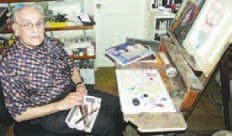
An accomplished medical photographer with a passion for painting and writing, Benjamin, 87, was prompted to reexamine his past by a group of young students seeking him as a mentor. Their questions raised dormant memories.
“Somehow I managed to get the upper hand,” Benjamin said in a recent interview. “I always looked at the room where all these bad things happened, but I never really walked into the room … Imagine all these people that you loved dearly were tortured, burned and Faced with difficult questions from students about the family and friends he left behind, Benjamin said he opened his mind and pored over his memories. Some startled him in the middle of the night, others came back slowly. Benjamin began to paint — portraits of starved and desperate Jews, of beastly Nazi soldiers.
The 32-year resident of Sunset Park is perhaps best known for a 1934 photograph he took of Adolph Hitler, which appeared in the Hamburgerfremdenblatt, Hamburg’s major daily newspaper. Benjamin, who is Jewish, said he was paralyzed with fear when Hitler stepped from his limousine just a few feet away from him.
Benjamin fled Germany in 1936, spent some time working with German youths separated from their parents, married, was sent to an internment camp, was released, worked briefly at a munitions factory, had two daughters and took a job as the chief photographer for the Queen Mary, a top hospital in London.
One day near the war’s end, Benjamin said he was filled with optimism as he headed to a Red Cross office, where officials had said they would help him find the many aunts, uncles and other family members he could not convince to flee with him.
Once there, a bombshell: All of them had been killed by the Nazis.
Benjamin moved to America in 1947. Here he has had a successful career as a photographer, especially in medicine, and has dabbled in writing, painting and teaching. But it wasn’t until April, when he first began meeting with a handful of students through the Holocaust Museum, that Benjamin looked in detail at his troubled past.
Here, the Daily Press asked Benjamin about the life he started when he left Germany, and about the loved ones he left behind.
Tell me about the picture you took of Adolph Hitler. What was that experience like?
“That was when I was an apprentice. I had a leica camera. In those days, only few people had cameras, especially leica cameras. And because of that the studio owner had an order from the paper, like the LA Times, the Hamburgerfremdenblatt. They wanted a picture of Hitler’s visit — first visit in Hamburg, in 1934.
“What happened is when, in the morning, when I got to work he said, ‘Are you ready to take a picture of Hitler?’ I was flabbergasted. First, because I am Jewish, and I was thinking maybe he doesn’t know, and because that is one of the biggest things for you to do — once I grasped at what was going on, I was thinking it was such a wonderful moment of history that I don’t want to miss.
“I went up there with my camera, and there were thousands of people in front of the town hall, the square was filled up with people. They were announcing on the loudspeaker, ‘He’s at the airport, he’s in the car, he’s on the way.
“I pushed my way to the front, and I could see the limousine drive by. He slowly moved forward, there was the limo and it was stopping in front of me, about eight feet away. He was standing there in the open limousine, with all the big shots… In those days they weren’t afraid of being shot.
“He was standing there with the outstretched hand with the heil-Hitler salute. He turned right toward me with a very stern look. I wanted to take the photo — it was an ideal photo, and I was trying to take it.
“I was trying to trip the shutter — the leica camera, like all the other cameras, you have to push the button down — and he looked at me, and I was really paralyzed, because this guy wants to kill us … I couldn’t trip the shutter. He turned on in the limousine and went on to the town hall.
“When I got back to the boss, I said, I couldn’t take his face, the close-by face, and he was mad at me, but he said he was going to send the picture in anyway, and it was a hit. That’s as close as I could get … It was a very far, far away picture.”
You mentioned that when you moved to London you spent some time as a teacher and guardian for children that had moved from Germany without their parents. What was that experience like?
“It was heartbreaking because they missed their parents. Also, at that time in Germany, before they heard about these things, people were turning up in ashes in boxes. It was unbelievable. It took about six years, the whole thing. Hitler became the chancellor in ’36 and then by ’39 it was full program to exterminate the Jewish race.”
Your recent work with high school students has helped you to deal for the first time with difficult memories. How?
“The students, I met them first in February, and they asked — it was not just me telling them about my experiences in Germany. I told them a story about how my uncle was returned in a box and one of the uncles jumped down from the roof (to avoid being taken by Nazis) and they asked, ‘Are you very angry?’
“And then, by asking the penetrating questions, I started wondering, ‘Am I angry?’And I started having dreams, and I started thinking about it.
“I got ideas and then all of a sudden, now, I am alive and very, very happy here and somehow it made it possible to look back and allow myself to have those feelings of terrible agony and anxiety.
“My turn could have been next, and my father could have been next … “I just didn’t allow myself to actually paint these things. When the class asked these questions and then thinking about it, to describe it, that allowed me to actually visualize it again, and then I felt I want to express them, I want to put it down and let all the emotion come out in my brush stroke — and the color, the non-color.
“By them confronting me and by me being forced to visualize, again and again, these events at a much later point in my life … that allowed me to really express my feelings. Not in words, but in colors, and maybe the expressions of these people in the pictures.”
Some of the people in the paintings are your family members. Did you lose a lot of your family in the concentration camps?
“My father’s family was all wiped out. I implored them to leave Germany, because in the first few years you could still go to Palestine, but they said they didn’t want to. They said, ‘It will pass.’
“They had wonderful homes, and somebody would tell, you know, ‘You have to leave because you’re either going to be killed or transported.’ It’s very difficult, and people didn’t believe it would happen.
“They had, in the first World War (been awarded) the Iron Cross. They said, ‘They won’t touch me, I am fighting for Germany.’
“It was done gradually, very methodically.”
Were you able to keep in touch with your family while in London?
“Once I left, before the war of course, in letters. Then they couldn’t move out, because there was no more money and nobody wanted them. And then, during the war, there was no more correspondence.
“After the war I was hoping to meet them again. I went to the Red Cross, and they were then trying to find out what happened to these people, and then I got the answer.
“They gave me a report that tells me exactly what happened to each of these people. The Nazis were very methodic. They kept book keeping of each one they killed and when they killed them … “There is a book that I have which tells you which date my aunt and my uncle, for example, were picked up, and then it will say when they went to the concentration camp and when they died.
“Mother’s side, thank God, as I say — everybody got out.”
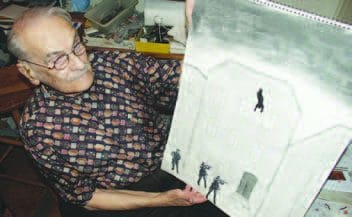
What about your “Act of Defiance” painting, where a Jewish man is jumping from a building while Nazi soldiers stand on the street below with their rifles drawn — where did the inspiration for that come from?
“That’s a great uncle of mine. He was 80 years old. The Nazis in those two years, ’41 or ’42, they instructed the people to be ready the next morning, whenever it was, to have a little box with their belongings — like washing, a toothbrush, whatever — so they could transport them to the concentration camp … “He was also told in the morning to be down there to be picked up, but instead of going down there to be picked up, he walked up to the roof, and he jumped down. The Nazis down on the street were waiting for him to come out the door, and they were pointing their guns to make sure he didn’t flee. They didn’t expect him to jump from the roof, but that’s what he did — and his wife did it too.”
You mentioned that another uncle of yours committed suicide in front of you, before you fled Germany, after being shunned for being Jewish. What advice do you have for others wading through traumatic memories?
“It’s very individual. Some people probably never can. In my case, I had psychotherapy years ago and somehow that made you come a little bit more in touch with your subconscious … to allow yourself to really think about it again — to write about it or talk about it, to really express yourself.
“All writing is a great relief. I’m very convinced about psychotherapy. The only good thing is that I saw Freud once. I didn’t talk to him, but I saw him in front of his house, and I wish I had my camera with me.
I’m a believer in it. Through therapy, I could be a happy man again. But also the thinking you learn in therapy makes it easier when you are trying to get in grips with it … “Some people don’t like to change. They like to be angry. They like to be the way they are. When you have an emotional pain you suffer, you are miserable. You see people smiling, happy, and you are miserable. And you think maybe someone can help me.
“Some people do yoga, some people do drugs … it’s a quick way of doing it, but it can be a very destructive way. But therapy is very positive. You don’t lose anything, maybe money. But it is really a wonderful tool. Because once you have a tool to yourself then nobody can take it away.”
You’ve been married to your wife, Selma, for 64 years. What is the secret to your longevity?
“The secret of good marriage is really to be able to compromise, really. You want a certain way, she wants a certain way — either you have the friction, or you say, ‘Where is the middle?’ It’s compromise and sleep it over, let it cool down if you really get upset at something in the younger years. Later on you don’t need it, because you know it can be done. Maybe I should become a marriage counselor.”
Alfred Benjamin Alfred Benjamin’s father, a lawyer, died when he was seven. One year later his mother remarried a medical doctor who Benjamin said was as good a father as one could desire. It was his stepfather that urged Benjamin to try photography. Born: Aug. 14, 1916, in Hamburg, Germany. Family: Married to Selma for 64 years. Two daughters — Roberta is 59, Wendy is 57. Hobbies: All types of photography, writing, painting. Background: Benjamin fled Germany in 1936, when Hitler was still allowing Jews to leave if they had the resources to do so. Since then, he has lived in London, New York, San Francisco and, for the last 30-plus years, a house in Sunset Park. Career: Since moving to Santa Monica, Benjamin, a photographer for more than seven decades, has worked as the chief medical photographer for the Orthopedic Hospital, done work for Cedars Sinai and partnered with the Rand Corp. He also taught photography for 33 years to adult students at Hollywood High School, and has worked on projects with Santa Monica College and the Holocaust Museum.
Originally published in the Santa Monica Daily Press print edition on June 14, 2004. Read the original PDF.