

By SHRADDHA R. JAISWAL Special to the Daily Press
In a city of Botox needles and skin stretches, one woman has found a way to stay young gracefully and naturally. Even after 72 years, Ebba Rosenblad is still able to do things most 20-year-olds couldn’t fathom.
Born in 1931 and raised in Stockholm, Sweden, Ebba has always rebelled against norms. Challenging her parents to become a dancer and then rekindling her performing spirit after she had pushed it aside for a family life, Ebba remains her own woman.
Her refusal to assume the life of a cookie-cutter girl — and later on, woman — gave her the opportunity to rub elbows with Hollywood’s elite and build a memory bank of priceless encounters and events.
Although most people see growing older as the end of a cycle, Ebba’s dedication to her health, gymnastics and performing for the past 30 years proves that the so-called “golden years” can be the peak of life, not just its conclusion.
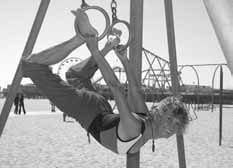
As Ebba would say in her smooth Swedish accent, “Ageing is not about getting older, it’s about getting better.” And anyone who witnesses her in action on the gymnastic rings is hard pressed to say otherwise.
She can stretch in ways that wouldn’t seem possible at any age, much less 72, and her smiling enthusiasm and excitement at recalling her meetings with Ronald Reagan and Marlene Dietrich can be likened to the wide-eyed joy of a child on Christmas morning.
The Daily Press sat down with Ebba at Muscle Beach one sunny afternoon as she prepared for the September Senior Olympics to talk about staying young, life at the CopaCabana and embracing each and every day.
What is the competition like in the Senior Olympics?
“In Senior Olympics, you enter in your age group, but there isn’t anyone in my age group because I go from 70 to 75. The woman closest to me in age is 45, so I’m there alone, but the thing is I’m competing with myself because I want to always get a better score. And I have been increasing my score from around four-point-something to six-point-something. So this year, I want to be perfect.”
How long have you been working out at Muscle Beach?
“Well, it’s been probably close to 30 years off and on. I started working out when my youngest daughter took gymnastics, and then I got into it, and now I’m here, but she’s not. She can still do it, but she was six years old at that time, and she had a wonderful teacher, but I don’t know what happened. She got into something else — dancing, acting.
“That’s how I got started. There was several of us mothers who said we would like to do gymnastics, and the teacher, a wonderful teacher, said OK, but then he disappeared, and then I looked for another teacher and found Bob Carreiro, who is fabulous. He is still my teacher. He teaches gymnastics and circus arts on La Cienega.”
What is your workout routine? “Well, I do stretches that are similar to yoga stretches, and I stand on my head. I do my routine, and I do push-ups. I do 60 push-ups on my toes, but I don’t go all the way down. I do 60, and then later on I do 15. I go all the way down, but I do it on my knees. I used to do only 20, but since I got this amazing little thing (an energy pouch she wears around her neck) I’ve gone from 20 to 40 in one week.
“It’s always the same (routine) everyday because that’s always in the back of my mind that I will do my act or the Olympics or something. I work out about an hour or hour and a half. I don’t do that much.”
How have you adapted to ageing and still doing gymnastics and working out?
“It’s the same. In fact, it gets easier. ‘Better not older’ is my motto. It doesn’t matter. It’s exactly the same. You have to work out, and you have to stretch. It’s no different. There are people who do things that I don’t do, but that doesn’t matter. Everyone in (Bob Carreiro’s class) does their own routine.”
How did you get into dancing? “Well, it’s very interesting because my parents didn’t want me to be a dancer. They were very conservative. I had a friend who was a choreographer, and I worked in Canada doing her show where I actually had a solo doing point work because I had studied ballet. And I was at ballet lessons and someone said, ‘You should go to an audition,’ and I didn’t even know what it was, but I went and I got the job going to Canada for one summer, working in a nightclub. And this woman said, ‘You really should go and audition for the CopaCabana because you’re the type and you’re a good dancer.’ And they weren’t really looking for dancers, they were looking for very good showgirls, and I was a good dancer as well. So that’s how I got into that. And then I moved to New York and I did other work.”
What was it like working at the CopaCabana?
“You know, it was amazing. I was probably in four or five shows. And if you look up CopaCabana and the Copa Girls on the Internet, you get legendary Copa Girls. And we were. We became legendary. We were considered the most beautiful showgirls with a very special style. And usually the girls who worked at the Copa had never worked in a night-club before. I went there in an audition. There were so many girls. I made the first call, and then later I got a call back.”
Did you meet anyone famous while at the Copa?
“All the big stars worked at the Copa. I worked with Frank Sinatra... Dean Martin and Jerry Lewis. And the audience was full of celebrities. And I met Marlene Dietrich. I had a drink with Marlene Dietrich. It was wonderful, you know? But I was kind of new in this country, and I was really shy except when I was on stage — I felt totally like a fish in water. It was amazing, but in the dressing room they used to call me the quiet one. I was pretty fluent in English, but anyway, it was a wonderful experience.”
What did you do after your Copa adventures?
“My next job that was interesting was that I worked in Italy as part of a ballet company that was called American Broadway Ballet, and I actually got that through working at the Copa. I never auditioned. June Taylor’s husband called me up and said, ‘Would you like to go to Italy with the American Broadway Ballet,’ I said, ‘Yes, of course!’
“So, we were 12 girls and one male dancer, and we went to Italy in 1965 in November and landed in Rome, and the interesting thing is, all of us girls have kept in touch. In this coming November we’re having reunion in Arizona because three of the girls live in Arizona. There’s only nine of us left.”
Were you ever married and how did that affect your performing career?
“I was married in 1962, divorced in 1979. I have two daughters, one is who is a photographer and one who is a dancer, actress, everything. When I got married, my husband didn’t want me to work, and I’m very, very happy that I could be home with my daughters when they were really small, but I’m a ham!
“I like to perform. That’s why I like gymnastics and why I kind of went more into gymnastics than into dancing — because I can perform. I mean, doing the senior Olympics, it’s not a big audience, but I’m on, you know what I mean?
“So now, what I’m really looking for personally is somebody that would be a fabulous manager or agent that would book me to do my act and commercials and things like that for a very, very, very generous fee and sponsor some health food company or do something elegant.
“I feel because I’m a trade on my age, I’m 72, almost 73, and I do things that as you said, not even you can do, that makes me valuable to somebody who thinks it’s good to stay young. That’s my passion.
Who influenced you in life? “I had an amazing maternal grandmother. She didn’t have any gray hair (at 96). She read the paper every day without glasses, and she died consciously at 96, because one of my uncles was talking to her and she said, ‘I am tired of listening to you. You bore me. I’m going to turn around, and I’m going to leave my body and die. Good-bye.’
“I learned so much from her. She totally, totally believed in keeping your body in a pure state — detoxified. She was a purist. I’m not, but if I get sick, I know I need to go on a cleansing diet or fast or whatever. I learned that from her. She would fast every single year for 30 days on water. It’s the most fabulous feeling. You can’t do anything better for you body. You’re giving your body a rest.
“She was definitely an inspiration.”
You’ve seen a lot throughout your life, what’s do you remember about living through World War II?
“When the war started in 1939, I was eight. My mother said, ‘I think there’s going to be a war,’ and I was thinking, ‘What’s a war?’ I didn’t even know what a war was.
“Once in a while when they had trainings where we had to dash down into the cellar and sit quietly. But, you know, who knows about guns and war when you’re 8 or 9 years old? I heard, and I don’t know if this is true, but Hitler said, ‘Well, let’s keep Sweden. Let’s leave Sweden alone so that we have some place to go to if something goes wrong.’
“I remember all the food was rationed, but my mother believed in fasting. It did-n’t bother her at all. We always had plenty. She’d even give some away. We had plenty of food, you know? We were never starving, ever.
“I do remember one thing that was interesting. Things like meat and eggs and coffee were rationed. Well, nobody in my house drank coffee, so she gave it away. Well, I think my father drank some, but we got the coupons for the children too. And the meat coupons I think she probably used them. But with the eggs, I remember with the eggs it was interesting because my mother had a relative who had some sort of egg farm. They were not chickens, they were geese eggs, and they were not rationed. So, my mother could buy all the goose eggs that she wanted. Geese eggs or whatever. And there was nothing wrong with them at all.
“But we didn’t suffer in any way. I mean in any way.
“There was one other thing that I noticed during the war and that is, we couldn’t drive. We were not allowed to buy any gasoline except for one car. So my mother got an extra engine that ran on coal. It was huge engine. She filled it up with coal, and you had to do strange things to make it start. And that way we didn’t use any gasoline for the car. It was really weird, but it worked. It worked.”
How has the city changed since the 1960s? “The biggest change, I think personally, has probably been the Third Street Promenade. I used to take my daughter to dancing lessons on Wilshire Boulevard just off Third Street, and there was nothing. I’m talking 25 years ago, nothing. There was Newberry’s Five & Dime store. It was nice. It was really nice, but I would hang around there and go some place and have a beer because she would be in class for two to three hours. That has changed enormously, plus the traffic and all these beautiful hotels. I mean, it’s starting to look like the French Riviera.”
Are the changes for better or for worse?
“Oh, it’s always getting better. It’s just better.”
What’s your philosophy on life? “Well, I’m always working on it, always, every day. It’s getting better, not older, and have as much fun as possible, and try and live life to the fullest every moment.”
What advice would you give to both young and old?
“Enjoy your life to the fullest and acknowledge how wonderful and fabulous you really are and have fun. Follow you own guidance. Follow your heart and do what you like, you know. Appreciate life and stay healthy. That’s about it.”
Originally published in the Santa Monica Daily Press print edition on August 16, 2004. Read the original PDF.