

By CORTNEY FIELDING Special to the Daily Press
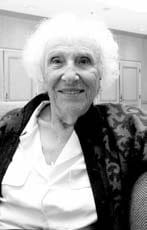
Longtime Santa Monica resident Jette Simmons believes the key to feeling young is staying useful. The 93-year-old just may be on to something. Simmons has been a volunteer at the Santa Monica-UCLA Medical Center for the past 40 years. In that time, she has seen doctors come and go, witnessed the birth of thousands of babies and made lifelong friendships that she views as vital to a healthy life.
Simmons was recently honored for her more than 69,000 hours of service to the hospital — almost twice as many hours as any other volunteer in SM/UCLA history.
Still, Simmons doesn’t think she’s done anything remarkable. While others see her as a woman entitled to sit back and let others take care of her, Simmons vehemently disagrees.
“I’m not entitled, no more than anyone walking in off the street,” she said.
Simmons arrived in Santa Monica from London with her husband, Max, and son, Peter, shortly after World War II. Her father’s entire family had just been taken by Hitler and the Nazi gas chambers. Following the war, she left Europe, never to return for more than a visit.
Life in Santa Monica in the early days was hard. “Ever try working for 60 cents?” she asked. But eventually, the family thrived. She worked for many years at the Old General Telephone Company, while Max was an executive at Bank of America and other financial institutions.
However, after years at the phone company, Simmons realized she “hated that job.”
“So Max told me to stop complaining and do something about it,” she recalled.
Simmons took his advice, and 40 years ago, a new career at the hospital began.
Her first task at the hospital was delivering flowers to patients, but Simmons quickly grew tired of the slow-paced activity. Through the years, she has served in many capacities, from working at the gift shop to checking in patients for surgery and wheeling patients out of the building when it’s time to go home.
“Always remember, brakes on before you release them,” she says.
These days, Simmons works at the Birth Place, UCLA’s maternity floor. When she is not taking care of patients, she is knitting thousands of tiny booties and hats for UCLA’s newborn baby program. Each baby born at the hospital receives a hat (“The pom-pom tops it off nicely”) and booties knitted by the volunteers. Simmons also stays busy assembling hundreds of informational packets for expected parents.
While age has required her to cut down on her time at the hospital, each Monday morning Simmons walks from her home on 17th Street to the hospital and back home again six hours later.
“I come home tired, but I am satisfied, knowing I made a difference,” she said.
Simmons has no family left in the city. Her husband died 20 years ago, and her son and his wife live in Canada. A brother and sister-in-law, with whom she moved to Santa Monica years ago and remained close, are also gone.
That is what makes her time at the hospital even more important.
“I’ve made such good friends. We go on vacation together. We go to lunch,” she said. “Whoever you talk to will tell you the same thing.”
Simmons says she treasures each and every day she is able to impact someone else’s life. “I love it. I hate for the day to happen when I have to give it up.”
You witnessed the first World War in London. As a child, did you understand what was going on?
I remember part of World War I. I was 4. I was in kindergarten, but I remember the teachers saying, “Under the desk, under the desk.” The zeppelin had flown over and that was just terrifying. That is something I’ll never forgot.
What was your World War II experience?
We are Jewish. When Hitler first invaded the low countries, so much of the families we tried to reach we just could-n’t. We tried reaching my father’s family. We sent money through the express exchange. My father, I think, must have bankrupted himself just to try and make contact to bring them over.
I wish that I paid more attention to my father’s parents when war broke out. They were put in the gas ovens with my uncles and my cousins and my cousin’s children — four generations. All the younger ones were shoved in the gas oven.
Have you ever gotten over such a tragedy?
It affected me greatly. Even when they show some of those war pictures, I remember my grandparents very well... too well to just slop it off, I should say.
What was it like as a young immigrant from Europe right after the war?
Hard work. Ever try working for 60 cents an hour? I couldn’t find a job. I used to be a fur operator in London and my husband had been on the London Stock Exchange. He couldn’t get work on the stock exchange here.
I couldn’t get a job. My sister-in-law got a job right away because she was an excellent typist. We rented a house for two couples. I found a job through the newspaper — “knitters wanted.”
At the end of the time you make something, they would take you to a store and weigh it, and that’s how you get your 60 cents an hour. After that, I said, “The heck with that. I’d sooner stay at home.” But I couldn’t stay at home. The men were not earning that much.
Has Santa Monica changed since you first arrived?
Unfortunately, yes. As a matter of fact, it hit me more so because of the band that played today (The Samohi jazz band played at the Santa Monica-UCLA volunteers lunch.). We’ve seen transients that I never saw before. We came here in 1947. I am sorry to say that there has been a horrible change. Samohi had one of the finest systems and one of the finest names of school systems. It’s just awful. But I loved living here. I have loved every minute of it.
How did you get into volunteering? I worked at the old General Telephone. I told my husband, “this job is driving me crazy,” and he told me to do something about it. He said if you want a job, pick up a newspaper and read it. He said, “In the beginning, you had to work, but now you don’t.”
So I took up golf, and after three lessons the instructor said “you will never be a golfer.” So I began volunteering.
What is a typical day for you at the hospital?
I used to work two days a week at the gift shop. Now, I work Monday, but occasionally I come in because I am bored. It gets to you. I check in at 8. I go up to the volunteers’ office and check on the work that needs to be done in the way of knitting I look forward to working on Monday. I long for the weekend to be over. It sounds strange to you, perhaps, in your young years when you can get up and go do what you want, but when you are incapacitated and you don’t drive, you’ll notice the difference.
Can you describe how volunteering makes you feel?
It gives you a great feeling of satisfaction. You’ve done something. I go home tired. I go home after five or six hours. I walk home and I’m pretty tired, but I have the feeling that it was good for me, that there is a place for me. No one needs to be alone. We all like to feel welcome.
It’s not the hospital, it’s the patients. That’s who I respond to. The hospital is just a building.
Do you find yourself getting emotionally attached to the patients?
I loved each and every one, and felt sorrow for each and every one of them that were in the hospital. It’s no fun, no pleasure at all. My idea is to be with them in case they should say, “Can you help me?” They are talking to me as a person, not as a volunteer, but as a person in the hospital, and I want to give them everything that I can. I want to hold their hand if they want their hand held. Sometimes, it’s just a touch of a person. You don’t have to do a lot for them.
That’s my aim — to help. That’s all I can do.
Was it hard to decide to stay at the hospital after the death of your husband 20 years ago? That was the best thing for me. The hospital had been wonderful to me in my time of need, when my husband died unexpectedly. I was working at the gift shop and went home and found him gone. I can’t possibly describe the amount of support they gave me — each and every one in their own different way.
Looking back at such a long life, what do you wish you had done differently?
When I was a youngster, I didn’t read so much. I wasn’t bothered with learning, I always wanted to be out with my friends. So be that as it may, I feel like I missed out on a lot of things. I missed out of a lot of learning.
I should have been a little more observant, for which I regret, because you learn from that.
What does it mean to be more observant?
Look outside of here. And you say, “I am outside.” You start to look at the flowers and the trees. Walk, look at the buildings and look at what flowers are planted — the difference in color... the difference in color in the trees alone. There is beauty all around, and who bothers to look? Maybe there is too much.
You see pictures and films of poor people who don’t have what we have — the trees growing outside. I could tell you such a lot and it wouldn’t amount to anything. It’s just my observations. You have to experience these things. Don’t forget it. Experience it while you are young and it remains with you.
What makes a person ‘old’? I think of these people as old people, not because their age, but because of their way of thinking. And they could oh-so-easily donate a few hours a week. They would benefit from it. They would enjoy it. They would get to like it and look forward to going back again.
How do you feel about people your age, and younger, who choose not to get involved with the community?
They are missing out on life. They are missing out on making friends.
People (at her assisted-living facility) ask me, “Why do you volunteer? Why don’t you let someone else do it?”
And I say, “Keeps me off the streets and out of the bars,” just to keep it light. But I think, you do it and you will soon know it is for you. You think you aren’t capable, but we can always find a job for you.
What advice do you have for young people?
When you get older you realize you should have kept tabs on your family. Once I went on a trip to Amsterdam, after my husband passed away, and I remembered staying with my grandparents — that’s my mother’s family — and I stood on the bridge and just wept. I think I added to the water that was under the bridge. I pinpointed the exact house where they had lived. Part of my childhood came back. It’s a wonderful thing once these things are implanted in your mind.
Originally published in the Santa Monica Daily Press print edition on April 25, 2005. Read the original PDF.