

Officials hear ‘chirping’ signals can be confusing
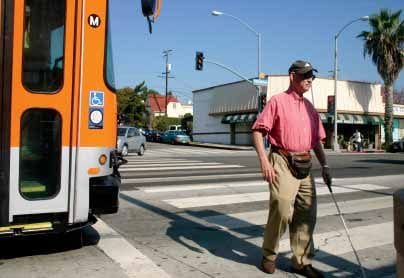
MID-CITY — For residents who are blind or have lost their hearing, just walking the city’s streets can be a scary proposition,let alone crossing a bustling thoroughfare like Wilshire Boulevard.
On Wednesday, city officials attempted to lead the way.
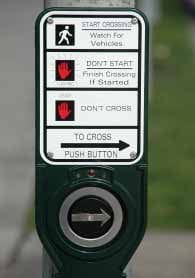
Standing at the corner of one of Santa Monica’s busiest intersections, officials joined with the disabled for the installation of a new technology that tells those who are blind or hearing impaired when it’s safe to cross the street. The technology, developed by Polara Engineering Inc., features a male voice that speaks to pedestrians, telling them which street they are on, what direction they are traveling and how many seconds they have left until the traffic light changes.
The “Accessible Pedestrian Signal,” or push-button, includes a raised directional arrow and Braille lettering so the blind can find out what street they are crossing and if they are headed in the right direction. The push-button also vibrates when it is safe to enter an intersection.
If someone pushes the button when the light is still red, the voice warns them to not cross. City officials can also program the push-buttons so that the male voice can alert pedestrians to the presence of an emergency vehicle, such as an ambulance or fire truck. Three different languages can be programmed into the system, something which could come in handy in Santa Monica, a prime tourist destination.
Pedestrians may have become accustomed to traffic signals that say,“walk, walk,” while others emit a loud “chirping” sound, but city officials contend those crosswalks do not provide enough information.
“The chirping sound can be confusing for some people because of an echo,” said Ken Ward, a traffic signal technician for City Hall. “This tells people what to do, where to cross and when to cross.”
The push-buttons alone cost around $4,000 to install at all four corners of an intersection. Currently, there are four such systems in Santa Monica, three of which are located on Ocean Avenue between Colorado Avenue and Santa Monica Boulevard. The fourth, put into place on Wednesday, is located at Wilshire Boulevard and 23rd Street, a bustling corner that features Whole Foods grocery store, O’Brien’s Irish Pub and Earth Wind & Flour, a popular restaurant.
Sam Genensky, a legally blind member of the city’s Disabilities Commission who helped pioneer the first closed-circuit television, was instrumental in getting the push-buttons installed, city officials said.
Genensky, who also lobbied for architectural modifications for people with impaired sight, particularly the shape modification for public restrooms (triangle for men, oval for women), lives just north of Wilshire Boulevard and often shops at Whole Foods. He was present at Wednesday’s installation of the new push-buttons, which he feels should be installed at every intersection in the city.
“This is going to help me out a lot,” he said.“These signals give us a lot of additional information so we can focus on other things going on around us. I think it’s great.”
Genensky isn’t the only one who likes the new push-buttons. Elizabeth Bogen, who is partially deaf, said she “has been waiting for this for a long time.”
“Now I don’t have to worry as much about crossing the street,” Bogen said. “I can take my time and don’t have to run. Before, the lights would turn really fast.”
Mike Morgan, the lead traffic signal technician for City Hall, said there are talks of replacing all traffic signals with the technology, however, at this time there are no plans for a complete roll-out.
The technology was installed at the Wilshire Boulevard location because of Genensky’s request, Morgan said, and he expects more as the technology catches on.
Pat Jordan, the public information officer for the Center for the Partially Sighted, said that as the population ages, such signals will become a necessity. She said Santa Monica is “ahead of the curve” in installing the new signals.
Originally published in the Santa Monica Daily Press print edition on October 5, 2006. Read the original PDF.