

Subterranean lines appeal to residents
PICO NEIGHBORHOOD Steven Keats just can’t seem to get away from the wires.
Each morning, he looks out his back window and sees a transformer with a series of clunky, high-voltage wires strung from one side of his backyard to the other.
“They really have become a part of our viewscape and you get used to them in a way,” Keats said of the wiring. “But you really wish they weren’t there. Hopefully, they’ll be gone soon.”
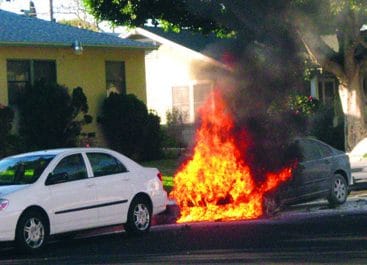
Not soon enough for one motorist. On Monday, around 7 a.m., Keats heard a loud roar outside his 19th Street home. A car had burst into flames after a 16,000-volt electrical wire fell on top of it.
The wire “plunged to the ground moments before the flames erupted, shooting sparks in all directions and writhing like a snake until it welded itself to the body of the car,” Keats said. “The nearly new Volvo was totally engulfed in flames within moments and destroyed. Neighbors agreed that had the vehicle been occupied the results would have been fatal.”
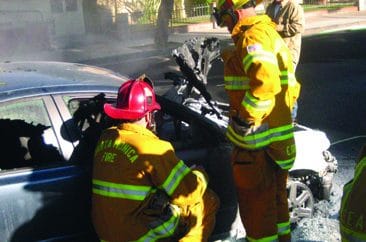
Firefighters were sent to extinguish the blaze, but only after making sure power to the line was turned off. No one was injured, according to the SMFD.
The cause of the conduit’s collapse was unknown as of Tuesday afternoon. Representatives with Southern California Edison could not be reached for comment.
While this week’s accident was by all accounts a rare incident, nonetheless, the dangers posed by overhead electrical conduits is one reason whyh City Hall has embarked on a 10-year-plan to move all of Santa Monica’s power lines underground.
However, it won’t happen overnight and it won’t come cheap.
The process of “undergrounding” is very expensive and funds are limited, according to Craig Perkins, City Hall’s director of environmental and public works.
“About four years ago, we were estimating that for every foot of undergrounding,it would cost about $200,” Perkins said.“To go 100 feet, you’re talking $20,000. That’s a lot of money.
“When you consider that the city only receives roughly $800,000 a year, that doesn’t take you very far.”
Currently, City Hall receives funding from the California Public Utilities Commission in the form of “Rule 20A” funds, which are paid by all ratepayers in the state. Funds are distributed based on previous allocations, the ratio of customers served by overhead facilities to all the customers in the community, and other factors.
To qualify, there has to be an unusually heavy concentration of overhead facilities, the location must be heavily traveled, and the overhead equipment must be located within or pass through a school, government building, or a recreational or scenic area.
Funds are hard to come by, Perkins said, but there are options to help accelerate undergrounding. Residents could chose to tax themselves in the form of neighborhood assessments, or City Hall could issue bonds, as it does with other community improvement projects.
So far, City Hall has been able to fully underground Main Street and is close to completing a portion of Marine Street. Work will continue from Marine Park up Ashland Court to 18th Street and then over to Pico Boulevard, behind Santa Monica College. That section is expected to take at least three years to complete, Perkins said.
From there, city staff will go before the council to create another 10-year-plan and identify new streets for undergrounding.
Some areas under consideration could include Nebraska Avenue, from Stewart Street to Santa Monica Boulevard, where there are many tall, high-voltage lines; Delaware Avenue, around 20th and 22nd streets; and 19th Street, Pearl Street and Michigan Avenue and 14th Street, Perkins said.
“It’s comes down to a policy decision on where to spend limited resources,”Perkins said.
While realizing that it is expensive, residents like Keats feel undergrounding needs to be a priority, and not just for aesthetics.
“Had children been playing nearby, there is a strong likelihood that the outcome could have been tragic,” Keats said. “Isn’t it time that Edison steps up to the plate, and the city of Santa Monica demands that all of these archaic, dangerous and ugly power lines be put underground where they belong?”
Originally published in the Santa Monica Daily Press print edition on March 7, 2007. Read the original PDF.