

Trees are set to go
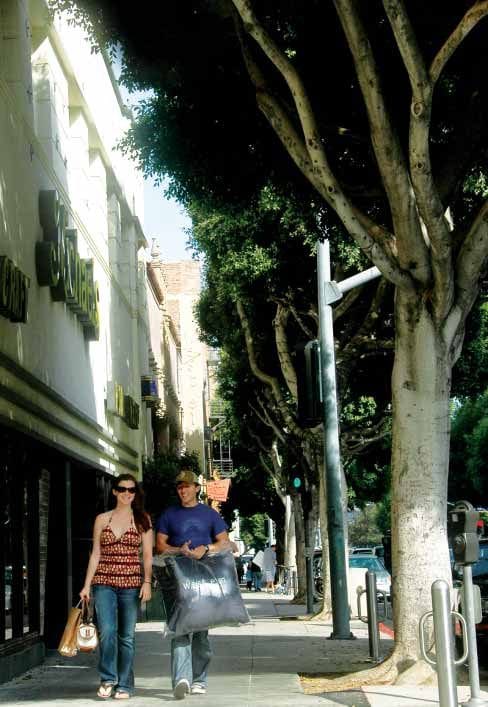
DOWNTOWN SM Beneath the foliage of the ficus trees lining Second and Fourth streets, a controversy is brewing over City Hall’s plans to remove more than 40 of the hearty, shade-producing perennials.
Several local business owners have openly complained about the dense ficus trees. Many of the specimens are overgrown, covering store signage and darkening streets, perhaps even keeping shoppers from patronizing neighboring businesses surrounding the famous Third Street Promenade.
Eugenia Chusid, a city civil engineering associate, said the plan to remove some of the ficus trees and plant the smaller, skinner ginkgo biloba trees will open up Second and Fourth streets to more sunlight and create added exposure for the many merchants’ signs.
But whether or not more sunlight and sign visibility would increase pedestrian shoppers on Second and Fourth streets remains to be seen.
“Just like the promenade took a while to evolve, it’s taken Second and Fourth streets longer to evolve than other areas,” said Kathleen Rawson, executive director of Bayside District Corporation, a private/public management agency that oversees Downtown Santa Monica.
Many of the businesses on the streets in question are service-oriented, with banks and churches and several city parking garages taking up a good portion of the available space. Most of the parking garages don’t include ground-floor businesses, with the exception of Parking Garage 5, which houses a dance studio on its first level.
There are mixed feelings about the removal of the ficus trees, Rawson said. Some see the blocking of store signs as an issue, others feel the tree canopies are so heavy that it doesn’t let in any light, creating an uninviting shadowy environment.
“The enhancement to Second and Fourth streets is to address a number of those issues to make the entire area more pedestrian friendly,” she said.
Shopping at the Santa Monica Farmers’ Market on Wednesday afternoon, Tony Davis commented that the ficus trees should be uprooted because of the litter of leaves on the sidewalk.
“Maybe a different type of tree would be better,” he said.
The presence of trees doesn’t make a difference for shoppers, said Anthony Hercules, using the Montana Avenue shopping district as an example of a place covered with trees yet still popular with shoppers.
“That’s why we have the trees, because there’s none on Third Street,” Hercules said as he waited for a bus to arrive on Arizona Avenue.“I purposely park on Second or Fourth streets... it’s close and nice because of the trees.”
The trees are an asset to any area due to the beauty they offer, said Jim Lynch, president of the Chamber of Commerce.
Lynch believes the removal of the trees would change the dynamic of Second and Fourth streets and increase pedestrian and shopper traffic to the area because the store signage would be more visible.
“I think trees really add a lot of beauty to an area, although maintaining them well would be the optimum answer that costs money,” Lynch said.
City officials should see the trees as more of a priority to balance out the needs of the business district, Lynch said, adding that proper maintenance, such as trimming the tree tops, would be a healthier practice.
The Civil Engineering and Architectural Division of City Hall sent out a notice in May, inviting contractors to submit bids for the streetscape improvement project, estimated at $6.5 million. Construction is projected to begin in the fall and be completed within 296 calendar days.
The project covers Second and Fourth streets from Broadway to Wilshire Boulevard, removing more than 40 trees to be relocated to the Santa Monica Airport and Palisades Park. About 28 trees have been determined by the community forester to have a low survivability rate if uprooted and will instead be cut down.
Approximately 152 young ginkgo biloba trees will be planted.
Curb bumpouts will also be installed on each block of Second and Fourth streets that fall within the parameters of the project.
Contrary to public opinion, the streetscape improvement project was initially started because the trees were becoming difficult and expensive to maintain, not because of complaints from the business community, said Barbara Bryan, co-owner of Interactive Cafe on Broadway.
“They’re lovely and big and beautiful, but they’re not really appropriate for what downtown has become,” Bryan said. “They’re expensive to maintain and do cause damage.”
Originally published in the Santa Monica Daily Press print edition on June 14, 2007. Read the original PDF.