

By ALICE OLLSTEIN Special to the Daily Press
SM PIER A new report on sport fish safety released by California's Office of Environmental Health Hazard Assessment (OEHHA) has come under attack by Santa Monica-based environmental group Heal the Bay for relaxing weekly consumption limits.
The lengthy report,entitled,“Development of Fish Contaminant Goals and Advisory Tissue Levels for Common Contaminants in Sport Fish,” is simply “an effort of the government to be more transparent” and meant to serve only as “a description of the framework we’ll use as we issue fish consumption advisories,” said co-author Dr. Robert Brodberg of the Pesticide and Environmental Toxicology Branch of OEHHA.
The first of its kind, the study weighs the health benefits of fish against the risks of eating contaminated species.
"It’s not nearly as protective of public health as it should be,” said Heal the Bay President Mark Gold. “This is a circumstance where the California administration has been worse on public health than the Bush administration. We have the right to eat fish that’s not contaminated, and now we’re losing that right. It’s being eroded.”
Gold’s main concern is that the report raises the acceptable cancer risk level for fish from 1 in 100,000 to 1 in 10,000.
"It doesn’t mean that it’s healthier than before, they’re just saying that it’s OK to have a higher risk of cancer,” he said. “This seems like a risk paradigm to promote fish to consumers, the false paradigm of comparing a double cheeseburger to fish. They’re saying that eating fish as your protein source outweighs cancer risk in a misguided attempt at bettering the public health of Californians.”
Brodberg said that the levels of acceptable risk are “based on our review of the benefits of fish.”
"Fish have a substantial benefit and are something we should be able to eat,” he said. “What we’re trying to do is point [eaters] toward the fish that have low to moderate contaminants, which corresponds to what the American Heart Association recommends.”
He noted that the recommendations were restructured so that if a fish is too dangerous to eat once a week or more — the minimum requirement for reaping the health benefits of the fatty acids — they advise not to eat it at all. The “Meal a Month” category has been removed.
"It’s hard to find a fish with enough healthy fats to have a once-a-month impact,” Brodberg said.
The report, instead of focusing on individual species of California fish, focuses on the various pollutants present in fish tissue. The most obvious of which is the roughly 100 tons of DDT remaining from the chemical company Montrose, who manufactured the pesticide until the late 1970s.
“We have the worst DDT hot spot in the entire world off the Palos Verdes shelf,”Gold said.
But another pollutant, PCBs, will be perhaps more important determining future fish advice for Santa Monicans, as the chemical compound has higher cancer potency and toxicity than DDT.
The report also addresses the toxin Mercury. While some of the mercury present in California fish tissues originates from mercury mines in northern California, most is atmospherically deposited from the nation’s coal-fired power plants, a notorious producer of mercury.
While Brodberg called the report “a little more conservative than in the past,” Heal the Bay plans to warn anglers and fish-eaters against following OEHHA’s advice.
“Heal the Bay is Heal the Bay; we’re going to do what we think is right. We don’t work for OEHHA,” Gold said.
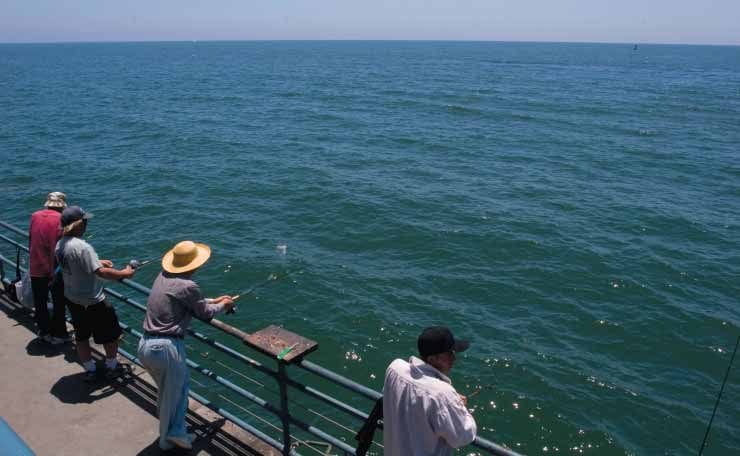
The organization plans to post warning signs on piers and educate anglers on the risks of eating contaminated fish.
Santa Monica fisherman Ramon Martinez, however, has yet to hear any word on fish health and safety.
“I’ve come every Saturday since I can remember,” Martinez said. “And they’ve never told me anything.I figure that if a fish is contaminated, it’s dead. If it’s alive, it’s probably OK.”
Heal the Bay has accused OEHHA of not thinking about the ethnic communities that rely on fishing for a large portion of their diet, but Brodberg contends that OEHHA has already taken such populations into consideration.
“We’ve made a real effort to work with various ethnic communities, which may include subsistence fishers, to make the recommendations relevant for them,” he said. “We know people eat it as part of their culture, and while we don’t know what every single person is eating, we can tell them how much is safe to consume.”
Brodberg said that because OEHHA’s fish advisories include a user-friendly presentation and tables to communicate information, they can be understood “even by people not fluent in English.”
Though the OEHHA report’s unique cost-benefit analysis of fish consumption has ruffled some feathers, Brodberg stands by the stance taken on the issue.
“When the national study came out on mercury in seafood, many women stopped eating seafood altogether, which isn’t good,” he said. “We want people to not be simply scared away from fish. Fish is a good food and should be part of your diet, but you have to choose wisely. We want to put out a balanced message about benefits and risks,because just looking at one small aspect would lead to making recommendations that hurt overall health, and protecting public health is our overriding goal.”
Originally published in the Santa Monica Daily Press print edition on July 7, 2008. Read the original PDF.