

As productions continue to move to Canada, local filming declines
(Editor’s note: This is the second installment of a two-part series that examines film production in Santa Monica and what it means for the local economy. Monday’s article focused on why production companies choose Santa Monica.)
By Andy Fixmer
Daily Press Staff Writer
Santa Monica increasingly found itself at the epicenter of the nation’s film production during the booming economy of the last decade as major studios and entertainment companies moved their headquarters into town.
Sony, MGM and MTV all moved their headquarters to the east end of Broadway and Colorado boulevards during the 1990s, creating an entertainment gulch of studios and post-production companies.
Now MGM is pulling up its stakes for new digs in Century City. And in recent years many of the region’s entertainment industry jobs have been rapidly moving to Canada, which in some cases subsidizes 30 to 40 percent of a production, entertainment officials say.
To stay competitive, firms have used Canadian companies and locations to get new contracts. The effects have been disastrous for local filming.
The city issued $222,755 in film permits in 1997, but this year officials estimate the city will take in about $122,000.
The Barker Hangar at the Santa Monica Airport also has felt the pinch. It’s been used for scenes from movies such as “Austin Powers: Goldmember” and the “Big Lebowski.” But lately, the movie business hasn’t reaped the same kind of benefits for the hangar.
It used to be that 40 percent of the hangar’s income came from filming. That has now shrunk to 10 percent, said Linda Sullivan, who books films for Santa Monica Air Center, Inc., which owns Barker Hangar. Still, the hangar can make tens of thousands of dollars renting out its space for a day.
“There’s still commercials out there but not like it used to be,” she said. “Commercial production used to be a significant part of our business and it no longer is. I find that troubling because there are so many people in this city whose livelihood is dependent on it.”
Now Barker Hanger’s focus is on live television events. For the third straight year, the Kids Choice Awards will be held in the hangar, and last month rap celebrity Eminem held a Pay-Per-View concert there with about 1,700 audience members. The annual World Stunt Awards have been held there for nearly five years.
638,“We are great for live television,” Sullivan said. “When you get a thousand people in here it doesn’t matter what sound is outside. Put a thousand kids in a room, you’re not going to hear a jet taking off.”
Restaurant owners get into movie biz
For other local business owners, filming has allowed them to maintain a stream of income even if their sales are slumping, or their operations are down.
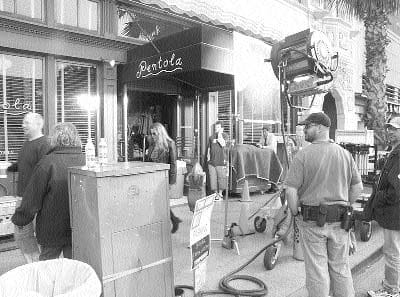
Bruce Beach, owner of Pentola Taverna at 312 Wilshire Blvd., temporarily closed his restaurant during a recent kitchen upgrade, but he is still renting out his space for filming. He can average $4,000 a day renting out his restaurant to film crews.
Beach said his restaurant is used for filming once or twice a month. He said he avoids renting it out more than that because it’s problematic for his patrons.
“You don’t want to alienate your customers by being closed too often,” he said. “Besides, I’m in the restaurant business, not the movie business.”
The restaurant often is used as an East Coast location, because of its high ceilings and elegant atmosphere, Beach said. It was used in the movie “Get Shorty,” in television shows “The West Wing” and “Buffy the Vampire Slayer,” and numerous commercials.
“Our primary benefit is that (local filming) puts a good face to Santa Monica and it gets our image out to the entire world.” — — KATHY DODSON Santa Monica Chamber of Commerce
“We’re losing some of it now,” Beach said. “A lot of it is going to the studios where they are building sets. It’s expensive to shoot in Santa Monica because of all the permits. If it’s a long series, now they’ll build a set.”
“It’s expensive to shoot in Santa Monica because of all the permits. If it’s a long series, now they’ll build a set.” — — BRUCE BEACH Santa Monica business owner
Film companies find local businesses by word of mouth and through advertisements those businesses place in industry directories that list their facilities.
The film and television industry is a vital aspect of Santa Monica’s economy, generating $1.5 billion in payroll and vendor expenditures annually, according to an industry study. The city also is home to thousands of industry employees who earn their living from entertainment production.
Santa Monica becomes center of attention
Many jobs in post-production studios are located in Santa Monica, and a large number of outdoor scenes take place here, generating hundreds of thousands of dollars annually in revenue for the city and local businesses.
Local government officials recognize the film industry’s importance to the city’s economy. Santa Monica has joined the national fight to keep film production in the United States and out of Canada.
The Santa Monica City Council was one of the first in the nation to sign a petition last May asking trade representatives to investigate the claims of wrongdoing by Canada. Film industry and labor unions hope to use the council’s resolution to pressure lawmakers in Washington D.C. to follow through with some action.
City Manager Susan McCarthy said it is unlikely film fees would be raised during the current budget deficits because officials want to encourage the film industry to continue shooting in Santa Monica.
To that end, the city has made its film permit process easier for production companies to shoot on location in the city.
“If a big job comes in and they’re late with their paperwork and we aren’t doing anything else too important, we’ll drop whatever we’re doing to make sure they get all the permits they need,” said Kathy Ruff, the city’s film permit coordinator. “We try to make it as easy as possible for them to get what they need.”
Generally, businesses that need to get permits for film productions say the bureaucratic tangles found in other departments within City Hall don’t exist when it comes to filming.
“The city has been pretty friendly with it,” Beach said. “Sometimes they object to parking situations, but in other cases the city has bent over backwards to accommodate... them too.”
Some location scouts said Santa Monica is known for being a difficult place to film, but others said it’s relatively easy.
“I love filming in Santa Monica because I understand what I can do in Santa Monica,” said Mike Beche, a location manager for the television show “7th Heaven.”
“If it causes a traffic problem, they don’t want it,” he said. “If I need to do something really crazy I go to L.A. because it’s so big they don’t ever know.”
While city officials want to protect an industry that is close to home and helps generate tax dollars, many in the business community want to see local filming continue to give Santa Monica widespread exposure.
From the sandy beaches depicted in “Baywatch” to the bungalow lifestyle shown in “Three’s Company,” the local film industry generates a lot of good buzz worldwide for Santa Monica.
“I think in the long run it gives Santa Monica more promotion and that’s generally good for business, especially tourism related business,” said Santa Monica Chamber of Commerce Executive Director Kathy Dodson. “Our primary benefit is that it puts a good face to Santa Monica and it gets our image out to the entire world.
“If for that reason alone, the film industry is a very important segment of Santa Monica’s local economy.”
Originally published in the Santa Monica Daily Press print edition on January 14, 2003. Read the original PDF.