

Witnesses testify about questionable moves by opponents of living wage
Supporters of Santa Monica’s failed living wage law put their opponents’ campaign tactics on trial Saturday.
Witnesses — who consisted of elected officials, campaign workers, favorable hotel employees and clergy — testified before a panel dominated by campaign reformers that a living wage victory was stolen by a high-priced opposition campaign.
Many witnesses, who were sworn to tell the truth before giving their testimony by former California Supreme Court Justice Cruz Reynoso — who was also a panelist — said deceptive campaign tactics used in Santa Monica should be a “poster child” for statewide campaign reform.
“From Sacramento to Santa Monica truth in campaigns is under assault,” said Sonya Fox Sultan, a local resident and attorney who volunteered on the living wage campaign. “And without taking action, it could eventually undermine the entire electoral system.”
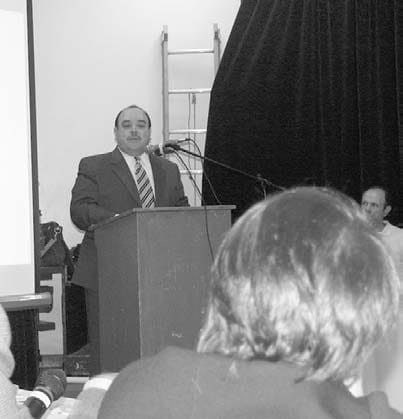
The living wage ordinance, which was passed in 2001 by the Santa Monica City Council, would have Andy Fixmer/Daily Press Lt. Governor Cruz Bustamante tells living wage supporters there should be truth in campaign advertising See LIVING WAGE, page 6 forced businesses in the coastal zone making more than $5 million annually to pay their workers $10.50 an hour with benefits and $12.50 an hour without.
Luxury beach hotels, restaurants and other businesses formed a coalition to defeat the living wage ordinance, which voters narrowly did in the Nov. 5, 2002 general election.
In three years, the group spent more than $2 million to convince voters to shoot down the ordinance, according to living wage supporters.
Living wage opponents didn’t attend the hearing Saturday and were unavailable for comment over the weekend. But on Friday the campaign’s spokesman, Seth Jacobson denied any wrong-doing.
The hearing was nothing more than “sour grapes” and a continued backlash by the Hotel Employees & Restaurant Employees union for losing the election, Jacobson said. Opponents, like living wage supporters, ran a spirited campaign but the they never misled voters or made any false misrepresentations in their mailers, according to Jacobson.
Witnesses at Saturday’s hearing vehemently disagreed, and a few went as far to characterize some tactics used by the opposition campaign as violating California election law.
In particular, opponents may have broken the law by allegedly hiring a firm to create a series of slate mailers solely funded by the anti-living wage campaign that indicated another campaign had been responsible for creating them, some witnesses said.
Slate mailers are created by for-profit companies that sell space on the fliers to candidates and causes as an inexpensive way to reach potential voters.
The mailers — which incorrectly inferred that the Democratic Party, women favoring abortion rights and education activists all opposed the living wage — indicated with an asterisk that a campaign favoring a parcel tax measure that was also on the ballot had helped pay for them.
However filings with the California Secretary of State’s office revealed the anti-living wage campaign was the only group who paid to appear on the mailers.
Having an asterisk next to the parcel tax measure may have also confused voters into believing education activists and the anti-living wage campaign were in agreement, according to Paul Ryan, an analyst with the West L.A.-based Center for Governmental Studies.
“Given how these were paid for and which measures received asterisks, it appears all three slate mailers violate California law,” he said. “They purposely misled voters to believe Measure EE supporters opposed (the living wage).”
Kent Wong, director of the UCLA labor center, gave an indictment of the living wage opponents’ campaign managers at the Westwood-based Dolphin Group.
The company of political consultants is known for its work on behalf of conservative candidates and causes. The group is most famous for its Willie Horton ads for President George H.W. Bush during the 1988 presidential election.
The group has used the same “deceptive” tactics employed to defeat the living in campaigns throughout the state and country, Wong said.
“It’s outrageous that in Santa Monica where strong support for the living wage existed, that this group was able to deceive voters and derail the living wage from being implemented,” he said.
Lt. Governor Cruz Bustamante (D-San Joaquin) said at the hearing Saturday that slate mailers that receive more than 10 percent of its funding from one source should disclose who is paying for the flier.
He said the anti-living wage campaign hid behind the slate mailers and used that anonymity to confuse voters.
“You shouldn’t be able to hide behind a name you make up for yourself,” Bustamante said. “It makes sense that we should have laws that force such disclosures. There needs to be more truth in the advertising.”
One living wage supporter delivered signed letters from Latino day laborers who were hired for $10 an hour to stand outside polling booths with anti-living wage banners. The banners weren’t translated for the workers into Spanish, so many said they did not know for what cause they were advocating.
“Work had been slow and we just wanted to make some money,” said Armando Vega in a letter read by Rev. Ramon Cisneros. Another day laborer named Arturo Mundez wrote “We were confused because people would scream obscenities at us as they drove by.”
The panelists will convene over the next week to discuss the four hours worth of testimony they heard and come up with recommendations for reforms at the state and local levels.
Some have suggested at the state level creating more public financing of elections and stronger election finance disclosure requirements, especially in regard to slate mailers. And possibly creating a local campaign ethics committee that would review any future questionable election practices in Santa Monica.
Originally published in the Santa Monica Daily Press print edition on February 24, 2003. Read the original PDF.