

Almost half considered ‘chronically homeless’
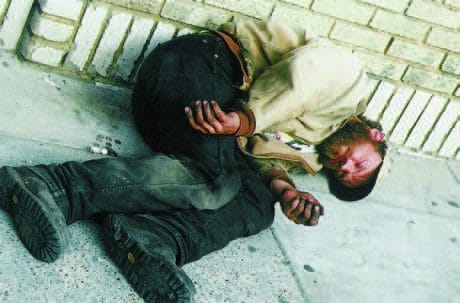
The latest count confirms the Los Angeles metropolitan area is the homeless capital of the country, with nearly half of that population having long-term problems getting a permanent roof over their heads.
The Los Angeles Homeless Services Authority, a group charged with addressing homeless issues for the county, presented a report on Thursday showing that 83,347 individuals are estimated to be homeless at any given time within the metropolitan area, 42 percent of whom are considered “chronically homeless” — which means they have been on the streets for a year or more, or have had at least four episodes of homelessness in the past three years. They also suffer from one or more disability, mental illness or substance abuse.
The Los Angeles metropolitan area has the highest chronic homeless population in the country, according to officials.
In addition to LAHSA’s count, there are 7,600 homeless individuals in Glendale, Pasadena and Long Beach, bringing the total number countywide to 91,000. Those cities will present information regarding their numbers of chronically homeless in coming weeks.
LAHSA’s physical homeless count, the first of its kind, was tabulated in January with the assistance of 1,000 volunteers and paid homeless workers, conducted in large part so the county could access an estimated $60 million in grant funding from the federal department of Housing and Urban Development for homeless programs and mental health services.
The count included those living in the streets and shelters in Santa Monica. Mitchell Netburn, executive director for LAHSA, said there would be more information about homeless demographics in cities such as Santa Monica in coming weeks.
LAHSA has concluded that 55 percent — or 19,194 — of the chronically homeless counted have three or more disabilities, indicating “these people face multiple barriers” to overcome their lack of housing, according to the report.
“The numbers of chronically homeless was far more surprising than we expected,” Netburn said. “Our previous counts led us to believe it was far fewer, from 7,500 to 10,000.” Netburn said the reason for the discrepancy was that chronic homeless numbers were based on national figures that, after having done the count, do not apply to Southern California. to prove it, but I suspect the large numbers of chronically homeless who are here has to do with the weather,” Netburn said. “I’m from back east, and I can tell you firsthand a few winters with the conditions these people suffer from kills them.
“Not that the weather is an excuse, but it lets them live longer.”
Netburn said of the $60 million in grant funding LAHSA has requested from HUD, $40 million would go to programs that may help the chronic homeless but do not specifically target them, such as meal centers.
Of the request for $20 million in new funding, $10 million would be earmarked for the chronic homeless problem. To do so, current programs within the county would likely be asked to service an additional amount of chronically homeless individuals in order to qualify for contract renewals.
THE SAME PROBLEM Debate has been stirring in Santa Monica recently regarding how to best go about addressing chronic homeless problems.
“We don’t have any hard information “We welcome any increased focus of resources.”
Councilman Bobby Shriver has proposed the creation of a regional homeless leader position to tackle the difficulties of mobilizing such an uphill battle.
The regional homeless liaison would be hired on a contractual basis, and the position’s effectiveness will be reviewed after a year, Shriver said. The person would likely be hired for one year, paid as much as $200,000 and report directly to City Manager Susan McCarthy. The regional homeless liaison would be responsible for advancing programs — such as a sobering center, a mental health and drug court, year-round housing through the Veterans Administration and chronic homeless outreach — to affect Santa Monica and neighboring communities.
Debate about the position, including how or if it will be funded, is set to be discussed at Tuesday’s City Council meeting, when next year’s budget is expected to be adopted.
Shriver said his idea is not exclusive, but came out of his own observations of a need for regional leadership regarding homelessness.
“The idea is to get a bulldog in there, to get providers and governments working together to solve this problem,” Shriver said. “If the other cities want to get bulldog with us, great, because we should all be getting bulldog together.
“If Bring LA Home were to hire such a person, fantastic, because such a person is needed.”
Councilman Richard Bloom, a long-time homeless advocate, said he has reviewed LAHSA’s report and believes that although more needs to be done on the chronic homeless issue, Santa Monica is taking steps to address it.
“Clearly, there is not enough being done to address chronic homelessness,” Bloom said. “However, that is where we have turned our focus in Santa Monica and where the developmental stages of regional plan are.
“The marching orders from Washington is to try to reduce the number of chronic homeless by 50 percent in two years, and that’s a tall order.”
Bloom said a comprehensive plan to reduce chronic homelessness by 50 percent in 2 1/2 years is expected to be rolled out in September by Bring LA Home, an association of 88 municipalities committed to helping the down and out.
“We need to focus on bringing together strong leadership in Los Angeles with a well-defined plan and adequate ongoing funding to make real changes,” Bloom said.
Netburn, who said he had some familiarity with both Bring LA Home and the idea of the regional homeless leader, said both efforts to address the issue would be welcomed.
“We welcome all ideas and willingness to help,” Netburn said. “The homeless problem is so massive it will take all segments of society to help address a human tragedy that simply can’t continue, and I think people are starting to realize that.
Originally published in the Santa Monica Daily Press print edition on June 17, 2005. Read the original PDF.