

Second workshop scheduled for March 12
SUNSET PARK — The first words used to describe gang affiliation were love, protection, homies, family and neighborhood.
Then the group of middle and high school students meeting as part of a weekend workshop on ending gang violence in Santa Monica added to their description the words boredom, isolation, death, rape, respect, money, cars, drugs, girls, alienation, harassment, loss of manhood and weapons.
At least some parents noticed the conflicting sentiments. Tapping the perceived positive aspects of gang membership, the things that lure young people into the gang lifestyle, was one key strategy proposed for quelling gang violence.
Developing an inter-agency partnership also was suggested, as were increasing parent involvement, re-examining the way officers police local neighborhoods, partnering with the business community to offer jobs and training to youths, and developing new education programs for students, teachers and counselors.
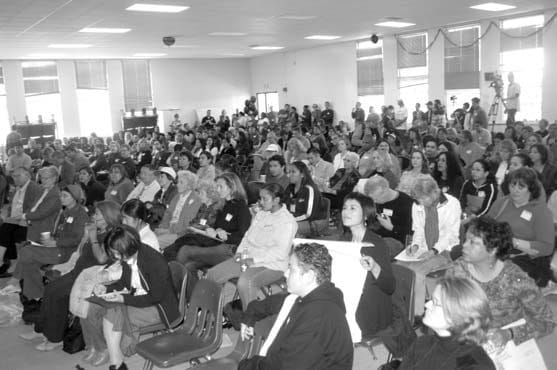
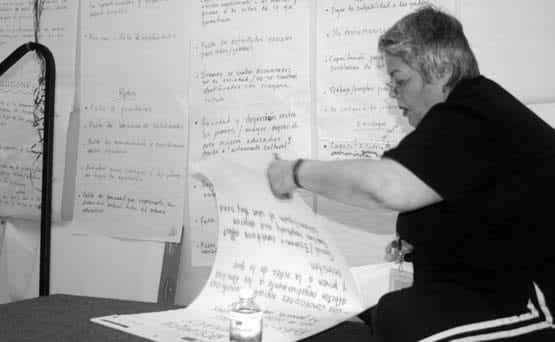
More than 400 people turned out for the Saturday morning meeting on gang violence held at John Adams Middle School, and hosted by State Sen. Sheila Kuehl and Santa Monica City Hall. Much of the workshop was spent in small groups of 20 to 40 people, where parents, students, ex-gang members and an array of experts began to fashion a solution for ending the ongoing cycle of violence.
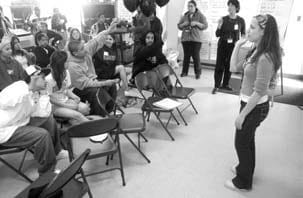
In a group only for youths, about 30 students, mostly from Santa Monica and Olympic high schools, offered their views on how best to deal with violence in Santa Monica and particularly in the eastside Pico neighborhood, where gangs are most entrenched and gunshots are frequent.
Asked by a facilitator who among the students was directly affected by gang violence, only one boy put up his hand. Asked who was affected through their family or neighborhood, every youth in the room raised a hand.
“Shootings on our streets,” said a girl clutching a pink handbag, after the facilitator asked how the youths were affected. “Getting shot at,” offered a boy slouched low in his seat and wearing baggy jeans, a white T-shirt and a striped Los Angeles Dodgers baseball cap.
The group of students agreed strongly that more counselors and mentors were needed to give advice to youngsters. Counselors who understand what it’s like to be young, to live in a tough neighborhood, to have family members in gangs.
Blinky Rodriguez, one of five experts on gang violence to speak later in the meeting, said hiring ex-gang members to work with youths is effective.
“We live in extreme times, everything is extreme,” said Rodriguez, an educator and motivational speaker whose 16-year-old son was killed in a drive-by shooting. “We need to be able to go out to the edge of the branch where the fruit is sweeter.”
Bill Martinez, a gang-violence consultant who runs a training program at California State University of Los Angeles, agreed.
“We’re up against a lot of pressure.” — Martinez said
“Gang members are made, they’re not born,”
Another workshop was scheduled for March 12, and officials said it was then that the community would formulate a specific plan for tackling gang violence in Santa Monica.
The series of meetings was called after a gunman this past fall fired 14 rounds at a bicyclist in front of an elementary school. No one was seriously injured in the incident, but it was witnessed by many school children, and solidified a group of parents and residents growing increasingly frustrated with the ongoing violence in the Pico neighborhood.
Former State Sen. Tom Hayden, an author and activist against gang violence, said reducing the ill affects of gang membership in Santa Monica will require three things: A commitment from City Hall to hire youths and former gangsters to work on public projects, a reformation of the prison system and a massive expansion of rehabilitation facilities for former gang members.
“They’ve been in continual violence trauma, and they’ve been shamed about it by others, and there are no veterans’ homes,” Hayden said.
The only way to make real progress, argued Leah Aldridge, associate director of youth services at the Los Angeles Commission on Assaults Against Women, was for the community to set its goals high.
“You all are the experts, and you all have the answers,” said Aldridge, who drafts and manages violence-prevention programs. “We have to live the change that we want our community to be. We have to practice it.”
Still, not every popular approach will work, cautioned John MacDonald, a Santa Monica resident and researcher for the RAND Corp. who has dedicated his career to studying gang violence. MacDonald said the community must choose its path carefully and realize that new programs can be expensive.
“Those cost money, and that’s a challenge,” said MacDonald, who offered to help craft a suitable plan for Santa Monica. “I don’t know how many people here want to open their wallets or raise their taxes, so I’m trying to be a realist.”
Officials closed the Saturday meeting by urging residents to return March 12 and help nail down specifics for dealing with gang violence. The goal is to formulate a two-year plan. An unspecified amount of money is available from City Hall, which last month made reducing gang violence a fiscal priority.
Young residents of the Pico neighborhood said they were hopeful the workshop might lead to significant change.
Alejandro Rodriguez, 16, a junior at Samohi, lives near the intersection of 16th Street and Delaware Avenue, where the violence is most prevalent. He said it seemed as if there was a growing interest in reducing gang violence among his peers.
“I think the youth are starting to get more involved nowadays, so they can be part of the decisions adults make for us,”
Rodriguez said after the meeting. “I see a lot of things that are wrong, a lot of negative things. Things need to change.”
Originally published in the Santa Monica Daily Press print edition on February 28, 2005. Read the original PDF.