

To get Holly Hunter to sign on to play a struggling, hard-working single mother in the film “Thirteen,” director Catherine Hardwicke and young Nikki Reed — who was 13 when she co-wrote the screenplay — sent the Academy Award-winning actress a videotaped appeal that featured Reed’s own single mother, upon whom the character was based.
“Nobody had ever done something like that to woo me into a project before,” said Hunter of the unorthodox pitch that convinced her to accept the role of Melanie, a recovering alcoholic torn between the desire to be her daughter’s best friend and a need to be an authority figure. “And these things count — originality matters in terms of lassoing an actress into a project. That’s my message to all you future moviemakers.”
Aspiring filmmakers would be hard-pressed to land anyone better than the versatile Hunter, who has garnered virtually every significant acting award out there, including an Oscar, two Emmys, a British Academy Award and a Golden Globe. In a film career that spans 20 years, she’s proven to be equally adept at high comedy and heartbreaking drama in such memorable films as “Raising Arizona,” “Broadcast News,” “The Piano” and “The Firm.” Her performance in “Thirteen” has critics buzzing about a possible fourth Academy Award nomination.
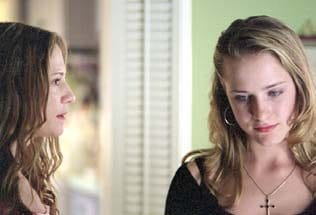
“I read the script and thought it was very fresh, very dynamic, vital and violent. Melanie, my character, is unusual because she transcends the two-dimensional adult characters we normally see in movies about kids,” said Hunter, in her familiar Southern drawl. “Normally, this movie would be told without adults. Melanie is very much a part of the triangle along with the two girls (Evan Rachel Wood as Mel’s daughter Tracy, and Reed as the pubescent femme fatale who seduces her). Without the strength of that triangle, a lot of the conflict would be missing from the story.”
On the contrary, “Thirteen” is rife with conflict, as Melanie tries to hold it together while her formerly squeaky-clean teenaged daughter spirals out of control attempting to remake herself into the “hottest chick in school.” After she scales the wall that separates the geeks from the popular kids, Tracy discovers a world of deceit, peer pressure, drug abuse and promiscuity that threatens to destroy her relationship with Melanie, if not her entire life.
“I wouldn’t call this film a cautionary tale, I think what it is a real specific examination of a girl’s life. And I think it looks at the glamorous image that these girls are exposed to, and how they’re affected by it,” said Hunter, who spent time with Nikki Reed’s mother Cheryl to prepare for the role.
“There’s a maliciousness in the privacy of a family that is often not seen. A vicious rage that generally is kept at home. This movie opens the door and let’s you peer into what goes on between this girl and this woman. It shows how heartbreaking it is, and how, in a way, it’s a right of passage — a right of passage that can be quite ugly.”
Still, Hunter claimed the experience of making “Thirteen” was a surprisingly pleasant one — not at all what you might expect on the set of a film with such somber subject matter. She attributed the good vibrations to the predominantly female cast and crew, especially her young co-stars Wood and Reed.
“I learned a lot working with them. They are so impetuous, you know, and life flows through them without censorship, without an editor. That’s youth. It was enchanting to be around them, but it was also exhausting because that energy is boundless.”
Looking back on her stellar career, Hunter believes the films she’s made have had as much of an impact on her as they have on her legions of fans and admiring peers.
“There have been real watershed moments for me personally, in making movies,” she said. “I remember vividly the last shooting days of ‘Broadcast News’ and ‘The Piano.’ Those two movies, when I finished them, I knew I’d gone through something that had changed me radically.”
As for “Thirteen,” Hunter appreciates the message delivered at the film’s denouement, which reinforces one of her core ideologies: “Maybe I’m an idealist, but I do believe that love can prevail. Love is the salvation for all of us. That’s a belief that I have about my life, not just this movie … but certainly, it’s in this movie.”
Originally published in the Santa Monica Daily Press print edition on August 29, 2003. Read the original PDF.