

Earthquake shook up SM comedy club scene THE CLUB SCENE
THIRD STREET PROMENADE — “I’m not a comedian! I am a comic!!”
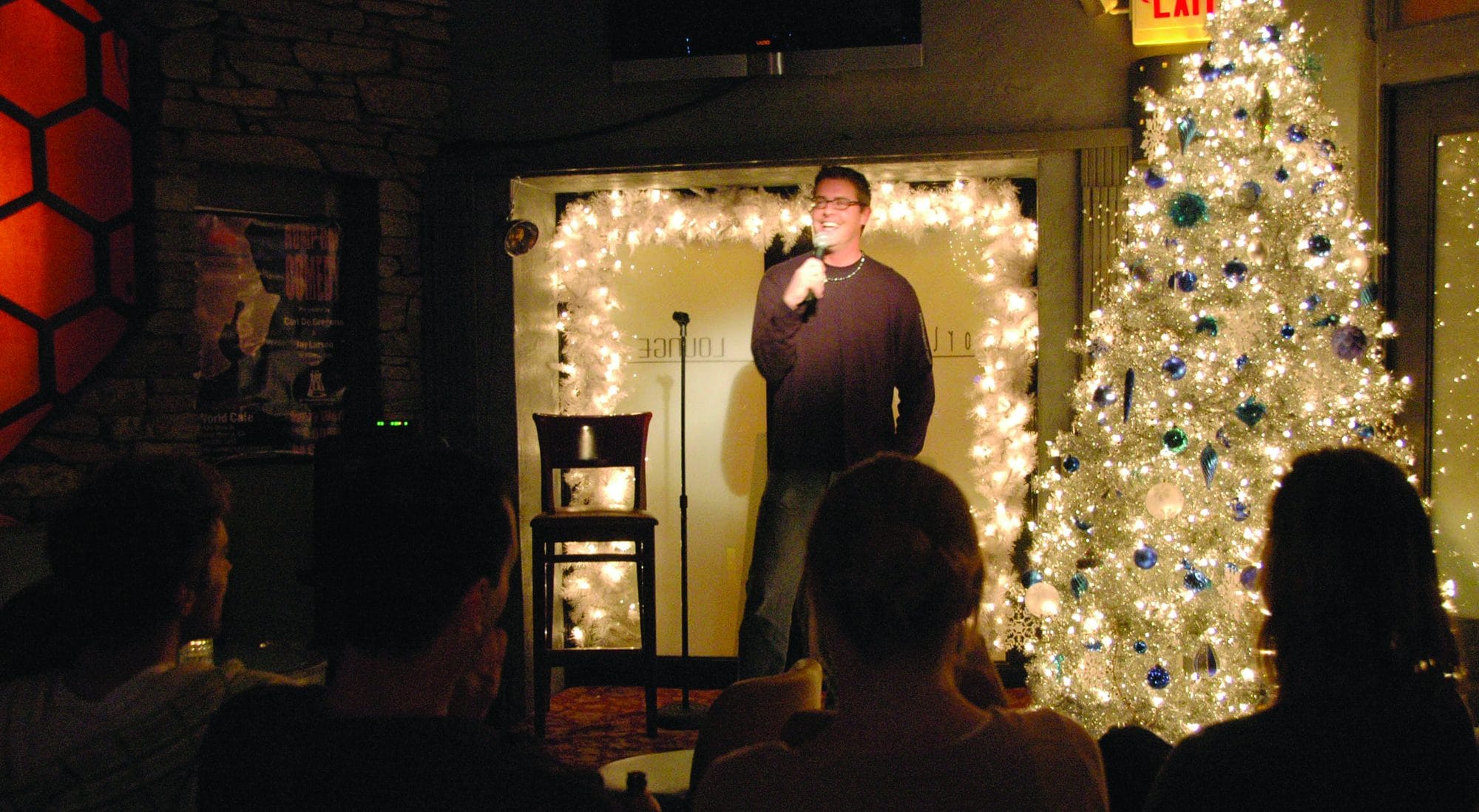
Laughter fills the air in this dark underground-style comedy club, located on an alley behind the promenade, as a “comic” known as “The Truck” is screaming his way through a stand-up routine. Flashing a book of Shakespeare’s insults, The Truck is fully prepared for hecklers, in order to avoid pulling a Michael Richards.
It may not be on the same scale as its famous Hollywood counterparts such as The Improv, The Comedy Store and Laugh Factory, but the absence of prominence and prestige doesn’t faze the audience at the Westside Eclectic, which packs the small room, devoid of any type of decoration. With Bud Lights all about the room, the audience appears as if they are mutual friends or colleagues who run in the same comedy circuit.
The Westside Eclectic is the newcomer to an existing, albeit small comedy scene in Santa Monica. Besides a few open mic nights and comedy nights at bars and cafes here and there, comedy clubs are an uncommon sight in Santa Monica.
“Down by the beach, people don’t like to go indoors as much as other areas like in New York [City],” said Comedian Mark Schiff during a recent morning at the Coffee Bean on Second Street — two blocks from the Pacific Ocean.“A dark club in a beautiful environment like this is weird.”
Typically, the best comedy clubs emerge in high-stress areas such as West Hollywood, Los Angeles and New York City. With its relaxed setting and breezy ocean backdrop, Santa Monica just doesn’t fit that criteria, said Ritch Shydner, who wrote a book with Schiff entitled “I Killed: True Stories of the Road From America’s Top Comics.”
For the same reason Santa Monica isn’t the home of comedy clubs, because of its resort-like feeling, the city — despite its being an entertainment industry heavyweight — also isn’t a breeding ground for comedians.
A certain tough environment with hard-to-handle circumstances make comedians who they are, said Schiff. Comedy is the therapy for these comedians, many of whom experienced trouble in their youth. The audience has to connect with a comedian in order for that person to be successful — something decidedly more difficult when a comedian comes from a privileged background.
“The poor neighborhoods seem to produce the greatest amount of funny people,” Schiff joked.
Once upon a time, a famous entrepreneur by the name of Budd Friedman was hoping to capitalize on his success of opening one of the first comedy clubs in America — The Improv in New York City — by starting a branch club in Santa Monica.
The Santa Monica Improv opened in January of 1989, in the same space currently occupied by Hooters on Santa Monica Boulevard. The business, unfortunately, never caught on and following the Northridge earthquake in 1994, Friedman decided to close the Santa Monica club, said Dave Rath, a producer and manager who used to run the Santa Monica Improv.
“Fridays and Saturdays were always busy when I was there, but those kinds of businesses need more than two nights to sustain,” Rath said on Friday.
Shortly after the original club flourished in New York City in 1963, Friedman expanded his business to Hollywood, where The Improv remains to this day.
Comedian and Writer Barry Sobel, who has appeared in numerous films, believes comedy clubs are on the verge of a comeback in Santa Monica.
“When you see places like the Westside Eclectic, you see that there could be a boom of comedy clubs in Santa Monica,” Sobel said on Wednesday night, just before starting his act at the Westside Eclectic.
He bases his theory on the fact that many West LA residents seek comic relief, but don’t want to drive all the way to Hollywood and waste time and money sitting in traffic for what should be a short trip. Sobel himself resides in a nearby West LA community and calls The Comedy Store his “home,” but loves the fact that his gig at Westside Eclectic is so close to his residence.
Part of the reason why the Santa Monica Improv did not succeed could be due to location. It could be the same reason why The Comedy Store in Westwood also had to shut its doors, Sobel said.
The Santa Monica Improv and Westwood Comedy Store were around at the same time when the Hollywood Improv and Comedy Store were stealing the comedy spotlight in Los Angeles, he said. When tourists think comedy, they visit Hollywood, not Santa Monica.
Soble is hopeful that may soon change. It’s how all the comedy greats like David Spade, Robin Williams and Jerry Seinfeld got their starts.
“The book is about the funny and not so funny things that happen to comedians,”
“It was the easiest book in the world to sell.” — Schiff said
The comedy club is a comedian’s gymnasium. It’s where they arrive every day to build their craft. It’s where they work out and become stronger in their act.
Schiff started making the comedy club rounds in 1978 with friend Jerry Seinfeld. Before comedy clubs were around, the funny guys would perform at resort hotels, doing six to eight shows a night with little to no monetary compensation.
Some comedians had regular jobs, while others like Schiff managed to save money by paying low rent in his New York City apartment.
“We had a huge place for $350 a month,” said Schiff, a New York native. “Me and the second roommate paid $25 a month. The third roommate paid $300 and he lived with us for seven years.
“That’s how I survived. Coming up with stuff like that,” Schiff said with a smile.
Friedman came around and opened the first Improv near Broadway, hoping to catch the actor and singer crowds who needed a place to hang out after their show, Schiff said.
“Budd really started the whole thing,” Schiff said. “After people saw how it worked, someone else opened a comedy club.”
Shydner started performing in coffee houses and pubs in Washington D.C. during the 1970s. Shydner, who lives in the San Fernando Valley, said the crowd was surprised to see him stand up during those open mic nights and perform comedy instead of belting out a tune.
“Now, people are really educated about stand-up comedy,” Shydner said. “But back then, they weren’t.”
Shydner and Schiff, long-time friends, interviewed more than 600 comedians for their book. The book is a compilation of stories from famous comedians such as Carlos Mencia, Larry David, Tim Allen, Brett Butler, Jeff Foxworthy and Tom Arnold.
Shydner recently promoted the book on “The Howard Stern Show,” when he told the story about Jay Leno and how he once tied up a woman in her New York City apartment at her request. Realizing that he had to move his car, which was parked in a New York City street, Leno left the woman tied up in the apartment. After moving his car, Leno realized he did not remember the woman’s last name or her apartment number and roamed the building calling out her first name. When he realized he would not be able to locate the apartment, he left, knowing the woman had a roommate.
THE OTHER COMEDY LOCALES IN TOWN For the past two years, the World Cafe on Main Street has held a comedy only night on Wednesdays.
The program was started by Comedian Carl DeGregorio and former World Cafe bartender Jay Larson, who wanted to reintroduce comedy in West Los Angeles.
Anywhere between five to eight comedians perform on any given Wednesday night. Over the years, audiences at the World Cafe have seen comedians who have appeared on late night shows and Comedy Central. The show attracts about 60 people on a good night.
Both DeGregorio and Larson perform in the show.
“We try to keep it fresh,” DeGregorio said on Thursday. “We have a core roster that we try to rotate and we’ll bring new people in.”
BACK TO WESTSIDE ECLECTIC Husband and wife team Mark and Alison Campbell opened the club in February. Mark Campbell, who has been in comedy for about 12 years, saw the location — in an alley immediately east of the promenade — as the perfect location.
The business offers comedy shows and classes teaching improvisation, writing and voiceovers.
Emily Paulson of Santa Monica has been in comedy for about 10 years,and has taken classes and performed at Westside Eclectic, including an improvisational show on Wednesday night. Comedy is a way for her to express herself artistically while making people laugh at the same time, the South Dakota native said.
What brought Paulson out to Santa Monica to pursue her comedic career?
“Location, location, location,” she said. “It’s like heroine,” she said of comedy. “Once you’ve tried it, you want more.”
Originally published in the Santa Monica Daily Press print edition on December 16, 2006. Read the original PDF.