

Iraqi woman with dying son pleads for peace
By KELLY HAYES-RAITT Special to the Daily Press
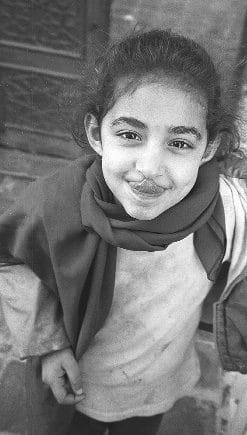
I met Sura, a 12-year-old Iraqi girl, at Baghdad’s Amariyah bomb shelter, where more than 400 men, women, boys and girls like her went to escape a night of bombing during the ’91 Gulf War. A U.S. bomb pierced the ceiling, curling the 1/2” steel like shaved chocolate and incinerated the cowering families.
Trying hard to be grown-up and solemn, this chirpy little girl showed me blood stains embedded in the concrete, shadowy burns outlining people’s last moments alive, and human flesh still clinging to the walls. Sura was born the year of the Gulf War. In her 12 years, she has known nothing but recovering from one war and preparing for the next.
Now she has a new war from which to recover.
Sura’s murky future rests on President Bush’s ability to be as forceful with aid and rebuilding as he has been in bombing and invading.
We’ve proven we can wage war. Can we successfully wage peace?
Before last week’s assaults, Iraqis were still recovering from the devastation of their last war, from 13 years of crippling sanctions and from Saddam Hussein’s brutal oppression.
Falling from middle income status to near Third World status in under a generation, Iraqis are still struggling for medicine, adequate food, jobs and clean drinking water. Children have been hit the hardest. Half of the 26 million Iraqis are children and 4,000 are infants or preschool age. Childhood diseases have become killers: Every other family loses a child under the age of 5, according to UNICEF. The average child has diarrhea 14 days a month.
Childhood leukemia has skyrocketed, especially in Southern Iraq, where the U.S. dropped bombs containing depleted uranium in 1991.
Hassan is the entrepreneurial boy stationed outside our hotel who offered a filmy shoeshine in exchange for a few dinars or coveted power bars. He is either 5 or 7 years old depending on which day I asked, but his memory for which one of us carries candy is flawless. Nearly all Iraqi children were schooled during the 1970s and 1980s. Now, almost a quarter of the children are on the streets, earning meager money to help support their families.
Iraq’s “street” children are bright and funny, not the vacant-eyed children who descend from generations of poverty and have little hope of transcending their stations. I teach one sparkling, dark-eyed girl to touch her nose with her tongue. Through gleeful laughter, she proudly manages the feat, charming me into a donation.
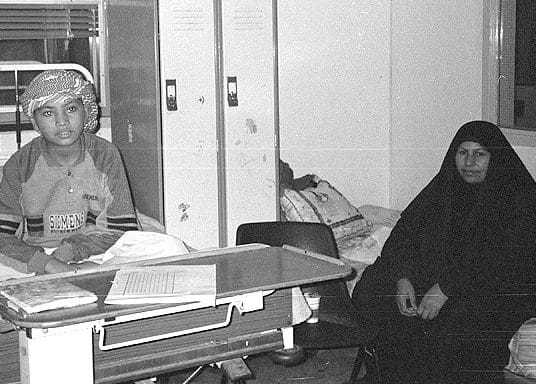
I met Ahmed on the leukemia ward of Baghdad’s Al Mansour Pediatric Teaching Hospital. His mother had left her eight children and moved into the cot next to her youngest son to care for him as he dies. Ahmed is a casualty not only of the Gulf War, but of the U.N. sanctions. Depleted uranium bombs were dropped on Ahmed’s town in 1991, and contracts delayed by the U.S. under the U.N.’s Oil-for-Food program prevent him from getting the medicines for his chemotherapy.
As I passed her son’s bed, Ahmed’s mother grabbed my arm and pulled me toward her, fervently pleading in Arabic. I thought she might be begging for medicine, for help — something for her dying son. The doctor translated her urgent plea: “We have everything we need, we just need peace.” (Kelly Hayes-Raitt is a political consultant and traveled to Baghdad from Jan. 29 –Feb. 8. She welcomes the opportunity to speak to community groups and congregations about her trip and (310) 581-4421. Photos may be viewed at www.CommunityCampaigns.com/Iraq.)

Originally published in the Santa Monica Daily Press print edition on April 3, 2003. Read the original PDF.