

Red Cross director was born to lend a hand to community
11TH STREET — Jerry Washington is a product of his environment.
And he hopes that by re-creating that environment for hundreds of other kids, they and their communities will be the better for it.
As director of youth services and volunteers at the Santa Monica Red Cross chapter, Washington mentors and guides hundreds of kids through their formative years. What he hopes they get out of it is the value of volunteerism and feeling as though they are contributing members of society.
Growing up with an activist mother who operated a youth center in his hometown of Waterbury, Conn., Washington never knew anything other than community service. He worked at the youth center as a teenager and helped rebuild the family home to accommodate the growing occupants — nearly 100 foster children lived with the Washingtons in a four-year span.
But Washington’s path to the Red Cross was long and winding. He served as a chef in the Army and then ended up back in Waterbury, working at a local factory. He moved to Los Angeles to pursue a life in entertainment. When that didn’t pan out, he managed a Foot Locker store, started a couple of businesses and eventually went back to his community service roots by joining the Red Cross in 1994. Apparently, his passion for youth and giving back has stuck.
Washington, 44, has been working with youth at the Santa Monica Red Cross chapter in some capacity for 12 years, taking on many roles over that time. He joined the chapter as a customer service assistant and by 2000, he had moved up to youth services assistant. In 2003, Washington was appointed director of youth services and volunteers. He also is responsible for the chapter’s computers and software, as well as maintains the chapter’s Web site and handles the computer graphics and creative work. Washington also works community events and first-aid stations for the chapter on weekends when the need arises.
Washington’s Santa Monica Red Cross volunteer program has 600 youth, ranging from 12 to 18 years old. They assist at the chapter working alongside the staff doing everything from answering phones and passing out flyers to stuffing envelopes. Youth volunteers act as Red Cross ambassadors at community events, health fairs, arts festivals and other community gatherings.
Youth volunteers are trained in first-aid and CPR, and some assist in disaster services. They often deploy at canteens such as set-up for public safety workers at the recent small private plane crash near the beach in Ocean Park. They also can be pressed into service, helping victims at localized disasters such as at the Farmer’s Market tragedy a few years ago and house or apartment fires.
In his free time, Washington is a part-time employee and volunteer at Upward Bound House, a transitional housing complex on 12th Street for homeless and indigent families who are transitioning from the streets to permanent housing and jobs. On his own time, he teaches children computer skills and software.
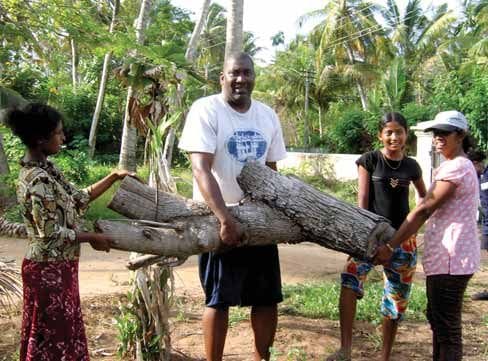
He volunteers with Relief International, a youth communications and empowerment nonprofit corporation. Last summer, Washington accompanied 10 high school students on a three-week trip to Sri Lanka as an adult chaperone. While in Sri Lanka, Washington was bitten by a spider which required five days in the hospital.
Washington lives in Hacienda Heights. He is single and has a 14-year-old son, Jerry, Jr., who lives with his birth-mother in Santa Monica and attends Lincoln Middle School. Washington recently sat down with the Daily Press to discuss his role at the Red Cross.
How were you introduced to community service at an early age?
“It was a family value. My mother was an activist. I was a poster child for ‘Vote 18’ at 2 years old. The voting age back in the ’60s was 21 and she led a march and they took my picture and it made all the papers. It was poster of me in a stroller saying ‘I’m too young to vote, what’s your excuse?’”
What kind of activist was your mother? “She promoted racial harmony. She wanted to overcome some of the barriers that a lot of African Americans faced in the ’60s and in the ’50s. She was pro-affirmative action. She ran a youth center. They dealt with a lot of at-risk kids in my hometown. The center was called PRIDE — Preserving Racial Identity Through the Development of Education.”
What was it like growing up? “I was adopted at 2 months old. I grew up with all women. After me, (my mother) started a group home and we had maybe, during the course from 14 to 18 years old, at least 80 or 90 girls living there at different times for different reasons.”
How was that? “It was weird. She thought at the time, having boys, having a mix, would be too much trouble. But she had me since I was 2 months old. She had a better network to deal with the girls... They were 12 to 18.”
How many would you have, typically, at a time in your house?
“The most would be 10. Actually, I helped build the house. It used to be an old dairy farm. It started out as a four-bedroom house. When we got done with it, it was a 14-bedroom house.”
Was your dad around? “My dad was a police officer for 30 years. He served in the military. Now he delivers papers as part of his retirement. (My parents) still live Waterbury. He is 78 and she is 76.”
Why did you enter the military? “I didn’t get accepted into the schools that I wanted. I went in the Army and I was a cook. I was stationed in Frankfurt, Germany. I was in North Carolina for six months before I switched to Germany. I was in Germany for two years. It was great. It was a lot of work. I was in a gun battery, so we did a lot of traveling and I got a lot of cooking experience there. I cooked on an average day for between 400 and 800 people.”
Where did you go from there? “I came back home and worked at the youth center again. Then I started bouncing around from job to job, doing everything from construction to Deejaying, bartending, working in the factory for a little bit. I did that for about three years. Then I came out here.”
What led you to Los Angeles? “I don’t want to say because you are going to (print it). Opportunities. I wanted to be a comedian, but I wasn’t that funny. I didn’t bring enough money so I had to find a job real quick.”
Where did you get a job? “My first job was at Foot Locker. I went back to school. I took training to be a cardiac technician. I’ve always had an interest in the medical field. I took a couple of courses for cooking before I went to Germany. And I took the Army courses to get a chef’s license. I didn’t finish off the training for cardiac technician but I did finish off the training for medical assistant. I was transferred to the store at National and Overland. It’s not a store anymore. I became assistant manager. I left the company and started my own T-shirt company. That went good for a couple of years. I was making customized T-shirts with different slogans and that went well until the Lakers started losing. I needed a job because my girlfriend was pregnant and I needed a job that offered a little bit more stability so I joined the Red Cross.”
When was that? “In 1994. After the earthquake, I started out doing general maintenance and cleaning up a lot of the stuff — supplies and making sure everything was back in order. It was an opportunity for growth. It was something easy to start with. I do have good people skills and I thought it was something that I could easily grow into. That’s been the case. I’m trying to keep up with the growth of the city and now with technology.”
How has the Red Cross changed? “We put more emphasis on preparedness since I got here. Also in training in volunteers. Last year we sent out 92 volunteers to help out with hurricane relief. That is the most we’ve sent out in my 12-year history.”
Did you go to help with relief efforts in New Orleans?
“Unfortunately, my injury didn’t let me. I went to Sri Lanka last July. I missed the Fourth of July, the first one I’ve missed. I went with three youth from the Santa Monica chapter and seven from LA. We went to explore global volunteerism and see some of the effects of the tsunami and work with groups of kids as they rebuild the country and learn about their culture. We were there for three weeks.”
How did you respond to Hurricane Katrina here?
“We had a very overwhelming response where people wanted to help. We were providing training. We also assisted over 271 families from the affected area here. I had the opportunity to go to Florida on a relief effort two years ago which gave me a lot of inside knowledge on the protocols on what to do. It helped out a great deal.”
How far were you into the Sri Lanka trip before you got bit by the spider?
“About a week and a half. We were rebuilding Medicine Man’s garden. There was debris that had washed up from the ocean so we were going to rebuild the garden. We had to cut trees, move bushes and really I didn’t think anything of it — I was wearing shorts that day — because everything else, the vegetation was all taken off. There were a couple of scorpions, we saw them running. If a scorpion would take off, we thought it wouldn’t be a problem. But this spider had to be real, real tiny because I didn’t see it. Two days later my leg started swelling up from the knee down. We had gone to the northern part of the country. I took a six-hour trip to get to the hospital. I had seen a doctor up there and he said I needed to be on an IV for a couple of days. They had a lot of field doctors up there because they don’t have a lot of medical facilities. They have a lot of makeshift hospitals up there. There were a lot of foreign doctors there, making sure people were getting the proper care. And the UN has their own group, too. I was in the hospital for four days. I missed part of the youth working with children in the northern part of the country where they built an office and a kitchen at a Hindi temple.”
What did you get from the experience? “Seeing how people in Muslim countries lived. The effects of Buddhism on a country. Seeing how people recover from devastation who really didn’t have very much and watching how the experience has changed the volunteers.”
What do you get from being at the Red Cross?
“It is a change every day and every day is different. I feel that I am helping some kids from getting in trouble and providing them with a rewarding experience. I hope that they volunteer with a nonprofit organization during their lifetime. The trends of volunteerism have changed. We need to build back up our volunteer base within the youth now so when they get older, they have that instilled in their minds. Nonprofits need community support. The Red Cross has the most volunteers per staff, which is about 26 to one nationally. Ours is 75 to eight.”
What is your biggest challenge in the job?
“Juggling my three titles. Fixing computers, to managing a Web site to managing the youth volunteers. I took training with Community Digital about five years ago and I started teaching the homeless kids at Upward Bound computer classes and teaching web design as I learned. I brought those practices into the Red Cross and tried to help rebuild the Web site which was becoming outdated. Just by doing that, the jobs just grew.”
Is your job satisfying? “Working with the youth. We have between 15 and 20 students who come in after school. We have clubs in Santa Monica High School and Crossroads High School which poses a little bit of competitiveness between the schools because they come from such diverse backgrounds and structures in trying to build a friendship amongst these kids that normally would not even hang with each other.”
When did you start working with Upward Bound?
“We partnered with Upward Bound right after they first opened, providing homeless childcare, enabling parents to go out and look for jobs during the summer. I started working there five years ago. I was working with a group of troubled teenagers and they need a positive male figure. One of the youth that was involved in the program is now going to the Art Institute of LA for graphic design. I think that my involvement with the program in teaching web design got him interested in that and out of trouble. He was 13 and didn’t have a positive male figure in his life and he had a lot of anger because of other things that were going on in his life. He was there with his mother and sister. They stayed there for a year and got housing in South Central...”
Is that what keeps you going back? “There is a lot of fulfillment in the job. These kids also come to the Red Cross so we can expose them to different things and let them know that people do care about them and we do care about what they want out of life and become productive members of society.”
What has been your biggest challenge? “Being able to keep this job for 12 years. A lot of the Red Cross has been through a lot of changes over the years and being able to keep up with those changes.”
What is your favorite part of the city? “Lincoln Park. Playing basketball. I play every weekend and sometimes during the week. I meet a lot of professionals and there are a lot of community members. Basketball is relaxing for me.”
What is your least favorite part of the city?
“That there is not more programs for teenagers. If you look at the focus, there are a lot of activities for 0 to 5; a lot of program-ming at the schools but once you get into the high school, there is not that many programs. Everybody competes for programming instead of working together. I am going to try to bring all of the city organizations together by inviting them to the teen summit at the Santa Monica Library on May 6 and 7. Relief International is hosting kids from Bangladesh, who are coming to visit Santa Monica for two weeks to learn global volunteerism and I am inviting all city organizations to send at least a couple of youth delegates to listen to their ideas and attend these workshops.”
What is your philosophy on life? “Do the best you can. Each person that passes you is someone who potentially could be your friend or could help you down the road so always be nice to everybody.”
Originally published in the Santa Monica Daily Press print edition on April 24, 2006. Read the original PDF.