

Ocean dumping area used to send lesson
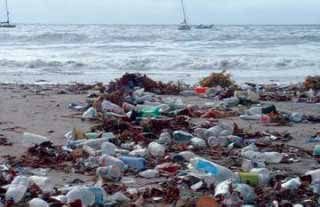
DOWNTOWN The Ocean Protection Council, a state agency that helps oversee coastal policy, unanimously approved a resolution on Thursday that is intended to dramatically reduce the amount of plastics bottles, bags, cigarette lighters and other trash that finds its way into the ocean.
The resolution, drafted by Santa Monica’s Heal The Bay, includes broadening the 20-year-old California Redemption Value, or CRV, program from bottles and cans to plastics commonly found in the ocean — meaning producers of these products would be charged a fee when plastic containers are created. That fee may be passed on to consumers.
The resolution also calls for increasing the enforcement of anti-litter laws and water quality laws to eliminate plastic pellet pollution.
The pellets, commonly referred to as “nurdles,” are melted down to make bottles and other plastic containers. They are too small — under 5 millimeters in size — to be captured in stormdrain filters and are commonly mistaken by fish, birds, turtles and other marine life for food and are digested. The pellets are made from and can attract toxic chemicals, and if swallowed, can lead to death, those who testified before the council said.
A plan for implementation of the resolution will be drafted by Dec. 1, according to members of the council.
“Marine debris is one of the worst problems our oceans face,” said Mike Chrisman, chairman of the OPC and the secretary for resources.“Studies have identified that between The OPC was established in 2004 as part of the California Ocean Protection Act that was signed into law by Gov. Arnold Schwarzenegger. The council consists of members of the state resources board, state lands commission, environmental protection and two ex officio members — State Sen. Sheila Kuehl (D-Santa Monica) and State Assembly member Pedro Nava (D- Santa Barbara).
The council is not a legislative body and can only make recommendations to the governor and the Legislature, according to Sandy Cooney, a spokesman for the resources agency.
“While the council’s action does not have the weight of law, it does spur public debate and hopefully increase advocacy for legislation,” Cooney said.
The resolution is important because it will promote coordination among California agencies that deal with waste and recycling, said Eban Schwartz of the state Coastal Commission, who testified before the council.
Despite international agreements, annual organized clean-up events, efforts to minimize land-based sources of litter and various education and outreach campaigns, the problem of marine debris is escalating, most experts agree.
In an area of the Pacific Ocean halfway between Los Angeles and Hawaii, known as the North Pacific Sub-Tropical Gyre, there are roughly 10 million square miles of trash, much of it made from plastic, said Charlie Moore, captain of the Algalita, a marine research vessel that has studied the increased level of plastic pollution in the world’s waters.
“The area is literally a gigantic garbage patch, and it’s expanding,” Moore told the council. “It is truly a plastic soup out there.”
Marine debris — everything from cigarette butts to plastic bottles and abandoned fishing nets — is a global problem. Plastics are among the worst items because they take years to break up or dissolve, and even then they're harmful to marine life.
“The abundance of micro-sized plastic debris in the North Pacific has tripled during the last decade,” Schwartz said. “During the same period, near the coast of Japan, quantities of plastic debris increased by a factor of 10 every two to three years.” In addition to harming wildlife, marine debris impacts California’s estimated $46 billion ocean tourism-based economy and may pose human health risks because of the toxins found in plastics, such as phthalates. Plastics also absorb other potentially harmful constituents such as PCBs, and toxic derivatives of DDT, experts said.
Along with expanding the CVB program, the resolution also calls for the reduction of plastic food packaging commonly found at fast food restaurants, as well as a ban on other plastic materials and additives.
A representative from the American Chemistry Council (ACC) said best practices have been developed, but not all companies that manufacture plastics or who transport the nurdles follow them.
“We welcome any assistance we can get,” said Tim Shestek, of the ACC.
However, Shestek said not all business owners would be happy with a ban on certain plastic products because of the added costs that may come with finding alternative packaging materials. Shestek suggested stricter enforcement on littering as a means to reduce marine debris found in the world’s waters.
Members of the council said the reduction of marine debris depends on a host of factors, including changing the way goods are produced and packaged, as well as how individuals dispose of their trash. Some suggested raising fines for littering to $1,000 an offense to match the severity of the problem, while others suggested outlawing the production of Styrofoam and other plastics.
Mark Gold, executive director of Heal the Bay, said the resolution is a good first step in the fight to reduce marine debris. He was pleased that the council adopted a resolution drafted by Heal the Bay because it includes deadlines and milestones, whereas the originally resolution, drafted by council staff, did not.
“This can have a dramatic effect on the way our oceans are managed, not just in California, but the rest of the western U.S. and quite possibly the world,” Gold said.
The fight doesn’t end with the resolution, members of the council said. It is now up to the council as well as advocates to pressure lawmakers into enacting the resolution.
“There’s a lot of work left to do to make these suggestions a reality,” said Bill Craven, a representative from Sen. Kuehl’s office.
Originally published in the Santa Monica Daily Press print edition on February 9, 2007. Read the original PDF.