

Landlord on the outside looking in
SUNSET PARK Undeterred by the two courts that have already ruled against him,an accused slumlord is digging in for another fight.
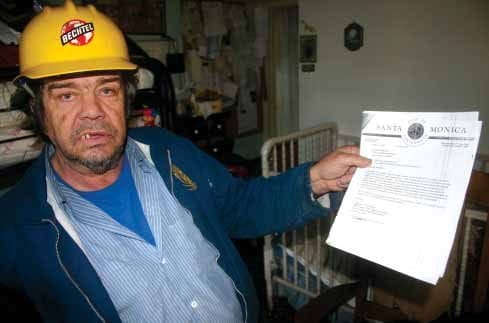
It’s been a rough few years for Guillermo Gonzalez, an embattled Sunset Park live-in landlord who has fueded with the city of Santa Monica over allegations that his three-unit apartment building at 2438 Ocean Park Blvd. is in dire straits.
City officials have charged that the structure is a fire and safety hazard for more than 15 years, serving as a haven for criminal activity.
“The city wants to see everyone homeless,” said Gonzalez, sitting in his front courtyard on a sunny Friday afternoon. “They don’t want to see anybody with a house.”
Two years ago, the maintenance and management of the 1,500-square foot property was taken from Gonzalez and placed in the hands of a Century City attorney, David J. Pasternak.
The 34-year landlord is fighting two battles — the trial court’s decision to appoint Pasternak as receiver, and its approval to bulldoze the building. Unfortunately for Gonzalez, the lower court’s decisions were upheld by the Appellate Court.Now,Gonzalez is hoping the third time is a charm and that the California Supreme Court will listen.
The apartment building on Ocean park Boulevard would not exactly be classified as eye candy. A mismatched combination of wrought iron and chain link fences set the property securely back from the busy boulevard. A combination of different chairs completes an outdated-looking patio furniture set. A slight breeze on Friday was nudging the bent hula hoop that dangled from the branch of a lemon tree in the courtyard.
Both Stan Stern, the attorney representing Gonzalez, and the city of Santa Monica, represented by Deputy City Attorney Adam Radinsky, have filed their briefs to the California Supreme Court. The highest court in the state is now accepting amicus briefs until March 2, after which time it will set a court date to hear oral arguments, according to Adam Radinsky, the head of the city’s Consumer Protection Unit.
In his petition to the Supreme Court, Gonzalez alleges that he was denied due process of law under the 14th Amendment and his property rights under the California Constitution were violated, Stern said on Thursday.
A list of claims accompany Gonzalez’ case, including that the landlord was not given the opportunity to raise his defense against the city’s motion to appoint a receiver; and the city failed to provide Gonzalez with an order of abatement to repair the conditions in the apartment.
“We don’t think he received proper notice in the first place (that the building) was going to a receiver,” Stern said. “If he had gotten proper notice... and had the opportunity to rehabilitate it on his own, he would’ve done so.”
But Gonzalez had more than enough time, the city claims.
“The code violations were serious and extensive,” stated a brief submitted to the Supreme Court by the City Attorney’s Office last month. “Gonzalez was given numerous opportunities over many years to abate the violations, but refused to do so.”
The saga began in 1989, when the city filed a nuisance suit against Gonzalez for fire, mechanical, plumbing and electrical violations. The landlord allegedly ignored the order, forcing the city to file an injunction to demolish parts of the building that had been constructed without building permits. It did so in 1991 and Gonzalez was forced to foot the bill of $21,900, which he did by refinancing his mortgage.
Less than a decade later, the City Attorney’s Office filed 85 misdemeanor charges against Gonzalez for numerous building, fire, housing, plumbing and electrical violations, leading Gonzalez to plead guilty on 15 of those charges. In 1998, Gonzalez spent time behind bars — 280 days — for refusing to make any changes.
The city alleged that none of the units in the apartment had heating; none of the bedrooms had usable windows; there was trash accumulating inside and outside the building; and the apartment was a favorite hangout for criminal elements.
Between October 2003 and September 2004, there were 32 calls reported to the Santa Monica Police for criminal activity.
But Gonzalez claims the building is in a livable condition and that he has fixed the problems. He himself has raised his son, who has since moved out, and is now raising another of his children in the building.
“We have hot water... I’ve tested the electrical system,” Gonzalez said.
In 2004, the city finally filed a motion to place the building in the hands of a receiver, which was subsequently granted by Beverly Hills Superior Court Judge Lisa Hart Cole in January 2005.
“He is a very experienced receiver for real property and performed the role in many other properties,” Radinsky said.
Pasternak suggested demolishing the building, saying that a vacant lot would command an additional $59,000 in sales compared to the property with a suddenly code-compliant building.
The City Attorney’s Office believes that it would be in Gonzalez’ best interest if the building was demolished and sold as a vacant lot.
Gonzalez contends he is in the mess he’s in because the city’s building inspectors provided him with one set of information and presented city officials with another.
“This is not the only building the city wants to take away from the owner,” Gonzalez said.
Originally published in the Santa Monica Daily Press print edition on February 17, 2007. Read the original PDF.