

Activists say suit is a fight for city’s diversity
A Santa Monica landlord is accused of allegedly harassing minority tenants so their apartments can be rented to white college students.
In a lawsuit filed in federal court Wednesday, Candido and Elvira Vivanco allege their landlord, Jaroslava Liska, is using racial stereotypes to evict them from their two-bedroom apartment at 1711 Delaware Ave. The Vivancos occupy the last rent-controlled apartment in the six-unit building and are the last Latino family to live there, according to the lawsuit.
Liska sent the Vivancos a 30-day notice in December ordering the family to move out of the apartment they have lived in for more than 17 years. Liska has not moved forward with court proceedings.
Liska’s eviction notice alleges that the family is disruptive to their neighbors because their children play outside, kick balls against the apartment walls and play loud music.
However, supporters of the family say Liska’s allegations are nothing more than an attempt to kick a minority family out of their home.
“These allegations falsely portray the Vivanco family as undesirable Mexican- American tenants by unabashedly invoking insidious racial stereotypes and deceitfully claiming they personify such odious stereotypes,” said Dario Navarro, the family’s attorney. “The allegations are themselves an appeal to racism.”
Liska, who lives in a condominium on San Vicente Boulevard, couldn’t be reached for comment. Her attorney, Eric Miller, said he had not seen the lawsuit. Miller declined to comment on the Vivancos’ allegations.
In her eviction notice, Liska complains that the family operates a business out of their apartment and they use common area water to wash down the outside of the building. She also said they held a party against her wishes in the building’s parking lot and accuses the Vivancos of acting like the building manager by making decisions on who can access the property.
But activists say the family’s plight is similar to that faced by other minority families in the Pico neighborhood, a predominantly working-class area of Santa Monica where they say poor families are being priced out as more wealthier residents move into the area.
“This is a stand for diversity,” said Oscar de la Torre, director of the Pico Neighborhood Youth and Family Center and a local school board member. “We are fighting for the sustainability of our city’s diversity here.”
“This is a stand for diversity. We are fighting for the sustainability of our city’s diversity here.” — — OSCAR DE LA TORRE Pico Neighborhood Youth and Family Center, director
Many of Liska’s complaints centers around the Vivancos’ children.
But the Vivancos, their friends and neighbors testified in the lawsuit that none of Liska’s allegations are true. The family’s next-door neighbors testified they find the children to be polite, well-behaved and friendly, according to the lawsuit.
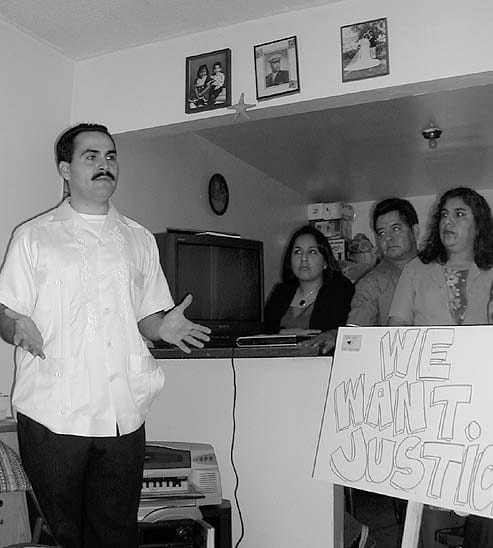
Ernesto Vivanco, the couple’s 16-year-old son, said Thursday at a press conference that he doesn’t play soccer in the house as Liska alleges. The press conference was called by the family’s attorney and neighborhood activists.
Aricka Traylor, a neighboring black mother of five children, testified in the lawsuit that when she approached Liska about renting a vacant apartment, Liska told her she doesn’t rent to people with children, only to single college students, according to court documents.
The lawsuit alleges that during the past 15 years, Liska has been charging the Vivancos rent above what is allowed under Santa Monica’s rent control laws.
The Vivancos pay $654 a month while the maximum allowed by the city is $623, according to the lawsuit. When the family began their lease in 1987, they were charged $650 for rent when the maximum allowed under law was $416, according to court documents.
The lawsuit also alleges the eviction threat has damaged family members physically and mentally.
Dr. Douglas Hopper — a Santa Monica-based physician who is the family’s doctor — states in a letter that Candido Vivanco is suffering from a fatal heart condition called “Wolf-Parkinson- White Syndrome,” which was brought on by stress from the eviction proceedings.
“You told me you were involved in a very stressful legal encounter with your landlord,” he wrote. “The tingling is brought on by the multiple encounters with this situation.”
And 9-year-old Teresa Vivanco has shown signs of being “traumatized” because she feels she is to blame for Liksa’s dislike of the family. Teresa Vivanco said Liska has yelled at her when she was playing in the small 25-square-foot concrete courtyard in front of the family’s apartment.
Teresa Vivanco wrote an essay for a class at Will Rogers Elementary school dated July 5, 2002, titled “The Meanest Manager Ever” about Liska.
“So know (sic) I can’t play at all outside because of the manager,” Teresa Vivanco wrote. “Because if she sees me play outside maybe my family and I maybe will be (kicked) out of the apartment and I don’t want that to happen. So that is why I don’t play outside any more.”
A letter dated Dec. 13, 2002 from Teresa Vivanco’s elementary teacher, Amy Teplin, is included in the lawsuit that indicates she is worried for the girl because she is often seen crying at her desk.
Teplin said the young girl has told her that her family is being evicted because she plays outside and the landlord yells at her, according to the letter.
“Teresa was sobbing and her exact words were ‘the landlady is traumatizing me,’” Teplin wrote. “This is extremely concerning me. It is rare for a child to use the word ‘traumatizing,’ and feel that upset about moving. Teresa is clearly deeply affected by this situation.”
Elvira Vivanco said the fallout with Liska and eviction proceedings are ruining her family’s lives.
“When we came to this country, we came to find our American dream,” she said through an interpreter, despite being able to speak conversational English. “That dream has become a nightmare ever since we received the eviction notice.”
Originally published in the Santa Monica Daily Press print edition on January 24, 2003. Read the original PDF.