

Homeowners have mixed feelings about selling homes
SUNSET PARK Laura Woods loves her home, the place where she is raising a family, the dwelling that has captured her heart for the past 10 years.
“Santa Monica has a great school district,”Woods said on Friday afternoon, refer-ring to why she bought the house in Sunset Park.
Woods was busy attending to her lawn on Friday afternoon, enjoying the day as her young son darted across the front lawn, the family dog barking in the background.
A roaring sound punctuated the tranquil scene as a jet flashes overhead, prompting Woods to take her free hand to cover her ear.
“We like it here a lot,” she continued after the jet is long gone over the Sunset Park neighborhood. “We’re not considering leaving any time soon.”
They wouldn’t leave even if the family is one day approached by city and Federal Aviation Administration officials about buying the home to make room for a runway safety buffer zone, Woods added.
Considered an unpopular idea by many residents in the neighborhood, one of the options the FAA has suggested in enhancing protections against a possible runway overshoot is to establish a Runway Protection Zone (RPZ), a voluntary program in which City Hall would give residents in critical areas the option to sell their homes.
The RPZ option was briefly mentioned during the City Council meeting on Tuesday when Kirk Shaffer, the FAA’s associate administrator for airports, formally presented a proposal to install a series of concrete buffers at the west end of the runway at Santa Monica Airport (SMO). The buffers, called an Emergency Material Arresting System, are precautionary safety measures protecting against aircraft from overshooting the runway and into homes — the blocks meant to handle planes traveling at up to 70 knots. City officials rejected the proposal, criticizing it as not going far enough, and instead enacted a ban on the fastest jets from the airport. The FAA followed up by serving City Hall with an order to show cause on Wednesday, an administrative action giving them 10 days to respond.
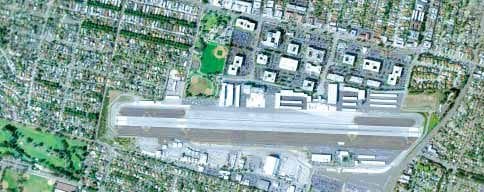
A map of the Santa Monica Airport and surrounding areas was displayed during the council meeting, the neighborhood to the west highlighted with a small yellow box, which was surrounded by a larger red box. The yellow box represented a suggested pilot phase in which a few homes would be acquired through the RPZ, and if successful, followed by the adoption of the full program, represented in the red box. The latter box represented about two to three blocks in the south western part of the Sunset Park neighborhood, covering areas such as Marine Street and Navy Street.
Ian Gregor, the spokesman for the FAA, said on Friday that the graphic presented was just an example and not a formal proposal or suggestion.
“The FAA does not have the authority to order local governments to acquire homes,” Gregor said, stressing that the RPZ is voluntarily and not a means of imminent domain.
The RPZ has been adopted in airports across the country, including 40 general aviation airports in 2007, locations such as Bryant Field near Yosemite National Park, Taos Regional in New Mexico and Fort Morgan in Colorado.
The standard protection zone is trapezoidal and centered on the runway’s cen-terline, its dimension dictated by the type of aircraft at the airport and the minimum visibility required for planes to land, Gregor said. There are certain prohibited developments in an established RPZ, including homes, churches, schools, office buildings, and other places of public assembly.
The buyout program is governed under the “Uniform Relocation Assistance and Real Property Acquisition for Federal and Federally Assisted Projects,” which dictates certain guidelines for residential purchases. The FAA is the body that oversees the program to ensure it is compliant with federal guidelines, Gregor said.
The amount of federal dollars allocated to pay for the RPZ is undetermined for Santa Monica and would be based on the size. The houses would be assessed based on fair market value.
Councilmembers have indicated that they have no interest in an RPZ program.
“Council would never want to displace residents, we value our residential neighborhoods,” Kate Vernez, the assistant to the city manager for governmental relations, said on Friday.“What we really want is a meaningful runway safety solution at both ends of the runway.”
Woods, whose house on the corner of 23rd Street and Navy Street was valued at $400,00 when purchased, said she would be open to being part of the RPZ if offered above and beyond fair market value. The houses in the neighborhood today average about $1 million.
“I definitely would not sell at market price,” she said. “It has to be somewhere in the range where I could purchase a house somewhere else.”
It was a sentiment shared by Tony Nitti, who lives on Navy Street between 21st and 23rd streets. “I would need to be taken care of handsomely that way,” Nitti said.“But then again, why should I have to move? Why should Navy Street have to move for Arnold (Schwarzenegger) or a few other pilots that want to use that airport?”
Schwarzenegger has been known to fly in and out of Santa Monica.
Nitti added that an RPZ would make sense at aviation centers like LAX where the airport serves a large population, whereas Santa Monica Airport serves a small group.
“The displacement factor doesn’t seem justified,”he said after the council discussion on Tuesday.
The RPZ program varies from airport to airport and would be mostly federally funded. It normally takes place at larger airports, but SMO is different in that development was allowed to occur right up to the runway, Gregor said.
“You don’t see it in Hawthorne, you don’t see it in Torrance, you don’t see it in Long Beach,” Gregor said. “The Santa Monica situation is pretty unique.”
Many of the residents in the blocks immediately west of the airport have lived in the community for years, some for decades.
They bought in for different reasons, some for the schools, others for the tight-knit community.
Jacqueline Mangum bought a house on Navy Street off 23rd Street in 1998 because it was one of the few places in Santa Monica that was large enough to accommodate her family.
Mangum said she doesn’t mind the small prop planes, likening the sound to the buzz of bumblebees. The jets can get overwhelming at times, she said.
“Sometimes it can be terrifying,” she said. “I feel like I have to duck.”
Magnum said she has never considered moving, nor would ever consider selling the house through the RPZ program.
It’s a feeling also expressed by Maxine Mayo who has owned a cubist style home since 1963 when she purchased the house for approximately $28,000. The house is now worth more than $1 million.
The neighborhood has changed quite a bit since then, families having come and gone. Bruce Springsteen’s sound man once lived in the house immediately to the west, Mayo said.
Mayo and her late husband once considered selling the house after a confrontation between the City Council and the Santa Monica Airport Association over an adopted jet ban in 1975, an ordinance that was later revoked by the Federal District Court.
The couple looked as far as Topanga but decided to stay home, unable to find a house that could accommodate their family of pets. The commute and traffic also scared the couple into staying in Sunset Park.
So the Mayos decided to fix the acoustics in the house, changing the windows to block out most of the sound from the jets.
The house isn’t directly under the flight plan so there isn’t a strong sense of fear that a plane will one day crash into the house, Mayo said, though she added there have been wonders of whether the plane would steer its course above the Marine Street home.
“Every so often I think of what might happen,” she said.“But we’ve been lucky so far.”
Mayo said she most likely wouldn’t participate in the RPZ.
“I’ll be here until I turn my toes,” Mayo said, chuckling.
Her neighbor across the street, Joe Owens has lived in a multi-story house since 1972 when he purchased the home for $41,000, picked for its view of the South Bay and proximity to Culver City where he worked at Hughes Aircraft and Cal State Northridge where his wife was a professor.
The retired couple said they have no intention of moving or selling their home, adding that while property values have dipped in their neighborhood, they just can’t give up the view.
The home today is sprinkled with the couple’s loving care, cultivating their own produce section with a garden, an apricot, naval orange and fig trees. But the pride and joy for Owen lies in the second-story deck where the couple likes to relax and take in the view.
In the more than 30 years he has lived in Sunset Park, Owens said he has heard several runway overshot accidents, including the most recent one in January when a kit airplane rolled off the west end of the runway and landed on the service road. There were no reported injuries in the crash.
He has fears that a plane will one day crash into the neighborhood.
“I know it’ll happen eventually,” he said.
Originally published in the Santa Monica Daily Press print edition on March 29, 2008. Read the original PDF.