

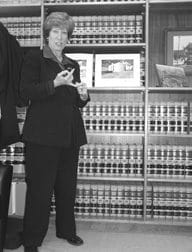
Santa Monica’s top judge didn’t finish college until after she’d had two kids, lived for a stint on the east coast and tried her hand as a military researcher with the RAND Corp., a national think-tank based across the street from here.
“I was just bored, very bored,” said Santa Monica Superior Court Judge Linda Lefkowitz, 63, who became presiding judge in January. “And I kind of felt like I wasn’t doing anything with any meaning to me, particularly.”
The 1958 graduate of Venice High School credits her “Type A” personality with pushing her to finish her undergraduate work at Cal State Northridge and going on UCLA to earn a law degree. Lefkowitz then embarked on a government career that has her overseeing six courthouses.
“It’s very hard to get to this courthouse,” said Lefkowitz, who lives with her husband in the Pacific Palisades. “It’s a very popular courthouse. You tend to move west, usually.”
Her first two months on the job have been anything but easy, said Lefkowitz, who replaced the retired Santa Monica Superior Court Judge Alan Haber. The local courthouse is in a state of flux — it’s undergoing a $4 million remodel, even while suffering from extensive budget cuts handed down from the state.
Starting this summer, all criminal cases will be sent to the Airport Courthouse near LAX, meaning only civil matters will be heard at Santa Monica Courthouse. The move is expected to save the county $500,000 in security expenses, but will be costly for local police and a detriment to the community, officials say. The move also was prompted by a major renovation taking place at the courthouse and because the security area used to hold prisoners was aging.
“There is an urban legend that it is so bad there was a judge that was stuck in there over the weekend and he was able to break off — but that’s just an urban legend,” Lefkowitz said.
Here, the Daily Press sat down with the top judicial officer of the local courthouse and asked her how she’s holding up under all the pressure.
Within weeks of taking over as presiding judge, you’ve been tasked with moving the criminal cases out of Santa Monica. What’s that been like?
“I had not expected it. I told someone the other day, ‘The first month I thought this was really an OK job,’ except I miss the cases.
587,“It was a difficult kind of job because you’re dealing with people’s problems all day long. (The move) has been less of a problem than I’d anticipated. There have been a lot of meetings, but everyone has been very responsible and we have worked together.
“I have never sat down with a group of people... that more sincerely felt they had a responsibility to do the right thing. It’s just been a remarkable process to see.
“But it’s been difficult... and as a result of that, sometimes you come home at the end of the day, and you just want to stare at the television for three hours.”
How do you explain to residents that we can’t afford to keep the criminal courtroom here, but can afford a $4 million renovation of the courthouse, especially after a $2 million jury room was recently completed last year?
“This building was 50 years old, so it needed substantial rehab. I don’t think anybody needed to apologize for the jury room. It was a cafeteria area, it was a health disaster — it was falling apart.
“The trailers (temporary courtrooms) have been here, and I may be wrong, for something like 20 years... and they were falling apart. They were leaking, they were rusting. There were odors coming out of the vents... There were animals living in them and under them. At one point, one day, a rat just basically ran across the courtroom while the jury was in session. They were really just uninhabitable.
5B9,“It’s just an issue of government finance that there are funds that are earmarked. There is a county courthouse construction fund that can only be used for construction. They cannot be used for sheriff’s salaries or for anything else.
“In addition, the initial stages (of planning for the renovation) was at about, or just before, the dot-com crash and I don’t think we had any idea of the extent of it.
Will the new courthouse have any added amenities?
“We will have the same number of courtrooms that we had earlier. We are also putting in a waiting room for children whose parents are here in family law litigation, because currently there kind of at the end of the hallway... really in an unsatisfactory environment.
“The supervisor felt strongly that there should be a safe and secure area that’s really colorful, where the children can go and there are toys and books.
“In addition, there’ll be a self-help center mainly for victims of domestic violence... to help people, most of whom can’t afford an attorney, with preparing the legal papers to get restraining orders against those who are committing or threatening domestic violence or other violence against them.”
Some workers have said morale is down at the courthouse — why is that?
“Judge Haber is kind of my mentor judge... He’s a larger-than-life figure. He’s been managing this court for six years and it’s almost a larger-than-life role to follow. It’s kind of like following Johnny Wooden.
4A7,“Also, the court is going through some severe problems... We have been a county court for years and suddenly we became a state court. There are a lot of changes because you’re moving, for many of the workers, from a small management to a management system where the direction is coming not even from the county but, in many cases, from San Francisco.
“Then there is the budget... Where we had six people, for example, doing a job in the clerk’s office, we now have two. It’s kind of like Lucille Ball always trying to keep up with candy line... We have court reporters now taking one Friday a month off without pay... And when you have that kind of work situation, it doesn’t take much stress to bring morale down. These are very real problems — the reality of the work setting has changed.
“I haven’t yelled at anybody.”
“I haven’t yelled at anybody.”
You’ve handled hundreds, if not thousands, of cases in the civil and criminal arenas — both as a lawyer and as a judge. Does one stick out?
“I represented the Los Angeles Police Department, in some cases representing their anti-terrorism unit... and had an opportunity to address constitutional issues at a level that probably only ACLU lawyers ever deal with.
305,“I represented the police department in a case involving the Jewish Defense League where there was an undercover officer that had been placed in the Jewish Defense League for years. It was just a fascinating case, because of all the constitutional issues.
“The privacy of the individual versus the need of the police to protect the public, and how you, in agony, balance all those conflicting needs. Now, we hear about these things all the time, but at the time it was a very unique and different thing.”
“I’ve had a number of medical malpractice cases and they’re just fascinating. There’s a certain drama about them...
“I thought the Holiday case (where a couple sued City Hall and won after a Eucalyptus tree fell on their car, injuring them) was just fascinating...
59F,“I find myself driving around town on rainy days, looking at the trees (lawyers for the Holidays argued the concrete around the trunk choked the tree, weakening its roots and leading to it toppling over in a rainstorm)...
“It goes back to the balance the jury had to make in my mind for the responsibility you give the city for keeping care of thousands of trees versus the responsibility the city has for the extreme damage that can occur when a mammoth tree falls.”
You seem to be a very disciplined, driven person with a strong history of civic service. Do you have a philosophy on life or a guiding principle?
“I think lawyers tend to be driven personalities. And I suspect that I must be a very driven, ‘Type A’ person because I chose to go back to school after having kids.
“I grew up in the, and this is really going to show how old I am, in the John Kennedy era. And I grew up in a time when my friends and I really thought that public service was a great thing to do. It was right before Vietnam and it was a time that people had a strong sense of optimism in the future.”
If you weren’t presiding judge of the Santa Monica Courthouse, what would you be doing?
“Well, if I wasn’t presiding judge, I would hopefully be in my courtroom doing jury trials. But if I weren’t a judge or a lawyer? You know, I love what I’m doing and, you know, I chose it mid-life. I can’t imagine doing anything else... I really do love it.
4E1,“I do have a grandson who is a juvenile diabetic and I suspect I would be giving some assistance to children’s hospitals if I had all the free time in the world to do so.”
<BOX>
Linda Lefkowitz
The daughter of a men’s clothes salesman and a housewife who later worked in an accounting office at UCLA, Lefkowitz credited Dr. Price, a constitutional law professor, for sparking her into a love of the law. She had planned to become a teacher.
Born: In Cleveland, Ohio in 1940.
Raised: Lefkowitz moved to LA 11 year old and graduated from Venice High in 1958.
Education: She spent one year at UCLA before marrying and dropping out of college. She later finished her degree at Cal State Northridge and went on to UCLA law school.
Background: After being married, Lefkowitz worked at the RAND Corp. as a researcher on military troop movements, where she said she was impressed by the number of professional women. She later worked for the LA City Attorney’s Office for 10 years.
Salary: $137,500.
Family: Husband Frank is an engineer. Daughter Terri is 37, son John is 34.
Residence: A house in Pacific Palisades.
Hobbies: Reading mystery books, gardening in her backyard and hiking. “My husband describes it as hiking — best downhill,” Lefkowitz joked.
Originally published in the Santa Monica Daily Press print edition on March 8, 2004. Read the original PDF.