

Fantasy sports has beget a generation of multi-taskers
VENICE As the manager of his own professional football team, Wannie Park is living a sports fan’s fantasy.
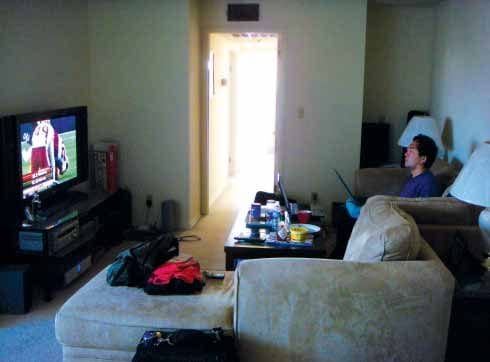
But rather than coaching on the sidelines every Sunday, with playbook in hand and wearing a headset, Park sits on his living room sofa, watching one NFL game on his Plasma TV, streaming another match-up on his Mac computer and monitoring a third game on his laptop — all while keeping track of his players’ statistics on a third computer.
“I don’t like picture-in-picture, it’s a distraction,” said Park, who subscribes to a media package that gives him access to all NFL games. “The Internet and laptop... allows me to watch the videos online and monetize my investment so I’m watching more than one game.”
Once considered a form of entertainment for the so-called sports dorks, requiring just a simple paper and pen and knowledge of an athlete’s statistics, fantasy sports has exploded over the past decade into a subculture that claims every type of sports fan, from the devout football follower to the number lovers.
“The people I know wouldn’t consider it dorky,” said Larry Rosales, a sports lawyer in Santa Monica who has played fantasy sports for nearly a decade.
An estimated 19.4 million people in the United States and Canada actively participate in at least one fantasy sports league and approximately 34.5 million people have played fantasy sports at least once, according to the Fantasy Sports Trade Association. The 11-year-old trade organization represents more than 120 members, from small start-ups to the larger multi-media corporations such as CBS, which offers several fantasy leagues through CBSSports.com, ESPN and Yahoo, whose sports division is based in Santa Monica.
The basic concept of mainstream fantasy sports is to manage a team of actual pro athletes, handpicking specific players in a draft held prior to the beginning of the professional sports season and selecting the line-up before each game. Teams win based on the collective performance of their professional athletes in their respective real-life games. Whichever coach has accumulated the most points at the end of the season wins the league.
For example, in football, most leagues set rules so that a touchdown is worth six points and an offensive player could earn additional marks for total yardage.
Depending on the service provider, the points and rules are established by the fantasy league’s players. A commissioner, who enforces the league’s bylaws, is usually appointed by the league’s players, unless already preselected by the service provider.
Perhaps the most celebrated element of fantasy sports is the draft.
Some fans will pick a player purely based on name recognition, selecting a Vladimir Guerrero over a Jonathan Broxton, others study players’ statistics in the weeks leading up to draft day, reading fantasy sports magazines cover to cover. Many users will wait until the end of the preseason in case their number-one guy has gone down with an injury.
Then, there’s the draft day rituals. Venice resident Abe Quigley will usually do the draft online with his friends, many of whom live out of state, or grab the ones that live nearby and have a small draft party at someone’s house, sitting around with chips and beers for several hours, talking trash.
Last year, Quigley, a musician, was on the road in Nebraska when his friends started the draft, so he pulled over and participated in a four-hour conference call, selecting his choice players.
“I can have fun with my buddies,” Quigley said. “I tell them how much their team sucks.”
There’s an art to selecting players, finding the right mix of offensive and defensive players, checking to see when the selected players would actually meet-up in the season, assessing which players are vulnerable to injuries. Park spends a week preparing for the draft and spends about $20 on a draft guide, reading up about how the players are performing in training camp.
“It’s no different from the war room you see in the (NFL) draft,” he said.
In late August, Park, who works at the electronics company Belkin, set up his laptop at Bay Cities Deli and spent four hours doing a live draft for his league, munching on his sandwich and taking in the sun as he went through more than 14 rounds.
“That is the most fun you’ll have all year,” Park said. “That is when you do the strategizing, in terms of which players to pick up.”
In virtually all fantasy leagues, the line-up has to be determined before kickoff.
For Yahoo, the deadline to select NFL players is 7 a.m. on Sunday, Park said.
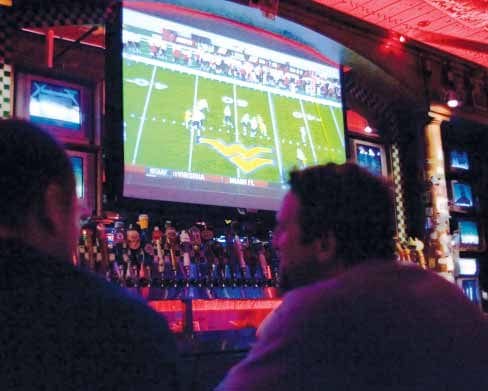
After the lineup is all set, fantasy league players will go about their ways enjoying game day, some sitting at a sports bar with multiple televisions, others setting up their own entertainment system in their home, some ignoring the games and checking online at the end of the day to see which user is leading the league. Almost all fans agree that fantasy sports is a great way to keep in touch with the game.
“It definitely makes me watch the game more,” said Thomas Hale, a bartender at Britannia Pub.
FROM INK TO MOUSE The paper and pen version of fantasy sports experienced a surge in popularity when it was made more widely accessible, going online thanks to Internet companies like ESPN and Yahoo.
But before the Internet, there was Andrew Mousalimas and his Greater Oakland Professional Pigskin Prognosticators League (GOPPPL).
While many trace the first fantasy sports league to Rotisserie League Baseball, founded in the 1980s by Daniel Okrent, who met with a group of friends at the La Rôtisserie Française restaurant in New York City, the origins can be found in the GOPPPL, according to Jeffrey Thomas, the president of the FSTA.
A group of men led by Mousalimas met in a bar in Oakland on Sundays in 1963 and developed what is believed to be the first fantasy league, each player moving his team name’s placard up or down a wooden board affixed to a wall at the bar, depending on how well their team performed that day.
By the 1990s, there was an estimated nine million people playing some form of fantasy sports. One of the most popular ways to play fantasy sports was in a newspaper. In the late 1990s, Yahoo and CBS both premiered their fantasy sports features, opening the “floodgates,” according to Thomas.
This football season mark’s Yahoo’s 10th anniversary of offering fantasy sports. The Internet company accounts for about nine million fantasy sports players.
Yahoo started with football and offers everything from fantasy football to fantasy golf.
Some companies even offer fantasy fishing and fantasy curling. Quigley said he has tried fantasy golf, but gave up after a few weeks, unable to keep focused.
“I tried fantasy golf because I’m an idiot,” he joked.
“There’s definitely been an exponential growth year after year since the first offering,” said David Geller, the director of fantasy sports for Yahoo.
Football is, by far, the overwhelming sport of choice for Yahoo fantasy players, surpassing baseball in popularity. Many fantasy sports users say they prefer to play football because baseball, which plays 162 games a year, requires more of an investment in time and energy.
CBS’ fantasy sports division is based in Florida and attracts more than three million fantasy players. The company launched its fantasy product in 1997, and today, offers several fantasy sub-games, like the Office Pool Challenge, where users can pick winners of the NFL games
Originally published in the Santa Monica Daily Press print edition on November 10, 2007. Read the original PDF.